Autumn Budget 2025: A tax hike that redefines wealth for a decade

Britain has entered a new era of even higher taxation

Sixteen months ago, Labour walked into Downing Street on a platform of “no major tax rises” and an £8.5bn package of revenue measures. Today, the picture is unrecognisable. Across just two Budgets, the Chancellor has now imposed £70bn of tax rises.

What was framed as “temporary and measured” has become a structural tax shift that hits working people, investors, entrepreneurs and property owners across the board.

What remains is a structural shift: Britain is now a high-tax, low-incentive economy, and working people are footing the bill in an attempt to keep Labour’s backbench benefits supporters on side, for now.

All figures used in this article are from Office for Budget Responsibility forecasts. Yes, that’s the OBR that leaked the entire Budget an hour early; with market-sensitive information available for all to see before even Labour’s own MPs knew its full contents.

The levels and bases of taxation, and reliefs from taxation, can change at any time. The value of any tax relief depends on individual circumstances.

A tax system ratcheting up every year until 2031

Income Tax and National Insurance thresholds frozen for a decade

Perhaps the most consequential move is the extension of the Income Tax and National Insurance threshold freeze to 2030-31 – a full three years beyond what had been planned previously. While welfare payments have been index linked, working people will now suffer a decade of stealth tax, extracting £66.6bn a year from taxpayers by 2030-31. Despite manifesto pledges not to raise “taxes on working people”, the reality is a sweeping stealth raid on the financially productive.

Key impacts:

  • 920,000 more people dragged into the higher-rate 40% band above £50,270
  • 780,000 more low earners pulled into paying income tax above the personal allowance of £12,570
  • 8.7 million higher-rate taxpayers by decade-end (almost double the 4.4m when the freeze began in 2021-22)
  • Those earning £50,000 will be £1,500 worse off
  • Someone earning £100,000 will be over £4,000 worse off

Different rates and thresholds of Income Tax apply to Scottish residents.

Mitigating solutions

Planning as a couple: Make full use of both partners’ allowances and tax bands where possible by thoughtfully allocating income-producing assets. If assets are transferred, this must be on an outright and unconditional basis.

Boosting pension contributions: A direct way to bring taxable income down while strengthening long-term retirement resilience.

Strategic charitable giving: Well-planned donations can meaningfully reduce your tax burden while backing the causes that matter most to you.

Reassess work commitments: As galling as it is that hard work no longer pays off; a couple might decide to reduce working hours between them, so as to keep their respective incomes just below a threshold and devote more of their time elsewhere.

The value of an investment with St. James’s Place will be directly linked to the performance of the funds you select and the value can therefore go down as well as up. You may get back less than you invested.

The levels and bases of taxation, and reliefs from taxation, can change at any time. The value of any tax relief depends on individual circumstances.

A direct hit on pensions and long-term investment

Salary sacrifice pension contributions – £2k to lose NI exemption from 2029

The Budget strikes at one of the last major tax advantages available to professionals: salary-sacrifice pension saving.

From April 2029, salary-sacrifice contributions above £2,000 lose their National Insurance exemption:

  • Employee NI: 8% up to £50,270 and 2% above £50,270)
  • Employer NI: 15%

Real-world example:

One earning £120,000 and making pension contributions of £20,000 via salary sacrifice, will now face an additional National Insurance bill of 2% on the amount of £18,000 above the £2k cap; equivalent to £360 a year.

The measure raises £4.7bn in 2029-30 and £2.6bn in 2030-31, but at the cost of undermining long-term saving behaviour and pushing more households back into punitive tax thresholds.

Mitigating solutions

Spouse/partner strategy: Balance income and assets between partners to leverage joint tax efficiency.

Diversify investment wrappers: Consider using ISAs and other vehicles, alongside pensions where their tax efficiency begins to diminish.

Maximise employer benefits: Ensure you contribute enough to qualify for full employer pension matching and confirm whether NI savings are passed on.

Review thresholds: If targeting income limits (e.g. £100,000), explore alternatives to salary sacrifice for reducing taxable income. Net pay arrangements, and making your own contributions to a private pension, are not exempt from National Insurance.

Tax relief on pension contributions above the basic rate of 20% must be claimed separately via your annual tax return.

The value of an investment with St. James’s Place will be directly linked to the performance of the funds you select and the value can therefore go down as well as up. You may get back less than you invested.

The levels and bases of taxation, and reliefs from taxation, can change at any time. The value of any tax relief depends on individual circumstances.

Wealth and savings hit hard: ISAs, dividends and property income

Cash ISA allowance cut from £20k to £12k for under-65s from April 2027

In a further blow to savers, the Cash ISA allowance for under-65s is to be slashed by 40%. A significant £8,000 portion of one’s total ISA allowance will be reserved for non-cash investments only.

This poses a significant threat to one’s ability to accumulate cash savings, including emergency funds, in a tax-efficient manner.

Over-65s will reserve the freedom to use their full £20,000 allowance for cash each year should they choose to.

Please note that Cash ISAs are not available through St. James’s Place.

Dividend tax and savings income tax soar by 2 percentage points

Dividend tax rates for basic and higher rate taxpayers will rise by 2% as early as April 2026.

  • Basic rate moves from 8.75% to 10.75%
  • Higher rate increases from 33.75% to 35.75%
  • Additional rate remains at 39.35%

The dividend tax allowance remains frozen at a pitiful £500 a year.

Real-world example:

A higher rate taxpayer receiving a dividend of £20,000 will see it eroded by £6,971.25; nearly £400 more than previously.

Meanwhile, in a double blow to cash savers, Labour has now created a two-tier income tax system. From April 2027, savings income is to be taxed at a hiked rate of 47% for additional rate taxpayers; meanwhile higher rate taxpayers face a rate of 42%, and basic rate taxpayers will pay 22%.

Real-world example:

An additional rate taxpayer earning 4% annual interest on £50,000 in cash (a £2,000 gross return) currently pays £900 in tax; this will rise to £940.

Mitigating solutions

Spouse/partner strategy: Utilise a total of £24,000 a year available as Cash ISA allowances between two people. Make use of both dividend tax allowances totalling £1,000 a year.

Furthermore, where at least one partner earns less than £125,140, capitalise on savings income allowances of £1,000 a year for basic rate taxpayers and £500 a year for higher rate taxpayers. There is no savings income allowance for additional rate taxpayers.

Diversify savings wrappers: Consider using NS&I premium bonds up to £50,000 on which returns are tax-free.

Investors seeking lower-risk, tax-efficient options might use a Stocks & Shares ISA to access conservative strategies such as cash funds.

Another route is through fixed income assets (gilts and qualifying corporate bonds) which can deliver tax-efficient outcomes even when held outside a wrapper. While the income remains taxable, any capital gains are free from CGT. This makes lower-yielding bonds that generate most of their return through price movement an appealing, lower-risk alternative to traditional cash ISAs.

Consider crystallising chargeable events on onshore or offshore bonds before April 2027, allowing any gains to be taxed under the current, lower savings rates.

The value of an investment with St. James’s Place will be directly linked to the performance of the funds you select and the value can therefore go down as well as up. You may get back less than you invested.

The levels and bases of taxation, and reliefs from taxation, can change at any time. The value of any tax relief depends on individual circumstances.

Please note that Cash ISAs are not available through St. James’s Place.

With thresholds frozen until 2031 and tax rises on savings, property, and dividend income, before then, proactive planning with a wealth adviser is essential.

Schedule a call

Property owners and investors hit with two critical tax whacks

Property income tax rises by 2 percentage points from April 2027

Landlords have been targeted yet again, with another two-tier example in property income tax facing newly hiked rates:

  • Basic rate: 22%
  • Higher rate: 42%
  • Additional rate: 47%

Real-world example:

A landlord earning £50,000 a year in rental income from a single, modest property will face a tax bill £1,000 a year higher than before. Multi-property portfolio landlords could see many times that eroded from their already constricted earnings; putting yet more pressure on rental market prices.

Homeowners stung by high-value council tax surcharge from April 2028

In this de facto ‘mansion’ tax; annual, unavoidable, and index-linked via valuation banding; owners of properties worth more than £2m face a new surcharge on their council tax bills.

Landlords themselves will face this cost as the owner of the property, as opposed to council tax paying tenants footing the bill.

Property valueAnnual surcharge
£2m – £2.5m£2,500
£2.5m – £3.5m£3,500
£3.5m – £5m£5,000
£5m+£7,500

The measure will disproportionately hit London and the South East, and will become a long-term cost baked into ownership.

An estimated 145,000 properties will fall within scope. For many owners, securing the liquidity to meet the charge could prove difficult – particularly where the asset is a primary residence rather than a rental property.

Mitigating solutions

Accurate property valuations are crucial, particularly for assets near the threshold, taking into account factors that could raise or lower their value.

As the charge targets owners rather than occupiers, renting rather than purchasing a property may be a more attractive option.

Downsizing to a lower-valued property could reduce or even eliminate the liability.

Properties in Wales and Scotland currently appear exempt, which may present opportunities for those near the border. This may change in future Budgets by these devolved regions.

Consider the optimum location of high-value properties; holding a larger home abroad and a cheaper UK property if you still need a base, may be advantageous.

Splitting ownership between multiple individuals or entities could provide planning benefits. Converting a single property into multiple smaller units may also be worth exploring.

Individuals may want to review the structure through which they hold their properties and assess whether it remains appropriate.

Improving tax efficiency in other areas could free up liquidity to meet this charge.

The levels and bases of taxation, and reliefs from taxation, can change at any time. The value of any tax relief depends on individual circumstances.

Stealth Inheritance Tax (IHT) as it is frozen for even longer

Fiscal drag on estates worth over £325,000

The Chancellor has extended the freeze on IHT thresholds until 2030-31. This could bring in as much as £14 billion or more for the Treasury over the period.

Nil-rate band of £325,000 per person.

Residence nil-rate band of £175,000 per person, when passing main residence to direct descendants (tapered where overall value of estate exceeds £2m).

Individuals holding business assets, working farms, or qualifying AIM shares could, for the first time, become liable for IHT on these holdings. For example, a business owner with a £10 million shareholding could see their IHT liability rise from zero under current rules to £1.8 million from April 2026.

It’s important to note that previously announced reforms will mean pensions become subject to IHT from April 2027.

Mitigating solutions

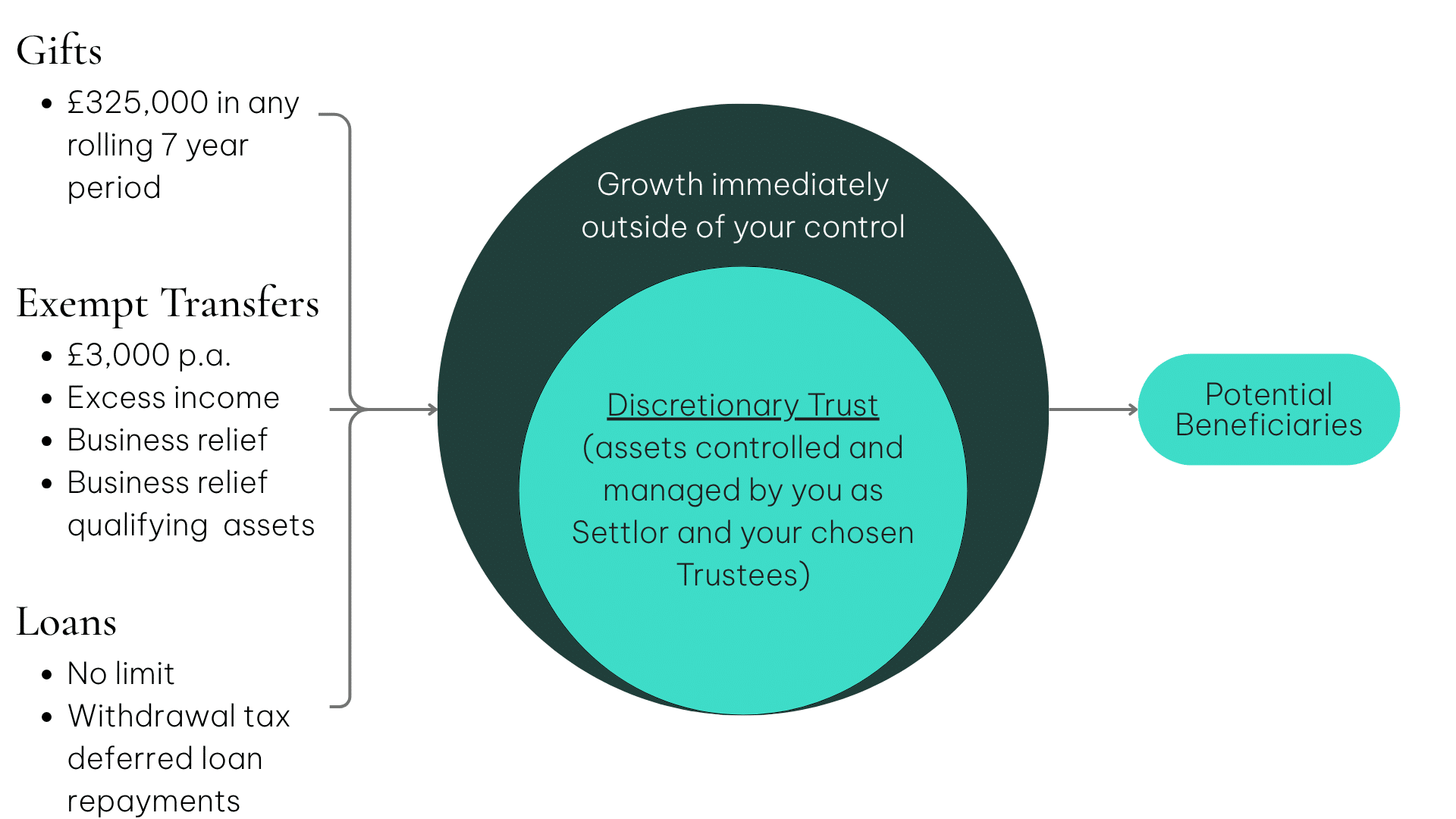
Lifetime gifting; including making immediately exempt gifts from surplus income, provided it does not affect your standard of living; remains an effective way to reduce the value of your estate for IHT purposes.

Writing a Life Cover Plan into Trust may calculate to be a prudent solution to help meet an eventual IHT liability.

Placing qualifying agricultural or business property into a trust before April 2026 can currently be done without an IHT entry charge. From April 2026, only the first £1 million will be exempt if the settlor dies within seven years, with any excess subject to an entry charge. For business owners planning an exit and wishing to allocate shares into a trust as part of their succession strategy, there is still a limited window to transfer larger holdings without an upfront charge.

For full details, explore The Inheritance Tax Escape Route.

The levels and bases of taxation, and reliefs from taxation, can change at any time. The value of any tax relief depends on individual circumstances.

Trusts are not regulated by the Financial Conduct Authority.

Business owners and entrepreneurs see investment incentives cut

Tax takes its toll on innovation
  • Writing Down Allowances cut 18% to 14% from April 2026
  • New 40% first-year allowance from January 2026
  • Dividend taxation up 2% from April 2026
  • Property income taxation up 2% from April 2027
  • EV road-pricing introduced at 3p per mile from April 2028
  • National Insurance thresholds held longer

Companies face higher friction across remuneration, capital allocation and investment planning just as borrowing costs tighten.

The levels and bases of taxation, and reliefs from taxation, can change at any time. The value of any tax relief depends on individual circumstances.

Yet more Capital Gains Tax hikes

CGT relief on qualifying disposals to Employee Ownership Trusts immediately cut in half

From 26 November 2025, CGT relief on qualifying disposals to Employee Ownership Trusts (EOTs) is reduced from 100% to 50% of the gain.

This change materially affects the net proceeds for business owners considering an EOT exit, with the effective tax rate rising from zero to 12% on the full gain. While employee ownership remains supported, the reduced financial incentive for vendors requires a reassessment of business valuations and personal financial planning strategies.

The levels and bases of taxation, and reliefs from taxation, can change at any time. The value of any tax relief depends on individual circumstances.

Other announcements

Venture Capital Trust income tax relief to fall to 20% from April 2026

VCT investments will see a reduction in upfront income tax relief but continue to offer tax-free dividends – a valuable income stream for many investors – alongside exemption from capital gains tax.

Qualifying EIS investments retain 30% upfront income tax relief, as well as inheritance and capital gains advantages.

As a BVCA member firm, Apollo is concerned by this reduction in income tax reliefs, which could lead to a decline in fundraising potentially impacting high growth investments that the government says it seeks to encourage.

Post-departure trade profits brought into tax net

Currently, distributions or dividends from “post-departure trade profits” (profits accruing to a company after an individual leaves the UK, calculated on a just and reasonable basis) are not subject to UK tax. From 6 April 2026, these profits will fall within the scope of the temporary non-resident rules, meaning dividends received while non-UK resident will become taxable in the UK.

Legacy Excluded Property Trusts to benefit from new cap

Excluded Property Trusts set up before 30 October 2024 will benefit from a £5 million cap on periodic and exit charges, with the cap applied retrospectively from 6 April 2025.

The farming tax U-turn: A political climbdown

In a rare moment of reversal, the Chancellor abandoned elements of her controversial “family farm tax” overhaul.

In the 2024 Budget a limit of £1million was introduced for agricultural property relief and business property relief, causing anger among farmers and businesses.

However, in the 2025 Budget Reeves confirmed this £1 million relief could now be transferred between spouses and civil partners if unused on first death. This means one half of a couple could now benefit from relief of £2 million.

The levels and bases of taxation, and reliefs from taxation, can change at any time. The value of any tax relief depends on individual circumstances.

Has anything been spared tax increases?

  • Pension income tax relief untouched
  • 25% tax-free cash cap untouched at £268,275
  • Stocks & Shares ISA allowance remains £20,000
  • Capital gains tax rates unchanged
  • Gifting rules and inheritance tax rates unchanged
  • Salary sacrifice NI cap only applies to pensions; and not to EV schemes etc.

As a BVCA member firm, Apollo is pleased that the government have not introduced a new tax charge on partnerships. The LLP model is an important component of the UK’s competitive advantage as a global destination for business.

The levels and bases of taxation, and reliefs from taxation, can change at any time. The value of any tax relief depends on individual circumstances.

Future outlook and planning

The bottom line is that this Budget deepens the tax burden on earned income, property, investment and retirement.

Whether you’re earning, investing, building a business or holding property, this Budget materially changes your 10-year outlook.

Key moves now matter more than ever:

  • Restructure your pension approach before 2029
  • Overhaul your estate planning to mitigate soaring IHT liabilities
  • Model net property income at the new 22/42/47% tax rates
  • Plan for increased dividend taxation
  • Factor in the high-value property surcharge to long-term ownership costs
  • Rebalance portfolios in light of reduced VCT relief
  • Prioritise tax-efficient wrappers before further erosion; take advantage of allowances while they still exist
  • Stress-test overall net income under extended fiscal drag
  • Review succession planning given the new farming inheritance rules (and possible future changes elsewhere)
  • Protect wealth from both fiscal drag and market uncertainty.

This is not episodic tinkering – it’s a structural reset. And for affluent households, the difference between reacting and planning will be measured in five- and six-figure outcomes.

For higher earners, senior executives, contractors, company directors and entrepreneurs, this Budget isn’t something to simply read and move on from. It reshapes the wealth landscape for the rest of the decade.

If your financial life touches pay, pensions, property, investments, or business ownership, now is the moment to re-plan.

The value of an investment with St. James’s Place will be directly linked to the performance of the funds you select and the value can therefore go down as well as up. You may get back less than you invested.

The levels and bases of taxation, and reliefs from taxation, can change at any time. The value of any tax relief depends on individual circumstances.

Still have questions?

Following the biggest set of tax increases in modern history, it’s an opportune moment to evaluate your family’s financial situation and objectives.

We encourage you to contact us, to ensure you are fully utilising all available allowances this year, and that you are adequately protected from risk, as far as possible, including any risk resulting from these changes.

Obtain support from an expert financial planner.

Create Your Bespoke Plan

UK economic picture

Welfare expansion and rising long-term fiscal risk

  • Welfare costs expected to exceed £400bn within a few years
  • Two-child cap scrapped: £3bn a year
  • Disability/PIP spending rising sharply
  • Higher-than-expected unemployment inflating welfare budgets
  • Revised asylum accommodation costs: £15.2bn (up from £4.5bn)
  • National debt heading to 96% of GDP

Fiscal space is evaporating just as taxation rises to historic highs.

The OBR flags acute risk exposure. A 35% global equity correction (AI bubble burst scenario) could blow £26bn out of the UK’s fiscal position. A more modest 15% market drop would still cut GDP by 0.6% by 2028.

Losses on the Bank of England’s QE programme now forecast to reach £164bn by 2036 – up £30bn from March’s estimate.

Meanwhile, the housing market is stagnating, retail is cooling sharply, and the country is already witnessing outward migration of higher earners and business owners.

SJP Approved 05/12/2025

Should you require more information or have particular questions, we invite you to contact us at your convenience.

Contact Us

The Inheritance Tax Escape Route

Your complete guide to preserving family wealth for 2025/26

How high‑earning families and business owners can build and preserve wealth across generations – with practical steps you can take this tax year.

With inheritance tax (IHT) thresholds frozen until at least 2030 and new pension tax rules taking effect from 2027, many families are asking the same question:

“Do I need to leave the UK to protect my wealth?”

The good news: you don’t. There are multiple estate planning strategies available that can significantly reduce or even remove an eventual IHT liability – without changing your residency or lifestyle.

Read this 1-min snapshot first

If your total estate could exceed £500k+ as an individual, or £1m+ as a couple, you’re in inheritance tax (IHT) territory. If you’re around £2m+, decisions about lifetime gifts, trusts, business relief and pensions will materially alter your family’s eventual outcome. Here’s the fast path:

Write/Review your Will (and Letters of Wishes) and Lasting Powers of Attorney.

Map out your estate: assets, liabilities, how they’re owned (sole/ joint/ trust/ company), and your domicile/ residence status.

Use allowances today: £3,000 annual exemption, wedding/ civil ceremony gifts, small gifts, and – the most powerful – regular gifts out of surplus income.

Plan around the £2m threshold: keeping your estate below the Residence Nil-Rate Band (RNRB) taper can increase the tax‑free amount that passes with the family home.

Protect business and farm assets: review eligibility for Business Relief (BR)/ Agricultural Property Relief (APR), as well as the reforms to these reliefs from April 2026.

Re‑think pensions: with most pensions facing IHT from April 2027, adjust nominations, drawdown plans, and wrapper strategy to avoid double‑tax traps.

Fund the bill: if you can’t (or don’t want to) gift enough, consider whole‑of‑life insurance written in trust and pay premiums from surplus income.

Consider structures: trusts (bare/ IIP/ discretionary, loan trusts, discounted gift trusts) and Family Investment Companies (FICs) to control, protect and direct wealth.*

Charity: leave ≥10% of the net estate to charity to reduce IHT from 40% to 36%.

Keep records: gift logs, income vs expenditure evidence, trust paperwork, valuations, ownership statements, and a family “financial map”.

The levels and bases of taxation and reliefs from taxation can change at any time. Tax relief is dependent on individual circumstances.

Wills as well as Trusts are not regulated by the Financial Conduct Authority.

*Please note that advice in this area will necessitate the referral to a service that is separate and distinct to those offered by Apollo Private Wealth or St. James’s Place.

What’s changed and what’s coming

UK resident non‑domiciled individuals & IHT scope: from 6 April 2025, the UK has moved toward a residence‑based approach for IHT scope. Transitional rules may apply, and planning is essential if you have overseas assets.

Business & Agricultural Property Relief reforms: from 6 April 2026, BR/ APR will be modernised – including a £1m per‑person allowance at 100%, with only 50% relief above that, plus holding‑period and listing clarifications, and separate allowances for trusts/estates.

Pensions: from 6 April 2027, most unspent pensions are scheduled to be brought inside your estate and face IHT. This creates potential double tax alongside Income Tax on beneficiaries on the net proceeds.

With these major changes it is absolutely critical that you review your estate planning as soon as possible.

The levels and bases of taxation and reliefs from taxation can change at any time. Tax relief is dependent on individual circumstances.

Arrange your no-obligation estate planning conversation with an expert wealth adviser

Select date and time

The 11 fundamental principles to mitigating unnecessary inheritance tax eroding your family’s wealth

Principle 1. How IHT works (2025/26)
  • Standard rate: 40% above the available Nil‑Rate Band (NRB) and Residence Nil‑Rate Band (RNRB).
  • NRB: £325,000 per individual, generally transferable between spouses/civil partners.
  • RNRB: up to £175,000 per individual when leaving a qualifying residence to direct descendants. Unused RNRB is transferable. There’s a downsizing addition if you’ve sold, gifted or downsized.
  • RNRB taper: the RNRB is reduced by £1 for every £2 that the estate exceeds £2,000,000. Importantly, the estate value for taper ignores BR/ APR and similar reliefs (so you can’t “taper‑proof” via BR/ APR alone).
  • Spouse/civil partner exemption: generally unlimited on transfers between UK‑domiciled spouses/ civil partners.
  • Charity: leave ≥10% of the net estate to charity, and the IHT rate on the rest drops from 40% to 36%.
  • When is IHT paid? Typically due by the end of the sixth month after death; some assets allow the option to pay by instalments. Probate is usually granted after IHT is settled, so it’s necessary to plan liquidity.

Lifetime transfers

  • Potentially Exempt Transfers (PETs): outright gifts to individuals become fully exempt if you survive 7 years. Taper relief reduces tax on failed PETs in excess of any available nil rate band after year 3.
  • Chargeable Lifetime Transfers (CLTs): gifts to most trusts are CLTs and can attract 20% lifetime IHT above your available NRB, with possible further tax if you die within 7 years.
  • Gifts with Reservation (GWR): if you keep some form of benefit (e.g. stay living in the gifted home rent‑free), the asset remains in your estate. Pre-Owned Asset Tax (POAT) may also apply to certain arrangements.

The levels and bases of taxation and reliefs from taxation can change at any time. Tax relief is dependent on individual circumstances.

Principle 2. Mapping your estate (so you can plan with it)

Build an inventory:

  • Property: main home, other UK/ overseas property; ownership (joint tenants/ tenants in common), mortgages, SDLT history.
  • Pensions: DC/ DB values; death benefit nominations; age 75 considerations; current drawdown; protected tax‑free cash; uncrystallised amounts.
  • Investments & cash: ISAs, GIAs, bonds, AIM shares; premium bonds; crypto; private equity and other investments.
  • Business interests: shareholdings, partnerships/ LLPs, carried interest; qualifying trading status; excepted assets.
  • Trust interests: you as settlor/ trustee/ beneficiary; type of trust; assets; appointment powers; 10‑year/exit charge cycle.
  • Insurance: policies, owners, lives assured; in trust?; beneficiaries?
  • Loans: intra‑family loans, loan trusts; director’s loans
  • Liabilities: mortgages, personal loans, guarantees, IHT loans, POAT charges.
  • Domicile & residence: your current status and history; exposure of overseas assets; treaty positions.

Outputs: (a) estimated taxable estate at death, (b) expected IHT liquidity (cash to pay), and (c) target actions this tax year.

An expert Private Wealth Adviser will help you gather this information and ‘model’ it, with various scenarios to show potential liabilities and mitigation actions.

The levels and bases of taxation and reliefs from taxation can change at any time. Tax relief is dependent on individual circumstances.

Wills as well as Trusts are not regulated by the Financial Conduct Authority.

Principle 3. The £2m question: Restoring a tapered RNRB

If your estate exceeds £2m, your RNRB can reduce to zero. Practical ways to manage the estate value at death:

  1. Time‑sequenced gifting
    • Use annual/ small/ wedding exemptions now.
    • Establish regular gifts out of surplus income (document the pattern and that your lifestyle is unaffected).
    • Consider larger PETs early to start the 7‑year clock.
  2. Charitable bequests
    • Calibrate a residuary gift to charity so that your adjusted estate drops below £2m while also unlocking the 36% rate.
  3. Trust strategies
    • Loan trusts/ discounted gift trusts — retain access to an income stream while moving capital growth outside your estate, subject to CLT/ GWR/ POAT rules.
  4. Business & agricultural planning
    • BR/APR relief does not reduce the estate value for RNRB taper, but lifetime planning may still reduce your taxable estate and improve control.
  5. Pensions & wrappers
    • Historically, pensions sat outside IHT; with pensions scheduled to face IHT from April 2027, revisit the balance between ISAs, GIAs and pensions and your drawdown plan.

Worked example (simplified): Total estate £2.3m; home £900k left to children; couple with full transferable NRB/ RNRB. Because the estate exceeds £2m by £300k, the RNRB is reduced by £150k. Bringing the estate down to £1.99m (via gifts/ charity) can restore up to £350k of additional tax‑free band for the couple.

The levels and bases of taxation and reliefs from taxation can change at any time. Tax relief is dependent on individual circumstances.

Trusts are not regulated by the Financial Conduct Authority.

Principle 4. Lifetime gifting that actually works
  1. Use the easy wins first
    • Annual exemption: £3,000 per donor per tax year (can carry forward one prior year if unused).
    • Small gifts: £250 per recipient per tax year (cannot combine with the £3,000 exemption to the same person).
    • Wedding/ civil ceremony: up to £5,000 to a child, £2,500 to a grandchild/ great‑grandchild, £1,000 to others.
  2. The most powerful – regular gifts out of surplus income
    • Gifts must be from income, regular/ normal, and not reduce your standard of living. Keep meticulous records (income/ expenses schedule, minutes/ letters, bank statements).
  3. PETs vs CLTsPETs (to individuals)
    • no lifetime tax, fully exempt after 7 years; taper relief applies on failed PETs in excess of any available nil rate band after 3 years (tax on the gift, not the estate).
    • CLTs (to most trusts): may trigger 20% lifetime IHT above NRB; further charges if death within 7 years. Trusts within the Relevant Property Regime may face 10‑year and exit charges.
  4. Trap‑dodgingGWR/POAT
    • Don’t keep using what you’ve “given away” (e.g. living in a gifted home) without paying full market rent; beware asset “share‑and‑stay” schemes.
    • 14‑year look‑back: earlier CLTs can reduce the NRB available against later gifts, increasing potential tax if you die within 7 years of the later gift.
  5. Record‑keeping pack (we’ll help you set up)
    • Gift log (date, recipient, amount, exemption used, cumulative totals)
    • Income vs expenditure statement (evidence for the “surplus income” rule)
    • Valuations and letters of intent/wishes

The levels and bases of taxation and reliefs from taxation can change at any time. Tax relief is dependent on individual circumstances.

Trusts are not regulated by the Financial Conduct Authority.

Principle 5. Trusts: Control, protection and precision
  1. Common trust types
    • Bare trust: simple, assets belong absolutely to the beneficiary at age 18 (16 in Scotland); gifts are PETs.*
    • Interest in Possession (IIP): named beneficiary has a right to income; can be pre‑ or post‑March 2006 with different IHT treatments.*
    • Discretionary trust: trustees decide who benefits and when; offers control/protection; falls under the Relevant Property Regime (RPR).*
    • Vulnerable beneficiary trusts: special tax treatment where conditions met.*
  2. Charges under RPR
    • Entry (usually CLT at up to 20% over NRB), 10‑year charges (up to 6% of value above NRB), and exit charges when capital leaves.
  3. Popular planning structures
    • Loan trust: you lend a lump sum to a trust; growth accrues outside your estate, while the loan remains repayable to you (no immediate gift for IHT, but loan forms part of your estate).*
    • Discounted Gift Trust (DGT): you gift into a trust but retain a fixed, actuarially‑valued income stream; the actuarial “discount” can reduce the initial CLT/GWR exposure.*
    • Life assurance in trust: Explained in greater detail in Principle 8.
  4. When trusts help most
    • You want control over timing/ quantum of distributions, or to protect beneficiaries (creditors, divorce risks, addiction, vulnerability).
    • You’re comfortable with trustee responsibilities, reporting, and charges.

The levels and bases of taxation and reliefs from taxation can change at any time. Tax relief is dependent on individual circumstances.

Trusts are not regulated by the Financial Conduct Authority.

*Please note that advice in this area will necessitate the referral to a service that is separate and distinct to those offered by Apollo Private Wealth or St. James’s Place.

Principle 6. Business & Agricultural Property Relief (BR/ APR)
  1. Today’s position (high‑level)
    • BR can provide 100% or 50% relief from IHT on shares in unlisted trading companies, interests in a trading partnership, or business assets used in a qualifying trade. Certain excepted assets may not qualify. Shares on certain junior markets may qualify depending on the rules.
    • APR can relieve the IHT value of qualifying agricultural property.
  2. Reforms from 6 April 2026 (headline points)
    • A new £1,000,000 per‑person allowance for the combined value relieved at 100% across APR and BR. Value above the allowance receives 50% relief.
    • Shares admitted to trading on certain recognised stock exchanges designated as “not listed” will receive 50% relief (not 100%).
    • Qualifying periods and conditions will be modernised/ clarified, and trusts/ estates will have their own allowances.
  3. What to do now
    • Audit eligibility of business/ farm assets and any AIM/ quoted exposures.
    • Consider timing of transactions, restructures, or succession ahead of April 2026.
    • Ensure excepted assets are minimised and trading tests are satisfied.

The levels and bases of taxation and reliefs from taxation can change at any time. Tax relief is dependent on individual circumstances.

Trusts are not regulated by the Financial Conduct Authority.

Principle 7. Pensions and the 2027 IHT change
  1. Position until April 2027 (simplified)
    • Currently, most unused DC pensions do not form part of the estate for IHT.
    • Income tax applies to beneficiaries’ withdrawals if death occurs after age 75; pre‑75 deaths can be tax‑free (subject to rules and timing).
  2. From 6 April 2027 (subject to legislation)
    • Most unused pension funds are scheduled to be included for IHT.
    • Spouse/ civil partner exemptions continue for death benefits paid to them.
    • This creates a potential double‑tax effect (IHT at death plus Income Tax on the net proceeds when beneficiaries draw the fund), producing very high effective rates for some families.
  3. Planning actions
    • Refresh nominations (make sure trustees have clear directions, and review expression of wishes wording).
    • Consider drawing part of the tax‑free Lump Sum Allowance and using it in‑life (spending, gifting, or funding insurance premiums) where appropriate.
    • Balance wrappers: re‑assess the trade‑off between keeping wealth inside pensions vs. drawing and moving to ISAs/ GIAs/ trusts/ FICs.
    • Integrate pension planning with your £2m RNRB taper strategy and overall IHT liquidity plan.

The levels and bases of taxation and reliefs from taxation can change at any time. Tax relief is dependent on individual circumstances.

Trusts are not regulated by the Financial Conduct Authority.

Principle 8. Life Cover written into Trust to help meet a liability

If you have surplus income and want to retain capital (or can’t gift enough), consider a guaranteed whole‑of‑life policy written in trust to create liquidity for heirs.

  1. Why trust‑own the policy?
    • Keeps the sum assured outside your estate.
    • Pays before probate, giving executors cash to meet IHT and other costs.
  2. Best practice
    • Pay premiums from surplus income (documented) where possible to avoid gifts counting against your NRB.
    • Review joint life, second‑death vs. single life arrangements; consider waiver of premium options.
  3. Illustrative cost
    • As a reference point, a joint life, second‑death guaranteed whole‑of‑life for age‑65 non‑smokers with £400,000 sum assured can be c. £6k–£7k p.a. (provider‑ and underwriting‑dependent). Your actual premium will vary.

The levels and bases of taxation and reliefs from taxation can change at any time. Tax relief is dependent on individual circumstances.

Trusts are not regulated by the Financial Conduct Authority.

Principle 9. Charitable giving

Leave ≥10% of your net estate (the “baseline amount”) to charity and your IHT rate can drop to 36% on the remainder.

Consider donor‑advised funds or charitable legacies via Will; you can also structure lifetime gifts (with Gift Aid where appropriate) to reduce the eventual estate.

The levels and bases of taxation and reliefs from taxation can change at any time. Tax relief is dependent on individual circumstances.

Principle 10. Domicile, residence and overseas assets

From 6 April 2025, the UK has shifted to a residence‑based approach for the scope of IHT on worldwide assets, with transitional rules. Long‑term UK residence can bring overseas assets into the IHT net after a qualifying period.

If you have non‑UK assets, review exposure and treaty interactions; consider excluded property trusts and timing where appropriate (specialist advice essential).

The levels and bases of taxation and reliefs from taxation can change at any time. Tax relief is dependent on individual circumstances.

Principle 11. Deeds of Variation (DoV)

Within 2 years of death, beneficiaries may vary an inheritance so they pass to others (including charity or trusts) and be treated for IHT/ CGT as if made by the deceased.

This can:

  • Restore RNRB by redirecting assets.
  • Reduce the overall IHT rate to 36% via charitable legacies.
  • Implement trusts where the Will didn’t.

All affected parties must agree; and we would refer you for legal advice.*

*Involves the referral to a service that is separate and distinct to those offered by St. James’s Place.

The levels and bases of taxation and reliefs from taxation can change at any time. Tax relief is dependent on individual circumstances.

Trusts are not regulated by the Financial Conduct Authority.

Pulling it together: Three mini case studies

A) Couple, estate £2.3m (home £900k), children as heirs

Goals: keep the family home; minimise IHT; keep flexibility.

  • Annual/small gifts and regular gifts out of income documented.
  • £60k charitable residuary legacy calibrated to bring estate below £2m at second death, to restore combined RNRB.
  • Loan trust established; growth now outside estate.
  • Whole‑of‑life policy £400k in trust funded from surplus income to create liquidity at second death.

The levels and bases of taxation and reliefs from taxation can change at any time. Tax relief is dependent on individual circumstances.

Trusts are not regulated by the Financial Conduct Authority.

B) Entrepreneur with trading company and AIM portfolio

Goals: succession to children; use reliefs; prepare for 2026 reforms.

  • Audit trading status/ excepted assets; rebalance AIM exposures mindful of 50% relief treatment changes post‑2026.
  • Pass controlling shareholding to family trust with staged appointments; equalise estates between spouses.
  • Update Wills to capture BR/ APR efficiently.

The levels and bases of taxation and reliefs from taxation can change at any time. Tax relief is dependent on individual circumstances.

Trusts are not regulated by the Financial Conduct Authority.

C) Widow with £1.7m pension + £600k ISA/ GIA

Goals: family provision with simplicity; aware of 2027 pension change.

  • Review beneficiary drawdown vs. lump sum; consider partial crystallisation and tax‑free cash gifting.
  • Increase ISA funding; consider charity legacy to reduce rate to 36%.
  • Evaluate whole‑of‑life in trust to fund residual IHT.

The levels and bases of taxation and reliefs from taxation can change at any time. Tax relief is dependent on individual circumstances.

Trusts are not regulated by the Financial Conduct Authority.

Your next 90 days (action list)

  1. Estate inventory and ownership map (Principle 2).
  2. Will and LPAs review; add letters of wishes (trusts/guardianship guidance).
  3. Set up gift log and begin surplus income gifting (documented).
  4. Decide on RNRB restoration approach if near/ over £2m (gift/ charity/ trust path).
  5. Pensions: update nominations; model drawdown vs. wrapper relocation ahead of 2027.
  6. BR/APR assets audit; plan around April 2026 reforms.
  7. Explore trusts if control/protection needed.
  8. Obtain quotes for a whole‑of‑life policy in trust funded from surplus income.
  9. Build the IHT liquidity plan and executor instructions.
  10. Schedule regular reviews; update on life events (property sales, business exits, windfalls).


An expert Private Wealth Adviser will help you put this plan into action.

Protecting your wealth from the taxman can be harder than creating it – but with early, structured planning and expert guidance, you can give your family the freedom, control and security you want for them. If any of this resonates, we’ll turn this into a personal plan and do the heavy lifting for you.

The levels and bases of taxation and reliefs from taxation can change at any time. Tax relief is dependent on individual circumstances.

Wills as well as Trusts are not regulated by the Financial Conduct Authority.

Arrange your no-obligation estate planning conversation with an expert wealth adviser

Select date and time

SJP Approved 11/09/2025

Should you require more information or have particular questions, we invite you to contact us at your convenience.

Contact Us

High earner navigating pension limitations? Plan for increasing retirement costs.

Retirement costs now exceed £60,000

The cost of achieving a comfortable retirement lifestyle has climbed above £60,000 per year for the first time, according to the latest data from the Pensions and Lifetime Savings Association (PLSA) – a figure that should prompt serious reflection among high-earning professionals who face constraints in how they can save for the future.

The 2025 Retirement Living Standards reveal that maintaining a lifestyle in retirement that includes regular dining out, a well-maintained car, generous gifting, and a two-week Mediterranean holiday will now cost couples £60,600 annually, and £43,900 for single individuals – with no housing costs included.1

While these figures may not seem daunting to those earning six or seven figures, the real challenge lies in how such individuals can structure their wealth to generate that income without relying on traditional pensions, especially when the annual allowance is tapered – in some cases down to just £10,000 per year. Business owners and self-employed Partners, too, often overlook the need to save sufficiently for retirement in place of defined contribution pensions.

1 Pension and Lifetime Savings Association Retirement Living Standards Report, June 2025

High income can limit your options

For senior professionals whose total earnings exceed £260,000 (and adjusted income over £360,000), the tapered pension annual allowance significantly reduces the capacity for tax-advantaged pension contributions. As a result, many are either not contributing at all or relying solely on employer contributions, often deferring proactive retirement planning for another day.

However, the figures from the PLSA make clear: deferring action comes at a cost. To replicate a £60,000 per year income in retirement (before tax and assuming full state pension entitlement), individuals still need personal assets in the region of £900,000 per couple – more if retirement is early, spending is considerable, or if higher inflation persists.1

“These aren’t aspirational figures plucked from the air,” says Zoe Alexander of the PLSA. “They reflect the reality of the lifestyle many professionals want – whether they’ve planned for it or not.”

Beyond pensions: Alternative choices

With limited pension allowances, high earners must turn to alternative vehicles to build tax-efficient retirement savings for future income streams.

A couple’s combined £40,000 a year ISA allowances (£20,000 per adult) offer an initial opportunity. Offshore Bonds could also be used to potentially defer tax liabilities (currency movements may affect the value of investments).

For business owners, consider extracting value from the enterprise itself or building diversified portfolios via corporate structures.

An expert financial adviser can help recommend more sophisticated solutions depending upon your individual circumstances.

The silent risk: Lifestyle creep

The greatest risk facing many high-income households isn’t low income – it’s lifestyle inflation. Private school fees, multiple mortgages, and elevated living costs often leave little room for accumulating diversified wealth in investments outside of pensions. Yet the assumption that income will convert automatically to retirement security is, in many cases, misplaced.

According to Scottish Widows, 20% of defined contribution pension savers are still on track for poverty in retirement, and 3.5 million people will carry some housing costs well into their later years – averaging £10,600 annually.2

For those navigating restricted pension allowances, the challenge isn’t saving more, but saving differently. This means a deliberate, tax-aware approach to building non-pension income sources – whether through investment choices, business liquidity events, or structured drawdown strategies.

For many, engaging with an expert financial adviser earlier – before the taper bites or entrepreneurial liquidity arrives – can make the difference between a retirement that reflects years of work and one that feels compromised.

Bottom Line for High Earners: Your income buys you lifestyle today. It’s your wealth structure that will deliver it in retirement. The two are not the same – and time, as always, is your most valuable asset.

2 Scottish Widows’ Annual Retirement Report, May 2025

The value of an investment with St. James’s Place will be directly linked to the performance of the funds you select and the value can therefore go down as well as up. You may get back less than you invested.

The levels and bases of taxation, and reliefs from taxation, can change at any time. The value of any tax relief is dependent on individual circumstances.

SJP Approved 06/06/2025

Should you require more information or have particular questions, we invite you to contact us at your convenience.

Contact Us

Lifetime Allowance Changes: Carry Forward Pension Allowance up to £220,000

Introduction

In spring 2023, the government took pension savers by surprise, by announcing Lifetime Allowance changes, including the removal of the Lifetime Allowance (LTA) Charge. In the 2023/24 tax year, the tax charge for exceeding the Lifetime Allowance threshold of £1,073,100 (or a higher threshold where LTA protection applies) was effectively removed, and the Lifetime Allowance itself was abolished from 6 April 2024.

The Lifetime Allowance changes are particularly welcome news for those whose pensions were already above the value of the LTA, and who were nearing a benefit crystallisation event – including turning 75 years old, drawing down funds, purchasing an annuity, or indeed upon their death.

Many who stopped making contributions to their pension, will now be considering restarting contributions, including Carry Forward Pension Allowance. If you’ve been a member of a qualifying pension scheme, but haven’t used your annual allowances for 2024/25 (£60,000), 2023/24 (£60,000) or 2022/23 (£40,000), then together with this year’s annual allowance of £60,000, you could kickstart your pension by carrying forward these allowances to make a one-off contribution of up to £220,000.

However, it is critical to remember that from the 2027/28 tax year, pensions will be considered part of one’s Estate for Inheritance Tax (IHT) purposes.

How the Lifetime Allowance changes impact retirement planning and saving

Removing the LTA is designed to keep people in work, and attract people back to the workforce

In the UK, employers are required to contribute to their employees’ pensions at a minimum rate of 3% of qualifying earnings, subject to that employee contributing at least 5% of their qualifying earnings. Over time, it’s a considerable benefit of being employed in the workforce. Previously, as workers’ pension savings had approached the LTA, they were becoming disincentivised to continue working. Now, employees may work longer, and those who had already retired may consider re-joining the workforce, which could lead to greater macroeconomic performance in the UK economy, and potentially lessen the burden on the state to subsidise people’s retirements.

It’s also designed to further incentivise savers, to maximise their pensions before turning to other investment vehicles

While it’s important to note that the Lifetime Allowance Charge might be reintroduced in the future, its removal coincided with the government raising the annual allowance from £40,000 to £60,000 with effect from the 2023/24 tax year. The purpose of the LTA had been to cap the tax privileges of pensions. Additional rate taxpayers qualify for income tax relief on pension contributions at up to 45%. If an additional rate taxpayer had opted to use their entire annual allowance at the previous level of £40,000, they would have attracted up to £18,000 in tax relief. With the increased annual allowance of £60,000, they could gain up to £27,000 in tax relief; an additional £9,000 a year. This may incentivise a greater amount of pension saving, subject to the limits on tax relief on pension contributions, before savers turn to other investment vehicles such as ISAs. One option is to Carry Forward Pension Allowance.

The tapered annual allowance may still punish ‘late savers’

Despite the removal of the LTA charge benefitting many savers, the complex tapered annual allowance (TAA) remains for those with threshold income in excess of £200,000 and adjusted income in excess of £260,000 who will see their annual allowance (the maximum they may save into their pension that tax year without incurring a tax charge) taper down (to a minimum of £10,000) by £1, for every £2 their adjusted income exceeds £260,000.

It doesn’t leave out those who took out fixed lifetime allowance protection

In 2012, 2014 and 2016, some pension savers had the opportunity to take out fixed protection against the falling Lifetime Allowance. Each form of fixed protection allows the claimant to retain the level of Lifetime Allowance that was available immediately before the reduction (£1.8 million, £1.5 million and £1.25 million respectively). As a result, those claimants have not made pension contributions for several years in order to preserve their protection.

With these Lifetime Allowance changes, claimants are likely to want to restart pension contributions. This would previously have automatically resulted in the fixed protection being lost and would have resulted in their maximum tax-free cash dropping to the current level of £268,275.

However, HMRC has since confirmed that, as long as fixed protection had been registered before 15 March 2023, the protections cannot be lost. They can therefore restart their contributions without renouncing their bigger tax-free lump sums.

What next?

If over the last few years, you had elected to cease making pension contributions, as the value of your pension crept above £1 million; then the Lifetime Allowance changes may represent a unique and valuable opportunity to significantly boost your retirement savings.

Assuming, as a member of a registered pension scheme, you have not used any of your annual allowances from the tax years 2022/23, 2023/24, 2024/25, and the current tax year 2025/26, you could make contributions amounting to up to £220,000 before 6 April 2026 – provided you are not subject to tapering in any of those years, and you have earnings to support personal contributions in the current tax year. This is via Carry Forward Pension Allowance.

The net cost of each £1,000 contribution could be as little as £550.

That’s because you’ll receive automatic basic rate tax relief of 20%, and an additional rate taxpayer may claim a further 25% tax relief via their tax return.

And, because of the gradual loss of your personal allowance for income between £100,000 and £125,140 resulting in an effective 60% tax trap, you could gain even more if restoring your full personal allowance.

However, it is critical to remember that from the 2027/28 tax year, pensions will be considered part of one’s Estate for Inheritance Tax (IHT) purposes.

There are a number of factors that may cause different results in individual circumstances, which is why it’s important to seek professional advice from an expert adviser, to help you maximise the amount you can contribute to your pension and benefit from tax relief on this year.

The value of an investment with St. James’s Place will be directly linked to the performance of the funds selected and may fall as well as rise. You may get back less than the amount invested.

The levels and bases of taxation, and reliefs from taxation, can change at any time.

The value of any tax relief is dependent on individual circumstances.

Any tax relief over the basic rate is claimed via your annual tax return.

SJP Approved 03/06/2025

Should you require more information or have particular questions, we invite you to contact us at your convenience.

Contact Us

How to pay yourself as a business owner tax efficiently

Introduction

There are three primary methods through which you can pay yourself as a business owner tax efficiently. This involves withdrawing profits from your limited company: salary, dividends, and pension contributions (though the latter involves setting aside funds from the company for future use). Alternatively, profits can be retained within the company and later accessed through the sale proceeds or dividends.

The primary consideration in choosing among these methods is the net benefit to the owner in terms of payment structure. While nobody enjoys paying taxes or national insurance, optimising these payments to maximise benefits is prudent. Paying taxes isn’t necessarily negative if it results in more money in your pocket when you need it.

For instance, a basic rate taxpayer making a pension contribution provides a straightforward illustration of net benefit. By receiving tax relief on the contribution, they effectively turn an £80 net contribution into an £85 net benefit, taking into account tax relief, and future tax paid. Given this, one must decide whether to retain 100% of the £80 in their bank account or make a pension contribution to receive 85% of £100 at a future date.

However, for the owner of a limited company, the decision is more complex, considering various factors beyond simple tax implications.

Taxation applying to extracting profit

Corporation Tax

Corporation tax is a levy imposed on the profits of a registered business entity.

The primary corporation tax rate is now 25%, applicable to profits exceeding £250,000. Small businesses, defined as those with profits below £50,000, continue to be taxed at the small profits rate (SPR) of 19%.

For companies earning profits above £50,000 but below £250,000, the full main rate will apply, yet they will receive marginal rate relief. This means their actual corporation tax rate will gradually increase from 19% to a figure between the small profits rate and the main rate.

The SPR does not extend to close investment-holding companies, such as those controlled by a small group of individuals not primarily engaged in commercial trading or land investment for letting purposes. For instance, a Family Investment Company may not qualify for the SPR.

Before calculating profits, business expenses such as employee salaries (including those of business owners acting as employees), employers’ National Insurance contributions, and pension contributions (subject to the “wholly and exclusively” rule) are deductible.

Employers National Insurance Contributions

Employers are obligated to pay National Insurance contributions for their employees once their salary surpasses specific thresholds. Typically this is at a rate of 15% on weekly income above £96 (equating to annual income above £5,000).

Be aware that the employment allowance, which provides up to £10,500 per year towards a company’s National Insurance contributions, may not be applicable to company owners unless they employ additional staff.

When paying yourself as a business owner, you cannot utilise the employment allowance if you are the director and the sole employee earning above the Secondary Threshold, or if you operate as a service company subject to ‘IR35 rules’, and your sole income comes from the intermediary (e.g., your personal service company, limited company, or partnership). If you are part of a group, only one company or charity within the group is eligible to claim the allowance.

Income Tax and Employee NI

Income will be taxed in line with standard employee taxation. When paying yourself as a business owner, you’ll receive a personal allowance, which currently stands at £12,570 per annum. However, it’s important to note that there’s a reduction for individuals with adjusted net income exceeding £100,000.

Similar to employer contributions, the rates and amounts of employee National Insurance (NI) contributions can vary. However, for most employees, NI is charged on weekly income between £242 to £967 at 8%, and on income above £967 at 2%.

Dividends

Dividends represent payments made from company profits to its shareholders and can be an important element to paying yourself as a business owner. They are subject to taxation in a consistent manner across dividends received from companies, unit trusts, and open-ended investment companies.

Since the 2016/17 tax year, the previous dividend taxation system underwent significant changes. The dividend tax credit was eliminated and replaced by the structure outlined below.

Each individual is entitled to an annual Dividend Allowance of £500. Subsequent dividends are taxed as follows:

  • Basic Rate: 8.75%
  • Higher Rate: 33.75%
  • Additional Rate: 39.35%

It’s crucial to note that the 0% rate serves as a starting point for dividend taxation and not a deduction from the dividend amount received. For instance, if an individual exhausts their personal allowance, falls £500 below the higher rate threshold, and receives £1,000 in dividends, £500 of those dividends would be subject to higher rate dividend tax.

Furthermore, it’s essential to understand that the entire dividend payment is considered in the tax calculation, not just the portion exceeding £500. While the initial £500 enjoys a 0% rate, any surplus is taxed according to the respective tax band. Dividends can offset any unused Personal Allowance before applying the £500 allowance. Consequently, an individual with no other income can receive dividends up to £13,070 before incurring tax liability.

What’s the most tax-efficient method for extracting profits from your business?

When paying yourself as a business owner, a straightforward solution to improve tax efficiency is to make pension contributions. As previously explained, these contributions are not subject to corporation tax or National Insurance when made by the business. Moreover, upon benefiting from these contributions, 25% is typically tax-free, with subsequent amounts taxed at marginal rates and no National Insurance to pay.

However, while pension contributions may be the most tax-efficient option, they might not always be the most practical. Individuals under 55 require accessible income for day-to-day living expenses. Even for those over 55, immediately vesting pension contributions could technically cover living expenses. However, in reality, this may not be feasible due to potential complications with recycling rules.

Moreover, accessing pensions beyond any tax-free cash can trigger the Money Purchase Annual Allowance (MPAA), limiting the ability to fund a Defined Contribution pension beyond the MPAA threshold.

Given the favourable tax treatment of pensions, it’s worth considering whether pension funds should be utilised to meet retirement needs rather than immediate financial requirements. It’s then important to explore how you can withdraw funds from your business to cover day-to-day living expenses both presently and in the future, when paying yourself as a business owner.

Dividends often outperform salary when it comes to meeting immediate daily needs, especially when considering all available allowances. However, the interplay between allowances and National Insurance (NI) thresholds can significantly influence this comparison. For instance, while you can draw a salary up to the personal allowance of £12,570 without incurring income tax, employers’ NI contributions become payable from £5,000.

Ultimately, the business owner must extract sufficient profit for livelihood. Therefore, determining the “sweet spot” for taking a combination of salary and dividends becomes crucial. Could the optimal approach entail taking a salary of £12,570, with the remaining amount as dividends? Perhaps. However, given the intricate nuances of taxation rates, thresholds, and allowances, the answer may be more nuanced and dependent on individual circumstances.

Once the immediate income needs have been met and any remaining profit is surplus to the business’s requirements, considering pension contributions becomes prudent.

Indeed, while there are many options for paying yourself as a business owner and extracting company profits, each carries its own tax and National Insurance implications for the business owner, considering both their employer and employee roles.

Despite the technical complexity involved, the planning approach can be fundamentally simple. The goal is to withdraw the minimum profit necessary to cover immediate needs, ensuring that the rest is directed towards the pension to optimise future financial security. An expert wealth adviser can help you determine the optimal strategy for your individual circumstances.

Advice around your remuneration structure is ultimately the responsibility of your company’s accountant.

The value of an investment with St. James’s Place will be directly linked to the performance of the funds you select and the value can therefore go down as well as up. You may get back less than you invested.

The levels and bases of taxation and reliefs from taxation can change at any time. The value of any tax relief depends on individual circumstances.

SJP Approved 23/05/2025

Should you require more information or have particular questions, we invite you to contact us at your convenience.

Contact Us

Five Ways To Reduce Inheritance Tax

Introduction

Understanding Inheritance Tax (IHT) can be complex, yet its implications may result in diminished financial assets for your heirs.

None of us can predict our future circumstances or the extent of wealth needed to safeguard our loved ones after we pass away. Though discussing topics like death and finances may feel uneasy, confronting these conversations can ensure your family’s financial stability and offer you peace of mind.

One thing is for sure, nobody wants to pay HMRC more than necessary. Inheritance Tax receipts for April 2024 to March 2025 were £8.2 billion – £800 million higher than the same period last year.1

Furthermore, the government has announced a proposal to bring most unspent pension values inside of one’s estate for inheritance tax purposes, from April 2027.

We can help you find the optimal strategies to mitigate inheritance tax when it comes to your own estate and provide you with the reassurance that your loved ones will be able to access everything you wish for them once you’re no longer around.

1 HMRC tax receipts and National Insurance contributions for the UK (monthly bulletin), March 2025

Simplifying a daunting process

Inheritance Tax (IHT) Planning

Are you aware of how much of your wealth may be liable to Inheritance Tax (IHT) upon your passing? Any assets which you legally own, so your primary residence, investments, life assurance plans unrelated to residential property, and even family heirlooms, certain trust interests and assets which you may believe you have gifted could all be subject to IHT.

Should you opt to plan ahead with us, we can assist you in structuring your wealth to optimise its efficiency and shield your loved ones by minimising the sum they’ll be required to remit to HM Revenue & Customs after your death.

Read more about our Inheritance Tax (IHT) Planning services.

What is Inheritance Tax (IHT)?

Inheritance Tax (IHT) is a levy imposed on the value of your estate, this includes your property, finances, and belongings.

Currently, the standard rate of IHT stands at 40%, applicable to the portion of your estate exceeding the prevailing threshold, also known as the ‘nil rate band,’ which is currently set at £325,000.

An additional threshold is also available in certain circumstances. For instance, if you’re leaving your main residence to your children or other direct descendants, your executors can use an additional allowance of up to £175,000, known as the residence nil-rate band (provided your overall estate value is under £2 million) against the value of the property.

Through strategic planning, we can empower you to manage your affairs effectively, enabling you to pass on the maximum portion of your estate to your chosen beneficiaries. Together, we can mitigate the burden on your loved ones, minimising their financial obligations.

The levels and bases of taxation, and reliefs from taxation, can change at any time. The value of any tax relief depends on individual circumstances.

At a glance

  • Review or write your Will, to express the way you would like your wealth distributed when you die – effective in helping to minimise tax obligations.
  • Consider giving family gifts now, or setting up a Gift Plan, within your Gifting Allowance of £3,000 per individual, per year.
  • Buy life assurance and write it in trust, to help meet an IHT liability – read more here.
  • Place assets into a trust, to provide more flexibility and control than a Will on its own.

Five top tips for reducing the impact of IHT

Each individual’s situation varies. Here, we’ve outlined several methods to potentially reduce your Inheritance Tax (IHT) liability. We can assist in pinpointing those most pertinent to your estate and executing the most advantageous measures in line with your preferences.

Key tax-efficient solutions

Review or write your Will

Drafting a Will,* or revising your current Will, stands as the simplest and most efficient method to articulate your desired distribution of wealth upon your demise.

In the absence of a Will, your assets will be distributed according to legal protocols and may be subject to Inheritance Tax (IHT), which could otherwise be circumvented.

Thus, a Will is effective in helping to minimise tax obligations.

*Will writing involves the referral to a service that is separate and distinct to those offered by St. James’s Place. Wills are not regulated by the Financial Conduct Authority.

Consider giving family gifts now

Gifting presents a gratifying avenue for mitigating an Inheritance Tax (IHT) burden. It could involve assisting your grandchild in purchasing their first car or contributing to a down payment on a new home. Alternatively, you may opt to provide regular financial support to a loved one, such as aiding them through university.

Regardless of your choice, gifting affords you the opportunity to witness your close ones benefit from your wealth while you’re still present. Concurrently, it enables you to diminish the IHT obligations they may face upon your demise.

Likewise, engaging in a Gift Plan, wherein we aid in establishing an investment fund for your beneficiaries, can also facilitate the transfer of your wealth according to your preferences.

If you survive for at least seven years after making a gift, it becomes exempt from IHT. There’s no tax payable on gifts made more than seven years before death; however, a chargeable lifetime transfer made more than seven years before death can affect the amount of tax payable on failed potentially exempt transfers or chargeable lifetime transfers. This is often referred to as ‘the 14 year rule’.

The tax on gifts in the seven years before death must be recalculated at the death rate of 40%. Any chargeable transfers in the seven years prior to the gift will reduce the available nil rate band for the gift being re-assessed, and so increase the tax on it.

Each individual has the option to make gifts totaling £3,000 annually, entirely exempt from IHT.

Furthermore, you can gift £5,000, free from IHT, on the occasion of a child’s wedding.

The value of an investment with St. James’s Place will be directly linked to the performance of the funds you select and the value can therefore go down as well as up. You may get back less than you invested.

The levels and bases of taxation and reliefs from taxation can change at any time. The value of any tax relief depends on individual circumstances.

Buy life assurance and write it in trust

To alleviate a potential future Inheritance Tax (IHT) burden and alleviate stress on your family, consider writing a life assurance policy in trust, where the assured sum covers any anticipated tax liability. It’s crucial to write this policy in trust to ensure that the proceeds are excluded from your estate for IHT assessment. Read more here.

Trusts are not regulated by the Financial Conduct Authority

Put assets into trust

A trust offers enhanced flexibility and control compared to a will alone since it allocates funds appropriately, to the right individuals, at the proper junctures. By transferring your assets into a trust, they cease to constitute part of your estate, thus becoming exempt from Inheritance Tax (IHT) after a period of seven years.

For instance, you might opt to place assets into a trust designated for the benefit of your grandchildren, accessible to them upon reaching the age of 18.

Four reasons to use a trust…
1. Futureproof your wealth and earmark funds for specific family members
2. Protect your wealth
3. Mitigate against IHT, as well as Income Tax and Capital Gains Tax (CGT)
4. Avoid delays in obtaining a Grant of Probate

Trusts are not regulated by the Financial Conduct Authority

Spend more of what you have

Ultimately, if you want to mitigate large portions of your wealth going to HMRC upon your death, then you might consider spending more of your wealth during your lifetime. One crucial way to plan for sustainable spending, is to employ an expert financial adviser, who can use sophisticated cashflow modelling solutions to ensure that you’re on the right trajectory.

What next?

Working together, we can ensure that a significant portion of your estate reaches the intended beneficiaries according to your wishes. If you’re interested in exploring how we can assist you in managing your assets, reach out to start this important conversation.

The levels and bases of taxation, and reliefs from taxation, can change at any time, and are generally dependent on individual circumstances.

Trusts are not regulated by the Financial Conduct Authority.

Will writing involves the referral to a service that is separate and distinct to those offered by St. James’s Place. Wills are not regulated by the Financial Conduct Authority.

SJP Approved 22/05/2025

Should you require more information or have particular questions, we invite you to contact us at your convenience.

Contact Us

Landlords: Mitigating Inheritance Tax When Passing On Property And Personal Assets

Introduction

Inheritance Tax (IHT) can be tricky to understand, but its impact can mean less money ends up in the pockets of your loved ones.

Landlords face additional considerations and potential barriers when it comes to Inheritance Tax (IHT) planning. Whether you opt to retain, sell, or gift a property, tax liabilities can arise for buy-to-let landlords. Amidst various choices, it’s easy to overlook other methods to diminish the size of your overall estate as well.

The levels and bases of taxation and reliefs from taxation can change at any time. The value of any tax relief depends on individual circumstances.

At a glance

  • You can reduce Inheritance Tax (IHT) or Capital Gains Tax (CGT) liabilities on your properties with careful planning and expert advice.
  • Starting your estate planning in your 60s and 70s can make a real difference to your IHT or CGT tax bills, and mean you leave more to your loved ones.
  • Bespoke trust solutions may help you reduce your estate for IHT purposes while retaining some form of access to your investments.

Trusts are not regulated by the Financial Conduct Authority.

Simplifying a daunting process

What will be counted as part of my estate?

Upon your death, all your possessions, including savings, assets like property, ISAs, and shares, constitute your estate. Inheritance Tax is typically charged at 40% on assets outside of the Nil-Rate band of £325,000 per individual. When passing on your primary residence to your direct descendants, you may also benefit from the Residence Nil-Rate Band amounting to a further £175,000.

It’s evident how a property investor accumulating holdings over several years could surpass £2 million or more. Once your estate exceeds £2 million, some tax allowances are reduced or become unavailable for Inheritance Tax (IHT) purposes.

The levels and bases of taxation and reliefs from taxation can change at any time. The value of any tax relief depends on individual circumstances.

How much does my estate need to be worth to be liable for IHT?

The first step in reducing your Inheritance Tax (IHT) liability is understanding how it operates. Everyone is entitled to a Nil Rate Band (NRB) threshold of £325,000. This threshold allows you to leave assets to ‘non-exempt’ beneficiaries, such as children, grandchildren, or other family members, without triggering IHT. However, if you leave more than this amount to non-exempt beneficiaries, IHT becomes payable on the excess.

If you pass away leaving your entire estate to a UK domiciled spouse or civil partner, it allows them to use any unused percentage of your NRB threshold upon their death. Consequently, they can leave assets up to 100% of the value of two unused NRB thresholds (currently £650,000) to non-exempt beneficiaries without incurring IHT.

Furthermore, if you leave your home to children or grandchildren, you may be eligible for an additional tax-free threshold called the Residence Nil Rate Band (RNRB), currently set at £175,000 for individuals. This threshold doubles to £350,000 upon the second death for married couples or civil partners who haven’t used any percentage of the RNRB on the first death.

Moreover, if you donate 10% or more of the net value of your estate to charity upon death, the rate of IHT applied to gifts exceeding the NRB to non-exempt beneficiaries is reduced from 40% to 36%.

The levels and bases of taxation and reliefs from taxation can change at any time. The value of any tax relief depends on individual circumstances.

What will happen if I decide to keep a buy-to-let property, and pass it on?

If you pass away owning property, your beneficiaries will inherit the property without any historical capital gain, but it will still be considered part of your estate for Inheritance Tax (IHT) purposes. IHT is levied at a rate of 40%, so if you die with a property valued at £400,000, and the nil rate band has already been utilised, your beneficiaries may need to pay £160,000 to HMRC.

However, IHT becomes a more significant concern if the estate exceeds the nil rate band. In such cases, if you only own one or two buy-to-let properties along with few other assets, retaining the property may be advantageous.

The levels and bases of taxation and reliefs from taxation can change at any time and are dependent on individual circumstances.

What will happen if I decide to sell any of my buy-to-let properties?

If you sell a property that you’ve never lived in, it becomes subject to Capital Gains Tax (CGT) if its current value exceeds the purchase price. CGT is imposed on the gain or profit you’ve realised. For residential property, CGT rates are 18% for basic rate taxpayers and 24% for higher rate taxpayers. The rate of CGT payable will depend on your other income.

However, there are avenues to potentially reduce your CGT liability. If the property was your main residence at one point, you may qualify for Main Residence Relief, which can lessen the amount of tax owed. Additionally, any expenditure on renovations can be deducted from the sale price to calculate your net gain. Selling a property offers the opportunity to reinvest the proceeds, potentially leading to further growth in a more tax-efficient environment, including one with reduced Inheritance Tax (IHT) implications.

It’s crucial to note that if you sell or gift a property just before your death, both CGT and IHT may apply, affecting you and your family financially.

While investing sale profits into an ISA can offer tax benefits concerning income and capital gains tax, they are still considered part of your estate for IHT purposes upon your death. Pension funds, however, are generally excluded from your estate.

Ultimately, the outcome will hinge on your individual circumstances, such as age, health, and other factors. These decisions are among the most significant financial choices you’ll make in your lifetime, underscoring the importance of consulting a financial adviser to explore your options thoroughly.

The value of an investment with SJP will be directly linked to the performance of the funds you select and the value can therefore go down as well as up. You may get back less than you invested.

The levels and bases of taxation and reliefs from taxation can change at any time and are dependent on individual circumstances.

Can I make gifts to mitigate IHT?

You have several options to gift money without it being included in the final calculation of your estate for Inheritance Tax (IHT) purposes.

Firstly, you can give away up to £3,000 each tax year, known as your ‘annual exemption’, in addition to the ‘small gifts exemption’ for making any number of small gifts up to £250 per person, to any number of individuals as long as you have not used another allowance on the same person. These gifts are exempt from IHT.

Furthermore, the £3,000 annual exemption can be carried forward for one tax year, allowing you to give away £6,000 in a single tax year if you made no gifts in the previous year.

Gifts exceeding the £3,000 allowance are still exempt from IHT as long as you survive for seven years after making the gift. However, gifts made within the seven years preceding your death will be added back into your estate, potentially using up some or all of your nil rate band. If the gift surpasses the nil rate band, some tax may be due. Nonetheless, if you survive the gift by at least three years, the amount of tax payable decreases on a sliding scale, meaning the longer you live, the less tax is owed. This approach not only supports your family during your lifetime but also reduces your IHT liability afterward.

Additionally, if one of your children or grandchildren is getting married, each parent or grandparent can gift up to £5,000 to the child or £2,500 to the grandchild. This gesture can provide a new marriage or civil partnership with a financial boost, aligning with your intentions.

Finally, gifts made regularly from surplus income are also exempt from tax, provided you can demonstrate that they do not impact your usual standard of living.

The levels and bases of taxation and reliefs from taxation can change at any time. The value of any tax relief depends on individual circumstances.

Can I gift my properties during my lifetime?

Many landlords consider gifting property during their lifetime as a strategy to reduce the size of their estate for Inheritance Tax (IHT) purposes.

If you don’t rely on the rental income from the property, an outright gift might be an option. This is known as a Potentially Exempt Transfer (PET). If you survive for seven years after making the gift, there will be no IHT to pay. However, once the property is gifted, you lose control and flexibility with no possibility of reversing the decision.

Gifting a property constitutes disposing of an asset, potentially triggering Capital Gains Tax (CGT) if the property has appreciated in value.

Alternatively, you could gift the property into a Discretionary Trust, offering more control. By transferring the property to such a trust, the transfer is a chargeable transfer for IHT, but you might qualify for a relief allowing you to defer CGT payment until the trustees sell the property. If you survive for seven years after making the gift, the property will not be considered part of your estate, resulting in no 40% IHT liability, similar to a Potentially Exempt Transfer.

Considering this option requires guidance from a financial adviser.

It’s important to note that when gifting any asset, you must survive for seven years. Failure to do so means the gift reverts to your estate, potentially leading to double taxation – CGT when making the gift and IHT upon death.

My properties are part of my retirement income – what happens if I give them away?

If you’re deriving income from your rental properties, or intend to do so in retirement, the situation becomes more intricate. If you gift the entire property – whether to your children or into a trust – while continuing to receive an income, it’s considered a Gift with Reservation. In this case, the property remains part of your estate despite the transfer.

However, there may be an option to gift only a portion of the property into a specialised trust, retaining the right to receive income without violating the gift with reservation rules. Seeking advice from a solicitor to determine whether a trust is suitable for your circumstances will ensure your financial plans align with your long-term goals.

There’s a limit of £325,000 that can be gifted into a lifetime trust within any consecutive seven-year period. Exceeding this threshold incurs a 20% IHT on the surplus. Additionally, if the property being gifted to the trust has appreciated in value since acquisition, you may also be subject to CGT.

Gifting and trusts can be highly advantageous and tax-efficient strategies for legacy planning. Trusts, in particular, offer versatility, but it’s essential to seek expert guidance and discuss your options with a financial adviser or solicitor before establishing a trust.

The levels and bases of taxation and reliefs from taxation can change at any time and are dependent on individual circumstances.

Trusts are not regulated by the Financial Conduct Authority.

The value of financial advice and IHT planning

Inheritance Tax (IHT) is a highly intricate area, and very few individuals are familiar with every rule, exemption, and allowance, or how to leverage them effectively.

Given that your assets may fluctuate in value over time, regular reviews of your financial situation are crucial as they will impact your IHT liability. Additionally, it’s advisable to consult with a financial adviser whenever you engage in property transactions or contemplate doing so. They can offer guidance to ensure that your choices are tax-efficient for both you and your beneficiaries.

Taking proactive steps in Inheritance Tax planning while you’re in good health enables you to create a more secure financial future for those you care about.

SJP Approved 21/05/2025

Should you require more information or have particular questions, we invite you to contact us at your convenience.

Contact Us

Using a Life Cover Insurance Plan Written in Trust to Meet an Inheritance Tax (IHT) Liability

Introduction

Inheritance Tax (IHT) can be tricky to understand, but its impact can mean less money ends up in the pockets of your loved ones. This is even more so the case as pensions will form part of your estate from 2027. A solution could be to write a Life Cover Insurance Plan into Trust.

Tax allowances such as the residence nil-rate band (RNRB) begin to fall away for estates valued in excess of £2 million. In the case of the RNRB, this is tapered by £1 for every £2 an estate exceeds £2 million.

What is a Life Cover Insurance Plan?

Life insurance offers a tax-exempt payout to a chosen beneficiary upon your death.

This insurance comes in two forms; term assurance and whole of life assurance.

Term assurance covers you for a set duration. It is often chosen to safeguard against debts that will diminish or conclude over time, like a mortgage repayment, or to ensure there is a fund available for specific future expenses, such as your children’s education costs.

Whole of life assurance, on the other hand, guarantees a payout at the time of death, as long as the premiums have been consistently paid throughout the policy’s term.

Whole of life policies are generally aimed at addressing financial responsibilities that will arise at your death, regardless of its timing, like covering an inheritance tax bill or enhancing the inheritance you leave behind. These plans are suitable when the need for coverage is indefinite or unclear.

How can a Life Cover Insurance Plan help pay towards an Inheritance Tax (IHT) bill?

Over and above gifting sufficient assets to reduce your gross estate value to within £2 million, if you have excess income during your retirement, it might make sense to consider a Life Cover Insurance Plan written in trust, to meet the eventual IHT liability, which could be as high as £400,000 on an estate valued at £2 million.

It is important that the Life Cover Insurance Plan is written into Trust, and that the premiums are paid using excess income, rather than from assets – otherwise, the premiums paid could be treated as a chargeable lifetime transfer (CLT).

Note that probate is required to release estate assets, and IHT needs to be paid before probate is granted. Therefore, an estate’s assets cannot be directly used to meet IHT liability, and an alternative solution such as life cover in trust provides the funds required.

How much might a Life Cover Insurance Plan cost?

As of May 2025, a guaranteed whole of life joint plan with a sum assured of £400,000 would cost £6,366 per annum, assuming a 65-year-old male non-smoker and 65-year-old female non-smoker insured through Vitality, and not including ‘waiver of premium’ as an additional option. These figures are based on guaranteed premiums, meaning the provider cannot change the premium as you get older.

Guaranteed whole of life cover provides certainty; if the premiums are paid until death, then the sum assured will pay out. To put the figures in perspective, a 65 year old woman has a life expectancy of 24 years. By the time she is 89, she would have paid around £153,000 in premiums, but the payout from the plan would be £400,000 on second death. If the woman lives to 100, she will have paid £223,000 in premiums, and the payout from the plan would still be £400,000 on second death.

The value of financial advice and Inheritance Tax (IHT) planning

IHT is a highly complex area and very few people know every rule, exemption and allowance, or how to use them.

As your assets increase or decrease in value, your IHT liability will change and regular reviews of your financial position will therefore be important. It’s always a good idea to get in touch with a financial adviser whenever you buy or sell property too, or if you’re thinking of doing so. They can help make sure the choices you make will be tax-efficient for you – and those you leave behind.

Making confident decisions about Inheritance Tax planning while you’re still fit and healthy helps to create a better world for everyone you care about.

Appointing an expert wealth manager may enable you to capitalise on tax efficiencies such as these, mitigating paying unnecessary tax in your retirement and in the event of your death.

The levels and bases of taxation and reliefs from taxation can change at any time.

Tax relief is generally dependent on individual circumstances.

SJP Approved 21/05/2025

Should you require more information or have particular questions, we invite you to contact us at your convenience.

Contact Us

How to manage a windfall, tax efficiently

A strategic guide for high net worth individuals

Receiving a windfall – whether from an inheritance, business sale, bonus, or other significant financial gain – presents both opportunities and complexities. Without a clear strategy, it’s easy to mismanage these newfound assets, potentially eroding wealth over time. This guide outlines a structured approach to making the most of your windfall while ensuring long-term financial security.

Save time – receive a no-obligation financial plan, tailored to your circumstances.

Let’s get started

Assessing your financial situation

Before making any financial decisions, take a step back and evaluate your current financial position.

Understanding your net worth

Compile a detailed breakdown of your assets, liabilities, income sources, and ongoing expenses.

Clarifying your financial goals

Define short-, medium-, and long-term objectives – whether that’s early retirement, property investment, philanthropy, or wealth preservation.

Evaluating your existing investment strategy

Assess whether your current portfolio is aligned with your new financial reality and risk tolerance.

Reviewing liabilities and liquidity needs

Determine if paying down liabilities (such as mortgages or business loans) is a priority or if maintaining liquidity for future opportunities is more beneficial.

A professional wealth adviser can help you take a holistic view and ensure your decisions align with your broader financial aspirations.

Managing tax implications

A windfall can have significant tax consequences, and careful planning is essential to ensure you retain as much wealth as possible.

Inheritance Tax (IHT) mitigation

If the windfall is from an inheritance, consider strategies such as gifting, trusts, and other qualifying investments to reduce future IHT liabilities.

Capital Gains Tax (CGT) planning

If assets (such as shares or property) are involved, a phased disposal strategy may help spread CGT liability over multiple tax years.

Income tax efficiency

Large bonuses and unexpected income surges can push you into higher tax brackets. Structuring receipts over time, pension contributions, or investing in tax-efficient vehicles can mitigate this impact.

Use of tax wrappers

Leveraging ISAs, pensions, and other HMRC-approved schemes and investment wrappers, can provide significant tax relief while ensuring long-term wealth growth. Don’t forget, you could also provide some funds to your partner, and/or children, to utilise their respective pension and ISA allowances.

The value of an investment with St. James’s Place will be directly linked to the performance of the funds selected and may fall as well as rise.

The levels and bases of taxation and reliefs from taxation can change at any time and are dependent on individual circumstances.

Trusts are not regulated by the Financial Conduct Authority.

Developing an investment strategy

Once tax considerations are addressed, focus shifts to deploying the windfall effectively. A well-structured investment strategy should reflect your risk tolerance, investment horizon, and objectives.

Diversification

Avoid overexposure to any single asset class. A mix of equities, bonds, property, private equity, and alternative investments can mitigate risk.

Risk management

Understand how your risk appetite has changed now that your wealth has increased. Stress-test different scenarios using cashflow modelling.

Tactical vs strategic asset allocation

Balance active opportunities (e.g., private equity or thematic investing) with a long-term passive core.

Liquidity considerations

Ensure you maintain an emergency fund while keeping a portion of your portfolio readily accessible for new opportunities.

Professional oversight

Regular reviews with a financial adviser can help ensure your investments remain aligned with your changing needs and market conditions; for example, regularly evaluating rebalancing need.

The value of an investment with St. James’s Place will be directly linked to the performance of the funds selected and may fall as well as rise.

The levels and bases of taxation and reliefs from taxation can change at any time and are dependent on individual circumstances.

Retirement planning

A windfall provides an opportunity to reassess retirement plans, whether accelerating retirement or enhancing existing strategies.

Maximising pension contributions

Consider using your Annual Allowance (£60,000) and any available Carry Forward from the past three years to boost tax-efficient pension savings. One could theoretically contribute up to £200,000 at once, at a net cost from £110,000, subject to relevant earnings. Discover more about Pension Carry Forward.

Overall pension value considerations

While the Lifetime Allowance charge has been abolished, excess pension savings may still impact income tax rates in retirement. The Lump Sum Allowance (LSA) caps tax-free cash at £268,275, while the Lump Sum Death Benefit Allowance (LSDBA) has significant estate planning implications for individuals who die before age 75. Furthermore, from 2027, unspent pensions will be brought inside of estates for Inheritance Tax (IHT) purposes. Strategic withdrawals and planning remain crucial.

Sustainable withdrawal strategies

If you’re considering early retirement, ensure you have a sustainable drawdown plan that balances income needs with longevity risks.

Decumulation tax planning

Structuring withdrawals across ISAs, pensions, and taxable accounts efficiently can optimise your income tax position in retirement. Discover more about managing a high-value retirement portfolio, tax efficiently.

A well-integrated retirement plan ensures your windfall contributes to a financially secure future, rather than being eroded by inflation or inefficient withdrawals.

Estate planning and wealth preservation

A windfall can have long-term implications for your estate and legacy. Proper planning ensures your wealth is protected and transferred tax-efficiently to the next generation.

Trust structures

Discretionary and bare trusts can provide tax-efficient intergenerational wealth transfers while maintaining control. Discover more about Trusts.

Gifting strategies

The use of the £3,000 annual gift exemption, potentially exempt transfers (PETs), and regular gifts out of surplus income can mitigate inheritance tax. Discover more about Gifting.

Family Investment Companies (FICs)

For larger estates, FICs can provide an alternative to trusts while offering greater control and flexibility.

Please note FICs are not offered by St. James’s Place.

Updating Wills and Lasting Powers of Attorney (LPAs)

Ensure legal documents reflect your new financial circumstances and wishes for asset distribution.

Charitable giving and philanthropy

If philanthropy is a priority, consider setting up a donor-advised fund (DAF) or a family charitable trust to structure donations effectively.

The levels and bases of taxation and reliefs from taxation can change at any time and are dependent on individual circumstances.

Will writing involves the referral to a service that is separate and distinct to those offered by St. James’s Place. Wills are not regulated by the Financial Conduct Authority.

Advice given in relation to a Power of Attorney will involve the referral to a service that is separate and distinct to those offered by St. James’s Place and is not regulated by the Financial Conduct Authority.

Trusts are not regulated by the Financial Conduct Authority.

Professional advice: A critical component

Handling a windfall effectively requires expert input from multiple disciplines, including financial planning, tax advisory, and legal expertise. Partnering with an expert Private Wealth Adviser ensures you:

  • Make tax-efficient decisions from day one.
  • Implement a diversified and well-structured investment plan.
  • Safeguard your wealth for future generations.
  • Maintain flexibility as your circumstances evolve.

A well-managed windfall can significantly enhance your financial future. With the right strategy, you can turn a one-time financial event into a lasting legacy of security and prosperity.

Start planning now – invest later. Obtain a bespoke financial plan, tailored to your unique objectives.

Book A Conversation

Should you require more information or have particular questions, we invite you to contact us at your convenience.

Contact Us

Legacy Planning Redefined: Navigating the new Inheritance Tax landscape for Pensions

Pensions set to be brought inside of Estates for Inheritance Tax (IHT) purposes from April 2027

One of the most surprising announcements in Labour’s first Budget, was the Chancellor’s decision to subject pensions to Inheritance Tax (IHT). This policy reverses George Osborne’s 2015 decision to exclude pension pots from an individual’s Estate for IHT purposes. Although this change won’t take effect until 2027, it has already faced criticism as a “cruel blow” for grieving families.

This guide will outline the key changes and actions you can consider.

Take Your Autumn Statement Impact Assessment

Start Now

What’s changing?

Currently, private pensions are not counted as part of an Estate, and are free from Inheritance Tax. If you inherit a private pension from someone who died aged 75 or older, you’ll pay income tax on it; however, if they died younger than 75, it’s tax-free, unless taken as a lump sum after two years.

From April 2027, pensions will be counted as part of the Estate. This shift might deter individuals from saving into their pensions.

When Osborne initially allowed pensions to be passed on tax-free, it was part of broader reforms, including scrapping the 55% charge on certain inherited pensions. Along with Jeremy Hunt’s abolition of the pension Lifetime Allowance (LTA), pensions became an attractive legacy planning tool. Now, however, the Government says it is “removing the opportunity for individuals to use pensions as a vehicle for Inheritance Tax planning.”

The Government has opened a consultation on implementing this change, as experts warn of complex administration challenges.

Families may need to rethink their Estate planning under this new policy.

It’s worth noting that pensions left to a spouse or civil partner remain inheritance tax-free. The inheritance tax spousal exemption allows married couples and civil partners to transfer their estate to one another tax-free upon death. In contrast, benefits passed to an unmarried partner may be subject to inheritance tax. Surviving unmarried partners could face reduced income and, as a result, a lower standard of living in retirement.

Explore your options, with a no-obligation financial planning consultation.

Book A Demo

Double taxation

Families may now face an effective 67% rate of tax on inherited pension funds following the rule changes; with a ‘double hit’ from the combined effects of Inheritance Tax and Income Tax.

The removal of the Inheritance Tax exemption effectively imposes a double tax on death benefits that don’t qualify for an Income Tax exemption, particularly for those who pass away after age 75. When the entire pension fund is subject to 40% Inheritance Tax, and beneficiaries are then taxed at their marginal rate of Income Tax on the remaining amount, this can lead to a combined tax rate of up to 67% on the pension’s death benefits.

Even basic-rate taxpayers could face a 45% marginal rate of Income Tax, depending on how they choose to withdraw the funds. Beneficiaries may choose between receiving a lump sum or ongoing income, which affects their tax rate. For example, a lump sum might push them into a higher tax bracket. These changes could leave families with less than a third of the original pension pot.

Key planning actions

Drawing the tax-free Lump Sum Allowance

Despite pre-Budget speculation, the Lump Sum Allowance (LSA) remains consistent, at one quarter of the previous LTA, or £268,275.

Withdrawing the LSA and using it during one’s lifetime, to fund spending, or make gifts to family members, could offer an efficient way to reduce the value a pension subject to Inheritance Tax.

Usual gifting rules apply; for instance, surviving seven years from making the gift.

Gifting

One could gift part of their pension pot to avoid the added levy. Regular income gifts may also help you avoid the seven-year rule: for example, taking £50,000 from drawdown each year, but only spending £30,000, allows you to gift £10,000 annually to a child’s pension or a grandchild’s ISA if done regularly and without diminishing your lifestyle.

Relocating into tax wrappers

Some savers may choose to withdraw from their pensions and pay income tax, to reallocate the funds into tax-efficient vehicles like ISAs. The decision comes down to a trade-off: either keep funds in your pension, or withdraw and pay tax to invest them in a more tax-efficient structure. Obviously each person’s circumstances will differ.

Still have questions?

Following the biggest set of tax increases in modern history, it’s an opportune moment to evaluate your family’s financial situation and objectives.

We encourage you to contact us, to ensure you are fully utilising all available allowances this year, and that you are adequately protected from risk, as far as possible, including any risk resulting from these changes.

The value of an investment with St. James’s Place will be directly linked to the performance of the funds selected and may fall as well as rise. You may get back less than the amount invested.

The levels and bases of taxation, and reliefs from taxation, can change at any time and are generally dependent on individual circumstances.

SJP Approved 07/11/2024

Should you require more information or have particular questions, we invite you to contact us at your convenience.

Contact Us
Privacy Overview

This website uses cookies so that we can provide you with the best user experience possible. Cookie information is stored in your browser and performs functions such as recognising you when you return to our website and helping our team to understand which sections of the website you find most interesting and useful.

Close Search

Email To Myself

Close

By submitting your details you give consent for Apollo Private Wealth to reach out for marketing purposes. You may unsubscribe at any time.

Apollo Private Wealth together with St. James's Place Wealth Management plc are the data controllers of any personal data you provide to us. For further information on our uses of your personal data, please see our Privacy Policy or the St. James's Place Privacy Policy.