Paying For Private School Fees: Start Planning Early And Optimise For Tax Efficiency

Introduction

There are now 526,611 pupils attending 1,455 independent schools. On a like-for-like basis, pupil numbers have fallen by 3.8%. Boarding numbers have fallen more sharply still, while the number of new pupils joining independent schools has also reduced. These figures reflect a sector operating in a markedly different environment from that of recent years. Schools continue to adapt to a range of financial, demographic and policy pressures, including the ongoing effects of the introduction of VAT on school fees.1

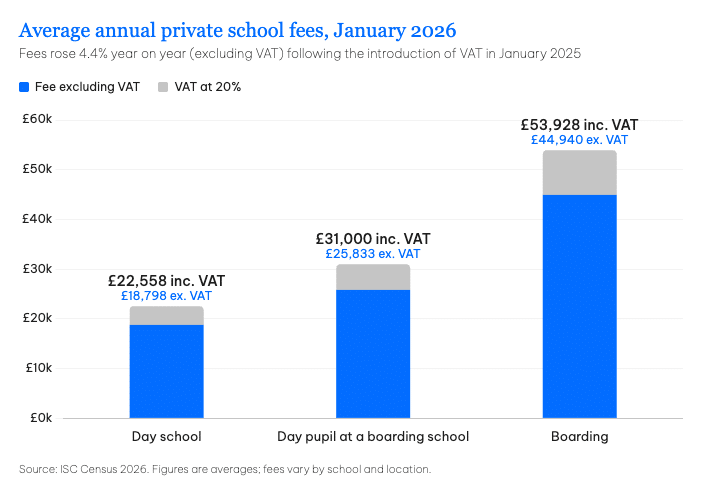
Following the introduction of VAT on independent school fees from January 2025, schools have adopted a range of approaches to fee setting. Across schools completing the Census in both years, average fees increased by 4.4% between January 2025 and January 2026 (excluding VAT).2

The average fee level increases as pupils progress through the different phases of education. In day schools, fees rise by 12.6% between junior and senior phases and by a further 4.0% between senior and sixth form, indicating a steady increase as pupils move through the system.3

While the cost of tuition fees can vary widely depending on the school and location, sending your child to a private school costs, on average, £18,798 per year for attending a day school, or £25,833 per year where a day pupil attends a boarding school, rising to £44,940 for pupils who board.4 These amounts exclude VAT at an additional 20%.

1, 2, 3, 4 ISC Census and Annual Report, June 2026
At a glance

  • Parents could face around £400,000-£550,000 in day pupil fees or £950,000 in boarding fees for each child, assuming 14 years at private school and 3.5% per year fee increase.
  • ISAs and Investment Bonds can be used as tax wrappers to save towards school fees, potentially making tax-efficient or tax-deferred returns on your investment.
  • Unit Trusts and General Investment Accounts (GIAs) may also provide access to investing in various asset classes, with tax treatment dependent on individual circumstances.

Average boarding school fees could cost nearly £1m per child

Taking a tax-efficient approach to saving towards private school fees…

Let’s assume that school fees increase by 3.5% a year. This would be the lowest increase seen over the course of a 14-year education. Based on the average costs, parents could face around £400,000-£550,000 in day pupil fees or £950,000 in boarding fees for each child.

However, while these figures are considerable, the sooner you start saving towards your child’s school fees, the better.

By starting early, saving regularly, and investing, parents could build up a substantial sum over time to help cover the costs of private education.

Taking a tax-efficient approach to school fees can help make private education much more accessible.

Key tax-efficient solutions

Individual Savings Accounts (ISAs)

An ISA is a tax-efficient investment vehicle that enables parents to put aside a certain amount each year, without incurring any income or capital gains tax (CGT) on the interest or investment returns earned on the savings.

If both parents make monthly contributions that fully utilise their ISA allowance (£20,000 per person in the 2026/27 tax year) from the child’s birth, this could accumulate to a sum of £585,000 by the time the child is 11 years old, based on 5% net annual growth after fees, compounding monthly.* Withdrawals from an ISA are tax efficient, so parents can extract funds as needed to pay for school fees without incurring any capital gains or income tax liability, or invest in other options, such as stocks and shares.

*These figures are examples only and they are not guaranteed – they are not minimum or maximum amounts. What you get back depends on how your investment grows and the tax treatment of the investment.

The value of an ISA with St. James’s Place will be directly linked to the performance of the funds selected and may fall as well as rise.  You may get back less than you invested.

The favourable tax treatment of ISAs may be subject to changes in legislation in the future.

On- and Offshore Investment Bonds

An Investment Bond is a tax-efficient investment wrapper that allows parents to save and invest to pay for private school fees. An Investment Bond invests in a range of assets, such as stocks, shares, bonds, and funds. You can invest a lump sum or make regular contributions.

During the term of the investment, returns earned within the bond are not subject to income or capital gains tax (CGT), providing significant tax savings over the long term with the option to draw down up to 5% of your original investment per year on a tax-deferred basis. As the 5% allowance is cumulative, any unused allowance is carried forward for up to 20 years.**

The value of an investment with St. James’s Place will be directly linked to the performance of the funds you select and the value can therefore go down as well as up.  You may get back less than you invested.

The levels and bases of taxation, and reliefs from taxation, can change at any time. The value of any tax relief depends on individual circumstances.

**Please note that if the withdrawals taken exceed the growth of the bond, the capital will be eroded.

Unit Trusts and General Investment Accounts (GIAs)

Unit Trusts and General Investments Accounts (GIAs) pool capital from multiple investors into a single fund, which is then invested across various asset classes, such as stocks, bonds, and property. Investors benefit from an annual dividend allowance of £500 in the 2026/27 tax year, and a capital gains tax annual exemption of £3,000 in the 2026/27 tax year.

Howver, Unit Trusts and GIAs are subject to income tax on any dividends or interests earned, which can reduce the overall tax efficiency of the investment. The tax treatment of these investments can also vary depending on personal circumstances, such as income level and tax bracket.

The value of an investment with St. James’s Place will be directly linked to the performance of the funds you select and the value can therefore go down as well as up.  You may get back less than you invested.

The levels and bases of taxation, and reliefs from taxation, can change at any time. The value of any tax relief depends on individual circumstances.

Gifting Allowance

Under current UK tax law, individuals can give up to £3,000 per year to another person using their annual gifting exemption, including a child or grandchild attending a private school. If you are married or in a civil partnership, you can combine this with your partner’s allowance, resulting in a total annual gifting exemption of up to £6,000 per year.

This offers a tax-efficient way to pay for private school fees. However, financial gifts above £3,000 can be subject to inheritance tax (IHT) if the donor dies within seven years of making the gift. The current nil-rate band for inheritance tax is £325,000 per person.

If a parent has adequate disposable income, this may be utlisied to pay for education costs (including private school fees) under ‘Dispositions for the maintenance of the transferor’s children’ rules.*** A disposition is not a transfer of value for IHT purposes if it is made by one party to a marriage or civil partnership and is both:

– in favour of a child of either party and
– for that child’s maintenance, education or training for a period not ending later than the year ending 5 April in which the child attains the age of 18, or
– after attaining 18, ceases to undergo full-time education

The levels and bases of taxation, and reliefs from taxation, can change at any time. The value of any tax relief depends on individual circumstances.

***Further criteria applies within the HMRC IHT Manual IHTM04175 which is subject to change.

Scholarships and Bursaries

Many private schools offer means-tested bursaries to help with the cost of tuition. A third of pupils in private education receive means-tested bursaries,3 which can cover up to 100% of fees.

Bursaries are awarded based on financial need, and can be a valuable way for families who may not otherwise be able to afford private school, to access high-quality education for their children. The amount of the bursary awarded is based on a means test, which considers a family’s income, assets, and other relevant factors.

Scholarships are typically awarded based on merit, such as academic or athletic achievement, musical talent, or artistic ability. Scholarships may not cover the full cost of tuition. The proportion of fees covered will depend on the school and the type of scholarship offered.

3 ISC School Fee Assistance, June 2026

Paying in advance

Paying private school fees in advance can be a way to save money on the overall cost of tuition. Many private schools offer discounts to parents who pay tuition fees in advance, with the size of the discount increasing with the size of the advance payment.

However, parents considering paying fees in advance should carefully weigh the potential gains against the risks associated with tying up a significant amount of capital in pre-payment.

Depending on the investment chosen, there may be potential for higher returns than the discount offered for advance payment, but there is also a risk of capital loss.

Navigating a myriad of options

Private school education can provide children with a vital head-start and opportunities that help them to achieve their goals. However, it’s undoubtedly an expensive commitment, and navigating the options for paying private school fees can be complex and daunting.

Many options are available, including tax-efficient investments, bursaries and scholarships, pre-payment of tuition fees, and a range of capital drawdown routes. It’s important to carefully consider your options and obtain expert advice when planning and funding private school fees.

The value of an investment with St. James’s Place will be directly linked to the performance of the funds selected and may fall as well as rise. You may get back less than you invested.

The levels and bases of taxation, and reliefs from taxation, can change at any time, and are generally dependent on individual circumstances.

SJP Approved 10/07/2026

Should you require more information or have particular questions, we invite you to contact us at your convenience.

Contact Us

How to pay yourself as a business owner tax efficiently

Introduction

There are three primary methods through which you can pay yourself as a business owner tax efficiently. This involves withdrawing profits from your limited company: salary, dividends, and pension contributions (though the latter involves setting aside funds from the company for future use). Alternatively, profits can be retained within the company and later accessed through the sale proceeds or dividends.

The primary consideration in choosing among these methods is the net benefit to the owner in terms of payment structure. While nobody enjoys paying taxes or national insurance, optimising these payments to maximise benefits is prudent. Paying taxes isn’t necessarily negative if it results in more money in your pocket when you need it.

For instance, a basic rate taxpayer making a pension contribution provides a straightforward illustration of net benefit. By receiving tax relief on the contribution, they effectively turn an £80 net contribution into an £85 net benefit, taking into account tax relief, and future tax paid. Given this, one must decide whether to retain 100% of the £80 in their bank account or make a pension contribution to receive 85% of £100 at a future date.

However, for the owner of a limited company, the decision is more complex, considering various factors beyond simple tax implications.

Taxation applying to extracting profit

Corporation Tax

Corporation tax is a levy imposed on the profits of a registered business entity.

The primary corporation tax rate is now 25%, applicable to profits exceeding £250,000. Small businesses, defined as those with profits below £50,000, continue to be taxed at the small profits rate (SPR) of 19%.

For companies earning profits above £50,000 but below £250,000, the full main rate will apply, yet they will receive marginal rate relief. This means their actual corporation tax rate will gradually increase from 19% to a figure between the small profits rate and the main rate.

The SPR does not extend to close investment-holding companies, such as those controlled by a small group of individuals not primarily engaged in commercial trading or land investment for letting purposes. For instance, a Family Investment Company may not qualify for the SPR.

Before calculating profits, business expenses such as employee salaries (including those of business owners acting as employees), employers’ National Insurance contributions, and pension contributions (subject to the “wholly and exclusively” rule) are deductible.

Employers National Insurance Contributions

Employers are obligated to pay National Insurance contributions for their employees once their salary surpasses specific thresholds. Typically this is at a rate of 15% on weekly income above £96 (equating to annual income above £5,000).

Be aware that the employment allowance, which provides up to £10,500 per year towards a company’s National Insurance contributions, may not be applicable to company owners unless they employ additional staff.

When paying yourself as a business owner, you cannot utilise the employment allowance if you are the director and the sole employee earning above the Secondary Threshold, or if you operate as a service company subject to ‘IR35 rules’, and your sole income comes from the intermediary (e.g., your personal service company, limited company, or partnership). If you are part of a group, only one company or charity within the group is eligible to claim the allowance.

Income Tax and Employee NI

Income will be taxed in line with standard employee taxation. When paying yourself as a business owner, you’ll receive a personal allowance, which currently stands at £12,570 per annum. However, it’s important to note that there’s a reduction for individuals with adjusted net income exceeding £100,000.

Similar to employer contributions, the rates and amounts of employee National Insurance (NI) contributions can vary. However, for most employees, NI is charged on weekly income between £242 to £967 at 8%, and on income above £967 at 2%.

Dividends

Dividends represent payments made from company profits to its shareholders and can be an important element to paying yourself as a business owner. They are subject to taxation in a consistent manner across dividends received from companies, unit trusts, and open-ended investment companies.

Since the 2016/17 tax year, the previous dividend taxation system underwent significant changes. The dividend tax credit was eliminated and replaced by the structure outlined below.

Each individual is entitled to an annual Dividend Allowance of £500. Subsequent dividends are taxed as follows:

  • Basic Rate: 10.75%
  • Higher Rate: 35.75%
  • Additional Rate: 39.35%

It’s crucial to note that the 0% rate serves as a starting point for dividend taxation and not a deduction from the dividend amount received. For instance, if an individual exhausts their personal allowance, falls £500 below the higher rate threshold, and receives £1,000 in dividends, £500 of those dividends would be subject to higher rate dividend tax.

Furthermore, it’s essential to understand that the entire dividend payment is considered in the tax calculation, not just the portion exceeding £500. While the initial £500 enjoys a 0% rate, any surplus is taxed according to the respective tax band. Dividends can offset any unused Personal Allowance before applying the £500 allowance. Consequently, an individual with no other income can receive dividends up to £13,070 before incurring tax liability.

What’s the most tax-efficient method for extracting profits from your business?

When paying yourself as a business owner, a straightforward solution to improve tax efficiency is to make pension contributions. As previously explained, these contributions are not subject to corporation tax or National Insurance when made by the business. Moreover, upon benefiting from these contributions, 25% is typically tax-free, with subsequent amounts taxed at marginal rates and no National Insurance to pay.

However, while pension contributions may be the most tax-efficient option, they might not always be the most practical. Individuals under 55 require accessible income for day-to-day living expenses. Even for those over 55, immediately vesting pension contributions could technically cover living expenses. However, in reality, this may not be feasible due to potential complications with recycling rules.

Moreover, accessing pensions beyond any tax-free cash can trigger the Money Purchase Annual Allowance (MPAA), limiting the ability to fund a Defined Contribution pension beyond the MPAA threshold.

Given the favourable tax treatment of pensions, it’s worth considering whether pension funds should be utilised to meet retirement needs rather than immediate financial requirements. It’s then important to explore how you can withdraw funds from your business to cover day-to-day living expenses both presently and in the future, when paying yourself as a business owner.

Dividends often outperform salary when it comes to meeting immediate daily needs, especially when considering all available allowances. However, the interplay between allowances and National Insurance (NI) thresholds can significantly influence this comparison. For instance, while you can draw a salary up to the personal allowance of £12,570 without incurring income tax, employers’ NI contributions become payable from £5,000.

Ultimately, the business owner must extract sufficient profit for livelihood. Therefore, determining the “sweet spot” for taking a combination of salary and dividends becomes crucial. Could the optimal approach entail taking a salary of £12,570, with the remaining amount as dividends? Perhaps. However, given the intricate nuances of taxation rates, thresholds, and allowances, the answer may be more nuanced and dependent on individual circumstances.

Once the immediate income needs have been met and any remaining profit is surplus to the business’s requirements, considering pension contributions becomes prudent.

Indeed, while there are many options for paying yourself as a business owner and extracting company profits, each carries its own tax and National Insurance implications for the business owner, considering both their employer and employee roles.

Despite the technical complexity involved, the planning approach can be fundamentally simple. The goal is to withdraw the minimum profit necessary to cover immediate needs, ensuring that the rest is directed towards the pension to optimise future financial security. An expert wealth adviser can help you determine the optimal strategy for your individual circumstances.

Advice around your remuneration structure is ultimately the responsibility of your company’s accountant.

The value of an investment with St. James’s Place will be directly linked to the performance of the funds you select and the value can therefore go down as well as up. You may get back less than you invested.

The levels and bases of taxation and reliefs from taxation can change at any time. The value of any tax relief depends on individual circumstances.

SJP Approved 11/06/2026

Should you require more information or have particular questions, we invite you to contact us at your convenience.

Contact Us

Employee Share Options as an Employment Benefit

What you need to know

Overview:

  • Many high-earning professionals receive shares as part of their remuneration package, which can impact their tax situation. Understanding different Employee Share Options arrangements can help optimise tax efficiency.
  • Employee Share Options schemes vary and often have different tax implications. For instance, under the Enterprise Management Incentives (EMI) scheme—frequently used by start-ups—employees can benefit from Business Asset Disposal Relief on Capital Gains Tax upon selling their shares.
  • Seeking expert advice is crucial to maximise any available tax reliefs and make the most of your wealth.

In today’s business climate, companies are carefully structuring remuneration packages, with Employee Share Options schemes becoming a popular option to promote employee loyalty. Such schemes can motivate employees, especially those in senior roles like executives and directors, by giving them a personal stake in the company’s success.

Simon Martin, Chartered Financial Planner at Technical Connection (a company owned by St. James’s Place), notes that many high-net-worth clients’ remuneration packages include either direct shares or Employee Share Options, regardless of whether they work for private or public companies.

Different types of share schemes offer unique tax benefits, and the specific scheme available often depends on the company’s nature.

Explore your Employee Share Options benefits, with a no-obligation financial planning consultation.

Book A Demo

Common schemes

Enterprise Management Incentives (EMI)

Common among start-ups, the EMI scheme allows employees to purchase shares if they meet certain performance or tenure requirements. This scheme helps attract talent by providing the potential for investment returns in the future, even if the company can’t currently match larger firms on salary.

Technology companies frequently use EMI as it enables key employees to own shares and benefit from the company’s growth in a tax-efficient way. A company can grant up to £250,000 worth of share options over a three-year period.

With EMI, you might have the option to buy shares in the future at an agreed price, potentially much lower than their market value at purchase time. If shares were priced at £1 initially and are worth £10 when purchased, you could gain £9 per share.

If shares are bought at or above market value when the option was granted, no Income Tax or National Insurance is due. A discounted purchase will, however, incur Income Tax and National Insurance on the difference. When you sell, Capital Gains Tax (CGT) applies at a reduced rate of 10% (rather than the standard 20%) if the option has been held for at least two years.

Company Share Option Plan (CSOP)

Under a CSOP, you have the option to buy up to £60,000 worth of shares at a non-discounted, fixed price.

As long as shares are held for three years, there is no Income Tax or National Insurance on the difference between the purchase price and their value. CGT may apply when the shares are sold.

Save As You Earn (SAYE)

SAYE is a popular UK share scheme available to all employees, not just higher-level staff.

With SAYE, you save between £5 and £500 monthly for three to five years, deducted from your gross salary. At the end of this period, you have the option to buy shares at a pre-set price, usually up to 20% below the market rate at the time.

If share prices drop, you can opt not to buy and withdraw your savings as cash, minimising risk. If you do buy the shares, they can be held or sold immediately for a profit. Income Tax and National Insurance do not apply, though CGT may be due unless shares are transferred to a pension or ISA within 90 days.

Share Incentive Plans (SIP)

With a SIP, employers can offer shares to employees or allow them to buy shares through gross pay deductions, holding these shares in trust until they leave the company.

Employers can give up to £3,600 worth of shares per employee annually, or employees may buy up to £1,800 worth themselves.

SIPs allow employees to acquire shares in four ways: free shares, partnership shares, matching shares, or dividend shares. Holding these shares for at least five years avoids Income Tax and National Insurance. If shares are sold immediately after this five-year period, CGT may also be avoided.

Other Share Plans

Beyond HMRC’s tax-advantaged schemes, some companies offer Employee Share Options as part of a bonus arrangement. For instance, you might receive a £20,000 share bonus, withheld for three years. When the shares are released, they are subject to Income Tax and National Insurance like a salary. If you leave the company within three years, the bonus is forfeited, encouraging loyalty.

Advice for maximising your Employee Share Options benefits

Understanding your company’s share scheme and tax implications is essential to make the most of your employment benefits. Seeking expert financial advice can help ensure your wealth is working efficiently for you.

The value of an investment with St. James’s Place will be directly linked to the performance of the funds you select and the value can therefore go down as well as up. You may get back less than you invested.

The levels and bases of taxation, and reliefs from taxation, can change at any time and are generally dependent on individual circumstances.

SJP Approved 11/09/2026

Should you require more information or have particular questions, we invite you to contact us at your convenience.

Contact Us

Net Adjusted Income: Crucial Information for Parents

Why net adjusted income is so important

Many parents overlook the complexities of net adjusted income, leading to costly financial mistakes. One of the most common errors involves pension contributions and eligibility for government childcare schemes. To ensure you make informed decisions, we’ll clarify how net adjusted income is assessed and how strategic planning can help you optimise your finances.

Optimise your net adjusted income, with a no-obligation financial planning consultation.

Book A Demo

A case study

Kate and Mark are new parents, both committed to securing the best future for their family. Kate earns an annual salary of £130,000, placing her above the income threshold for key government childcare benefits, including 30 free hours’ childcare, and tax-free childcare (£2 government contribution for every £8 saved into the scheme).

To bring her income below the relevant threshold and qualify for these schemes, she began making additional pension contributions. However, she made a critical mistake.

The miscalculation

Kate increased her pension contributions by £1,000 per month, beginning in January. She assumed this would immediately reduce her net adjusted income and enable her to access government childcare support. Unfortunately, this assumption was incorrect.

Net adjusted income is assessed over the entire tax year (6 April to 5 April), not on a monthly basis. Despite her increased pension contributions in the later months, Kate’s total net adjusted income for the full tax year still exceeded the qualifying threshold.

The financial impact

As a result of this miscalculation, Kate remained ineligible for government childcare support and may have lost £2,000 per year in potential savings, compared to if she had she structured her pension contributions strategically from the start of the tax year.

The value of an investment with St. James’s Place will be directly linked to the performance of the funds selected, and the value may therefore fall as well as rise. You may get back less than you invested.

The levels and bases of taxation, and reliefs from taxation, can change at any time and are generally dependent on individual circumstances.

Key actions

To avoid similar pitfalls, consider the following:

  1. Plan well in advance – Adjustments to net adjusted income should be made at the start of the tax year (April), not mid-year, to maximise potential savings.
  2. Understand the full-year assessment – Government childcare schemes evaluate income over a 12-month period, not on a rolling basis.
  3. Assess the financial trade-offs – While pension contributions can reduce net adjusted income, it is essential to balance contributions with immediate financial needs.

Steps to optimise your net adjusted income

With April fast approaching, now is the time to prepare. Here’s how you can take proactive steps:

Step 1: Determine the benefits available through government childcare schemes based on your income level.

Step 2: Calculate the impact of increased pension contributions on your take-home pay and long-term savings.

Step 3: Compare the financial advantages of reduced net adjusted income with the benefits of additional pension growth.

Many parents find that with careful planning, they can strike a balance between immediate cost savings, and long-term financial security.

Act now to establish your financial position

With the new tax year just around the corner, now is the ideal time to take control of your finances. By planning ahead, you can optimise your net adjusted income, access valuable childcare benefits, and strengthen your long-term financial security.

If you want to ensure you are making the right decisions without unnecessary complexity, book a no-obligation financial planning consultation for the start of the new tax year.

The levels and bases of taxation, and reliefs from taxation, can change at any time and are generally dependent on individual circumstances.

SJP Approved 11/06/2026

Optimise your net adjusted income, with a no-obligation financial planning consultation.

Book A Demo

Should you require more information or have particular questions, we invite you to contact us at your convenience.

Contact Us

Avoiding The 60% Income Tax Trap

Introduction

It’s often thought that the highest UK tax rate is 45% – but that’s not the case.

If you earn more than £100,000 per year, you could be taxed at a rate of 60% on income between £100,000 and £125,140.

Here’s how it works

If you receive income of £100,000 or more, the rate of Income Tax you pay will be impacted by the gradual removal of the £12,570 Personal Allowance (the amount of income you can receive each year without paying Income Tax). The personal allowance is currently tapered away at a rate of £1 for every £2 of income above £100,000.

Once your income is over £125,140, you don’t benefit from any tax-free Personal Allowance whatsoever.

Here’s an example

Let’s say your salary has increased from £100,000 to £110,000. Here’s how the extra £10,000 would be taxed:

£4,000 – the standard 40% rate of Income Tax for a higher rate taxpayer
Plus £2,000 – the additional Income Tax as the personal allowance is reduced by £5,000

That’s a total Income Tax liability of £6,000 on your £10,000 pay rise – or 60%.

Considerations to mitigating this 60% effective tax rate

Make pension contributions

Contributing more to your pension before the end of the tax year is an efficient strategy to lower your taxable income and avoid exceeding the threshold. This approach offers dual benefits: it decreases your tax liability and enhances your retirement savings concurrently.

Consider this scenario: receiving a bonus or pay increase of £10,000 raises your taxable income to £110,000. By using this to make a £10,000 pension contribution you avoid falling into the 60% tax bracket and so both restore your personal allowance and obtain higher rate relief on the contribution.

It’s worth noting that there’s an annual limit on pension contributions that qualify for tax relief, which is typically the lower of £60,000 or your annual earnings. For higher earners, your pension annual allowance might be tapered down further.

The value of an investment with St. James’s Place will be directly linked to the performance of the funds you select and the value can therefore go down as well as up. You may get back less than you invested.

Other forms of Salary Sacrifice

If your employer offers salary sacrifice, you can choose to give up some of your regular pay or bonus in return for a different benefit. 

The choice of benefits varies between employers, but often includes:

  • Electric or plug-in hybrid vehicle leasing
  • Childcare vouchers
  • Cycle to work schemes
  • Insurance, including life, health and dental

Your salary is then reduced by the cost of any benefits you choose.

What next?

If you would like to discuss how we can help you mitigate Income Tax liabilities, reach out to one of our experts who can discuss with you your individual requirements.

The levels and bases of taxation, and reliefs from taxation, can change at any time, and are generally dependent on individual circumstances.

The basic rate of tax relief of 20% is automatically applied to pension contributions. You must complete a Self Assessment tax return to claim additional rates of tax relief.

SJP Approved 11/06/2026

Should you require more information or have particular questions, we invite you to contact us at your convenience.

Contact Us

Using a Life Cover Insurance Plan Written in Trust to Meet an Inheritance Tax (IHT) Liability

Introduction

Inheritance Tax (IHT) can be tricky to understand, but its impact can mean less money ends up in the pockets of your loved ones. This is even more so the case as most unused pensions and death benefits will form part of your estate from 2027. A solution could be to write a Life Cover Insurance Plan into Trust.

Tax allowances such as the residence nil-rate band (RNRB) begin to fall away for estates valued in excess of £2 million. In the case of the RNRB, this is tapered by £1 for every £2 an estate exceeds £2 million.

What is a Life Cover Insurance Plan?

Life insurance offers a tax-exempt payout to a chosen beneficiary upon your death.

This insurance comes in two forms; term assurance and whole of life assurance.

Term assurance covers you for a set duration. It is often chosen to safeguard against debts that will diminish or conclude over time, like a mortgage repayment, or to ensure there is a fund available for specific future expenses, such as your children’s education costs.

Whole of life assurance, on the other hand, guarantees a payout at the time of death, as long as the premiums have been consistently paid throughout the policy’s term.

Whole of life policies are generally aimed at addressing financial responsibilities that will arise at your death, regardless of its timing, like covering an inheritance tax bill or enhancing the inheritance you leave behind. These plans are suitable when the need for coverage is indefinite or unclear.

How can a Life Cover Insurance Plan help pay towards an Inheritance Tax (IHT) bill?

Over and above gifting sufficient assets to reduce your gross estate value to within £2 million, if you have excess income during your retirement, it might make sense to consider a Life Cover Insurance Plan written in trust, to meet the eventual IHT liability, which could be as high as £400,000 on an estate valued at £2 million.

It is important that the Life Cover Insurance Plan is written into Trust, and that the premiums are paid using excess income, rather than from assets – otherwise, the premiums paid could be treated as a chargeable lifetime transfer (CLT).

Note that probate is required to release estate assets, and IHT needs to be paid before probate is granted. Therefore, an estate’s assets cannot be directly used to meet IHT liability, and an alternative solution such as life cover in trust provides the funds required.

How much might a Life Cover Insurance Plan cost?

As of June 2026, a guaranteed whole of life joint plan with a sum assured of £400,000 would cost £6,572 per annum, assuming a 65-year-old male non-smoker and 65-year-old female non-smoker insured through Vitality, and not including ‘waiver of premium’ as an additional option. These figures are based on guaranteed premiums, meaning the provider cannot change the premium as you get older.

Guaranteed whole of life cover provides certainty; if the premiums are paid until death, then the sum assured will pay out. To put the figures in perspective, a 65 year old woman has a life expectancy of 24 years. By the time she is 89, she would have paid around £158,000 in premiums, but the payout from the plan would be £400,000 on second death. If the woman lives to 100, she will have paid £230,000 in premiums, and the payout from the plan would still be £400,000 on second death.

The value of financial advice and Inheritance Tax (IHT) planning

IHT is a highly complex area and very few people know every rule, exemption and allowance, or how to use them.

As your assets increase or decrease in value, your IHT liability will change and regular reviews of your financial position will therefore be important. It’s always a good idea to get in touch with a financial adviser whenever you buy or sell property too, or if you’re thinking of doing so. They can help make sure the choices you make will be tax-efficient for you – and those you leave behind.

Making confident decisions about Inheritance Tax planning while you’re still fit and healthy helps to create a better world for everyone you care about.

Appointing an expert wealth manager may enable you to capitalise on tax efficiencies such as these, mitigating paying unnecessary tax in your retirement and in the event of your death.

The levels and bases of taxation and reliefs from taxation can change at any time.

Tax relief is generally dependent on individual circumstances.

Trusts are not regulated by the Financial Conduct Authority.

SJP Approved 11/06/2026

Should you require more information or have particular questions, we invite you to contact us at your convenience.

Contact Us

Pensions: Explaining The Tapered Annual Allowance

Introduction

For those earning a high income, it’s essential to understand the implications of the Tapered Annual Allowance on making pension contributions. This guide offers an overview of the tapered annual allowance and its operational mechanism.

Understanding when the Annual Allowance is Tapered

Pension tapering regulates the amount high-earning individuals can contribute to their pensions annually while still receiving the full benefits of tax relief.

For the 2026/27 tax year, the standard annual allowance is set at £60,000. Nonetheless, those earning a higher income may see their allowance reduced to as low as £10,000, based on their total yearly income.

Individuals with a ‘threshold income’ over £200,000 and an ‘adjusted income’ over £260,000 are subject to the tapered annual allowance. The reduction in allowance halts when ‘adjusted income’ exceeds £360,000, setting the annual allowance to a minimal £10,000 for pension savings that receive the full benefit of tax relief.

Broadly, ‘Threshold Income’ includes all taxable income received in the tax year, including rental income, bonuses, dividend, and other taxable benefits.  From this you deduct any personal pension contributions to personal pension scheme.

‘Adjusted income’ includes all taxable income plus any employer pension contributions and most personal contributions to an occupational pension scheme.

Mechanics of the Tapered Annual Allowance

Individuals exceeding both a ‘threshold income’ of £200,000 and ‘adjusted income’ of £260,000 will experience a reduction in their annual allowance by £1 for every £2 exceeding £260,000 in adjusted income.

For instance, an ‘adjusted income’ of £280,000 reduces the annual allowance by £10,000, resulting in a £50,000 allowance instead of £60,000.

Tapered Annual Allowance and Carry Forward

The tapered annual allowance does not prohibit the use of carry forward rules, which permit the transfer of unused annual allowance from the previous three tax years. The tapered allowance for each year determines the amount that can be carried forward.

Employer Contributions and Exceeding the Tapered Annual Allowance

The tapered annual allowance applies to all pension contributions, including those made by employers. Exceeding your annual pension allowance incurs an annual allowance charge at your highest marginal income tax rate.

Calculating Your Tapered Annual Allowance

Determining your adjusted and threshold income can be complex. Additional information on calculating your tapered annual allowance is available on the Government’s website, and consulting an expert Adviser or tax specialist is advisable for tailored planning.

The value of an investment with St. James’s Place will be directly linked to the performance of the funds you select and the value can therefore go down as well as up. You may get back less than you invested.

The levels and bases of taxation and reliefs from taxation can change at any time. The value of any tax relief depends on individual circumstances.

SJP Approved 10/06/2026

Should you require more information or have particular questions, we invite you to contact us at your convenience.

Contact Us

How to manage a windfall, tax efficiently

A strategic guide for high net worth individuals

Receiving a windfall – whether from an inheritance, business sale, bonus, or other significant financial gain – presents both opportunities and complexities. Without a clear strategy, it’s easy to mismanage these newfound assets, potentially eroding wealth over time. This guide outlines a structured approach to making the most of your windfall while ensuring long-term financial security.

Save time – receive a no-obligation financial plan, tailored to your circumstances.

Let’s get started

Assessing your financial situation

Before making any financial decisions, take a step back and evaluate your current financial position.

Understanding your net worth

Compile a detailed breakdown of your assets, liabilities, income sources, and ongoing expenses.

Clarifying your financial goals

Define short-, medium-, and long-term objectives – whether that’s early retirement, property investment, philanthropy, or wealth preservation.

Evaluating your existing investment strategy

Assess whether your current portfolio is aligned with your new financial reality and risk tolerance.

Reviewing liabilities and liquidity needs

Determine if paying down liabilities (such as mortgages or business loans) is a priority or if maintaining liquidity for future opportunities is more beneficial.

A professional wealth adviser can help you take a holistic view and ensure your decisions align with your broader financial aspirations.

Managing tax implications

A windfall can have significant tax consequences, and careful planning is essential to ensure you retain as much wealth as possible.

Inheritance Tax (IHT) mitigation

If the windfall is from an inheritance, consider strategies such as gifting, trusts, and other qualifying investments to reduce future IHT liabilities.

Capital Gains Tax (CGT) planning

If assets (such as shares or property) are involved, a phased disposal strategy may help spread CGT liability over multiple tax years.

Income tax efficiency

Large bonuses and unexpected income surges can push you into higher tax brackets. Structuring receipts over time, pension contributions, or investing in tax-efficient vehicles can mitigate this impact.

Use of tax wrappers

Leveraging ISAs, pensions, and other HMRC-approved schemes and investment wrappers, can provide significant tax relief while ensuring long-term wealth growth. Don’t forget, you could also provide some funds to your partner, and/or children, to utilise their respective pension and ISA allowances.

The value of an investment with St. James’s Place will be directly linked to the performance of the funds selected and may fall as well as rise.

The levels and bases of taxation and reliefs from taxation can change at any time and are dependent on individual circumstances.

Trusts are not regulated by the Financial Conduct Authority.

Developing an investment strategy

Once tax considerations are addressed, focus shifts to deploying the windfall effectively. A well-structured investment strategy should reflect your risk tolerance, investment horizon, and objectives.

Diversification

Avoid overexposure to any single asset class. A mix of equities, bonds, property, private equity, and alternative investments can mitigate risk.

Risk management

Understand how your risk appetite has changed now that your wealth has increased. Stress-test different scenarios using cashflow modelling.

Tactical vs strategic asset allocation

Balance active opportunities (e.g., private equity or thematic investing) with a long-term passive core.

Liquidity considerations

Ensure you maintain an emergency fund while keeping a portion of your portfolio readily accessible for new opportunities.

Professional oversight

Regular reviews with a financial adviser can help ensure your investments remain aligned with your changing needs and market conditions; for example, regularly evaluating rebalancing need.

The value of an investment with St. James’s Place will be directly linked to the performance of the funds selected and may fall as well as rise.

The levels and bases of taxation and reliefs from taxation can change at any time and are dependent on individual circumstances.

Retirement planning

A windfall provides an opportunity to reassess retirement plans, whether accelerating retirement or enhancing existing strategies.

Maximising pension contributions

Consider using your Annual Allowance (£60,000) and any available Carry Forward from the past three years to boost tax-efficient pension savings. One could theoretically contribute up to £240,000 at once, at a net cost from £132,000, subject to relevant earnings. Discover more about Pension Carry Forward.

Overall pension value considerations

While the Lifetime Allowance charge has been abolished, excess pension savings may still impact income tax rates in retirement. The Lump Sum Allowance (LSA) caps tax-free cash at £268,275, while the Lump Sum Death Benefit Allowance (LSDBA) has significant estate planning implications for individuals who die before age 75. Furthermore, from 2027, unspent pensions will be brought inside of estates for Inheritance Tax (IHT) purposes. Strategic withdrawals and planning remain crucial.

Sustainable withdrawal strategies

If you’re considering early retirement, ensure you have a sustainable drawdown plan that balances income needs with longevity risks.

Decumulation tax planning

Structuring withdrawals across ISAs, pensions, and taxable accounts efficiently can optimise your income tax position in retirement. Discover more about managing a high-value retirement portfolio, tax efficiently.

A well-integrated retirement plan ensures your windfall contributes to a financially secure future, rather than being eroded by inflation or inefficient withdrawals.

Estate planning and wealth preservation

A windfall can have long-term implications for your estate and legacy. Proper planning ensures your wealth is protected and transferred tax-efficiently to the next generation.

Trust structures

Discretionary and bare trusts can provide tax-efficient intergenerational wealth transfers while maintaining control. Discover more about Trusts.

Gifting strategies

The use of the £3,000 annual gift exemption, potentially exempt transfers (PETs), and regular gifts out of surplus income can mitigate inheritance tax. Discover more about Gifting.

Family Investment Companies (FICs)

For larger estates, FICs can provide an alternative to trusts while offering greater control and flexibility.

Please note FICs are not offered by St. James’s Place.

Updating Wills and Lasting Powers of Attorney (LPAs)

Ensure legal documents reflect your new financial circumstances and wishes for asset distribution.

Charitable giving and philanthropy

If philanthropy is a priority, consider setting up a donor-advised fund (DAF) or a family charitable trust to structure donations effectively.

The levels and bases of taxation and reliefs from taxation can change at any time and are dependent on individual circumstances.

Will writing involves the referral to a service that is separate and distinct to those offered by St. James’s Place. Wills are not regulated by the Financial Conduct Authority.

Advice given in relation to a Power of Attorney will involve the referral to a service that is separate and distinct to those offered by St. James’s Place and is not regulated by the Financial Conduct Authority.

Trusts are not regulated by the Financial Conduct Authority.

Professional advice: A critical component

Handling a windfall effectively requires expert input from multiple disciplines, including financial planning, tax advisory, and legal expertise. Partnering with an expert Private Wealth Adviser ensures you:

  • Make tax-efficient decisions from day one.
  • Implement a diversified and well-structured investment plan.
  • Safeguard your wealth for future generations.
  • Maintain flexibility as your circumstances evolve.

A well-managed windfall can significantly enhance your financial future. With the right strategy, you can turn a one-time financial event into a lasting legacy of security and prosperity.

SJP Approved 10/06/2026

Start planning now – invest later. Obtain a bespoke financial plan, tailored to your unique objectives.

Book A Conversation

Should you require more information or have particular questions, we invite you to contact us at your convenience.

Contact Us

Giving Your Children and Grandchildren a Head Start

Introduction

While money isn’t the be all and end all, it undeniably offers children a significant advantage. A nest egg can contribute towards their education, grant access to diverse opportunities, and give them a head start in their adult lives.

Saving now provides them with greater flexibility to pursue their desired paths when the time comes. It’s another avenue through which you can afford them the best possible start in life.

The cost of growing up

Raising children can be financially challenging. While families may cover many of the costs of raising young children through their income, having a financial reserve as adulthood nears can be invaluable.

As young adults approach major milestones such as purchasing their first car, attending university, or buying their initial home, significant expenses arise.

By providing support, you can assist them in pursuing their aspirations. Starting to save early ensures they’ll have greater opportunities as they grow older.

01

£48,470

The average debt of a student leaving an English university in 2024
Source: Statista, December 2024
02

£151,731

The average deposit for a first-time buyer in Greater London
Source: UK Finance Key Mortgage Market Data, February 2025
01

£48,470

The average debt of a student leaving an English university in 2024
Source: Statista, December 2024

02

£151,731

The average deposit for a first-time buyer in Greater London
Source: UK Finance Key Mortgage Market Data, February 2025

Start early

You don’t have to allocate a substantial sum each month to establish a solid nest egg for a child. The crucial step is to commence saving as early as possible.

Beginning to save when children are young offers the advantage of time. It’s remarkable how even modest amounts saved consistently can accumulate over time. The power of compounding, combined with prudent investment decisions, has the potential to substantially enhance the value of your fund as children mature.

The value of an investment with St. James’s Place will be directly linked to the performance of the funds selected and may fall as well as rise. You may get back less than the amount invested.

Savings that work for everyone

You might choose to save a modest sum monthly, or invest lump sums as it fits your circumstances.

Your choice may be grant the funds to your child/ grandchild at age 18, or you might prefer to maintain control for a longer period of time.

Regardless of your preferences, selecting an investment solution that provides a suitable balance of flexibility, tax efficiency, and accessibility is crucial.

Invest in a Junior ISA

Junior ISAs represent an opportunity for saving towards a child’s future. The funds are inaccessible until the child reaches their 18th birthday.

These accounts can be set up by a parent or legal guardian, however further contributions can be accepted from anyone once the account has been set up. Regular deposits or one-time payments up to the annual limit (currently £9,000) are permitted, with all income and gains being exempt from Income Tax and Capital Gains Tax.

Upon reaching the age of 18, the Junior ISA automatically turns into an adult ISA which offers further flexibility to invest or withdraw funds as desired.

Junior ISAs offer the choice between cash or stocks and shares options. While cash is perceived as lower risk, considering the potentially lengthy investment term of up to 18 years, stocks and shares Junior ISAs typically offer superior returns over time. Although it is possible to spread the risk by subscribing to both a cash Junior ISA and a stocks and shares Junior ISA – provided the annual limit is not exceeded.

The value of an investment with St. James’s Place will be directly linked to the performance of the funds selected and the value may fall as well as rise. You may get back less than the amount invested.

An investment in a Stocks and Shares ISA does not provide the security of capital associated with a Cash ISA.

The favourable tax treatment of ISAs may not be maintained in the future and is subject to changes in legislation.

Please note that St. James’s Place does not offer Cash ISAs.

Set up a trust

Another frequently overlooked option is establishing a bare trust or designated investment account for a grandchild. Typically, the funds are invested in a portfolio of unit trusts, offering the benefits of professional management, risk reduction through diversification, and tax efficiency.

This straightforward legal arrangement of setting up a bare trust is an excellent solution for grandparents seeking to invest money for a grandchild. Until the beneficiary turns 18 and assumes ownership of the investment, the grandparents retain control over the funds. Subsequently, the grandchild can independently make decisions about the plan.

Unlike a Junior ISA, there are no limits to how much you can invest in a bare trust. The assets are held by a trustee, usually the parent or grandparent, for the child’s benefit until they reach 18 (or 16 in Scotland).

As long as the investment is made by someone other than the parents, the assets are taxed as if they belong to the child, which usually means there is little or no tax to pay on any income or gains.

This information applies for bare trusts in England. Bare trusts work differently in other regions.

Payments into bare trusts are considered to be gifts for inheritance tax purposes.

The value of an investment with St. James’s Place will be directly linked to the performance of the funds selected and the value may fall as well as rise. You may get back less than the amount invested.

The levels and bases of taxation, and reliefs from taxation, can change at any time and are generally dependent on individual circumstances.

Trusts are not regulated by the Financial Conduct Authority.

Start a pension

While initiating a pension for a child might initially appear unusual, for certain families, it can be a highly astute decision.

These pensions can be established by a parent or legal guardian, with contributions welcomed from anyone once they’re set up.

The blend of tax efficiency and an investment horizon potentially spanning over 60 years presents an exceptional opportunity for wealth growth. Even a single lump sum payment into a child’s pension could significantly enhance their retirement savings and alleviate some financial burdens in adulthood.

Moreover, if concerns arise regarding how a child might utilise the saved funds, there’s the added advantage that the money will remain beyond temptation’s reach until they reach retirement age.

You can put a maximum of £2,880 into a pension for a child each year. Tax relief will boost it to £3,600.

Investing the maximum £3,600 each year into a pension fund from birth until a child turns 18 could create a pot worth £1,030,000 by age 65.*

*Assumes an annual growth rate of 5% net of charges.

These figures are examples only and are not guaranteed. What you get back will depend on your investment performance and the tax treatment of your savings. You could get back more or less than this.

The value of an investment with St. James’s Place will be directly linked to the performance of the funds you select and the value can therefore go down as well as up. You may get back less than you invested.

The levels and bases of taxation and reliefs from taxation can change at any time. The value of any tax relief depends on individual circumstances.

SJP Approved 10/06/2026

Should you require more information or have particular questions, we invite you to contact us at your convenience.

Contact Us

Protecting Income and Wealth: The Complete Guide

The Complete Guide to Protection Planning for High-Earning Professionals and High-Net-Worth Families

How to protect your income, family, business and long-term wealth.

Protection isn’t a product. It’s a philosophy.

Most successful professionals dedicate enormous effort to:

• building investment portfolios
• mitigating unnecessary taxation
• growing businesses
• planning for retirement

Yet far fewer devote the same attention to protecting what they’ve built.

We frequently meet successful professionals with substantial assets – sometimes portfolios worth several million pounds – yet protection arrangements that are fragmented, outdated, or incomplete.

The problem is rarely affordability. It is complexity. And the common misconception that specialist insurance is primarily for people with “less to lose”. In reality, the opposite is true.

The more wealth you accumulate – and the more people depend on you – the more important protection becomes.

For high earners and entrepreneurs, the greatest financial asset is often not their portfolio or property. It is their future earning power. A serious illness, accident or premature death can derail a carefully constructed financial plan almost overnight. Protection planning exists to prevent that.

In this guide we explore:

• The core types of financial protection
• How to identify gaps in existing cover
• The hidden limitations of employer benefits
• Advanced strategies used by high-net-worth families
• How protection fits into long-term wealth and estate planning

Arrange your no-obligation protection coverage sufficiency review with an expert wealth adviser.

Select date and time

Understanding the Real Financial Risks

Before selecting policies, it’s important to understand what you’re actually protecting against.

Most families face four primary risks…

Premature death

If the primary earner dies, their income disappears immediately.

Yet financial commitments remain:

• Mortgage repayments
• School fees
• Household costs
• University funding
• Retirement planning for the surviving partner

Professionals in their 30s and 40s have decades of future earnings at stake – earnings that would be lost entirely in the event of premature death. Protection planning effectively insures this “human capital”.

Hypothetical example: A 42-year-old business owner and father of two died suddenly from a heart attack, leaving his family reliant on a single income that had vanished overnight. A well-structured life policy ensured his mortgage was cleared and his children’s school fees could still be paid, giving his family financial stability during an unimaginably difficult time.

Serious illness

Medical outcomes for serious illnesses have improved dramatically.

But recovery can still mean:

• extended time away from work
• reduced earning capacity
• major lifestyle adjustments

Even wealthy individuals can face significant financial disruption if illness prevents them working.

Hypothetical example: At 49, a lady was diagnosed with aggressive breast cancer and needed to step away from her role as a senior solicitor while undergoing treatment. Her critical illness cover paid out a substantial lump sum, allowing her to focus on recovery without the added pressure of replacing lost income.

Long-term inability to work

Perhaps a more likely financial shock than death for someone in their 30s or 40s, conditions such as:

• chronic fatigue
• mental health conditions
• neurological illness
• musculoskeletal injuries

may prevent someone from working for years, without qualifying for a critical illness payout.

Hypothetical example: After a cycling accident left him with a spinal injury, a 37-year-old consultant was unable to return to work for several years. His income protection policy replaced a large portion of his salary each month, ensuring his household finances and long-term plans stayed on track.

Financial instability for dependants

Without proper protection, families may be forced to:

• liquidate investments prematurely
• sell property
• abandon long-term plans
• rely on extended family support

Protection ensures financial independence even when life does not go according to plan.

Hypothetical example: When a couple separated, the household finances became far more fragile, particularly with two young children depending on them. Protection cover ensured that if either parent became seriously ill or died, there would still be funds available to maintain the children’s home and future education.

Please note that these plans do not have a cash-in value and will stop if payments to them cease.

The Core Protection Building Blocks

Most well-designed protection strategies combine several layers of cover…

Life Insurance (Term Assurance)

Life insurance provides a lump sum if you die during the policy term.

This money can be used to:

• repay mortgages
• replace income for dependants
• fund education costs
• provide financial security for a partner

Two common structures are used:

Level term cover

Pays a fixed lump sum. Typically used to replace income or fund family commitments.

Hypothetical example: A couple had two young children and a large mortgage, so they wanted certainty that their family would be financially secure if either of them died. A joint level term policy ensured a fixed lump sum would be paid out at any point during the term, providing stability for school fees, living costs and long-term planning.

Decreasing term cover

Reduces over time, often aligned with a repayment mortgage.

Hypothetical example: When a couple bought their first home, their priority was protecting the mortgage without overpaying for cover they didn’t need. A joint decreasing term policy mirrored their repayment mortgage balance, ensuring the outstanding loan would be cleared if one of them died.

How much life cover is needed?

For many professionals, advisers calculate coverage based on:

• outstanding debts
• income replacement
• school fees
• retirement provision for the surviving partner

Critical Illness Cover

Critical illness cover pays a tax-free lump sum if you’re diagnosed with a serious illness such as:

• cancer
• stroke
• heart attack
• multiple sclerosis

This money provides immediate financial flexibility during recovery.

It can be used to:

• repay debts
• fund private treatment
• reduce working hours
• support family commitments

For affluent individuals, this liquidity is particularly valuable when wealth is tied up in long-term assets.

Hypothetical example: A 46-year-old was diagnosed with multiple sclerosis and had to reduce his workload significantly. His critical illness policy paid a lump sum that helped cover private treatment, adapt his home, and replace income during a period of uncertainty.

Income Protection

Income protection replaces a portion of your income if illness or injury prevents you working.

Policies typically:

• cover 50–70% of earnings
• pay a monthly benefit
• continue until recovery or retirement

For many professionals, income protection is the single most important policy, because the probability of long-term illness is far greater than premature death.

Hypothetical example: After developing severe back problems, a 38-year-old marketing director was signed off work for nearly a year. Her income protection policy paid a monthly benefit that covered the majority of her salary, allowing her to maintain her lifestyle while focusing on recovery.

Family Income Benefit

Family income benefit provides a tax-free monthly income to dependants if you die.

Rather than paying a lump sum, it replaces income over time.

This is often used to cover:

• school fees
• childcare
• day-to-day household spending

Hypothetical example: When a father died unexpectedly at 41, his partner and their two children faced the sudden loss of his income. His family income benefit policy paid a tax-free monthly income until the end of the policy term, helping to replace his earnings and support the family through the children’s upbringing, providing towards school fees and mortgage repayments.

Please note that these plans do not have a cash-in value and will stop if payments to them cease.

Please note that there is no pay-out of family income benefit if you die after the term of the policy, nor will you get your money back.

The hidden limitations of employer benefits

Many professionals assume workplace benefits provide sufficient protection. In practice, they rarely do.

Benefits vs gaps

Typical benefits include:

  • Death-in-Service cover
  • Group Income Protection
  • Group Critical llness cover
  • Private Medical Insurance

These are valuable – but they often leave significant gaps.

  • Cover disappears when you change jobs
  • Employer benefits are rarely portable.
  • If you change firm, start a business, or take a career break, protection may disappear entirely.
Income protection limits

Employer schemes may:

• exclude bonuses
• cap payouts
• limit claim duration

For senior professionals with performance-linked income, these limitations can be significant.

Death-in-service rarely replaces lifetime earnings

A payout of four times salary may sound substantial.

But in reality, that replaces only a few years of income.

Identifying gaps in your current protection

Most people already have some cover. The challenge is determining whether it’s actually sufficient.

A proper review should consider:

Auditing existing policies

Taking an objective view of

  • employer benefits
  • personal life cover
  • critical illness
  • income protection
Financial commitments

By leveraging sophisticated cashflow modelling, a professional adviser can help you visualise the ongoing costs of

  • retirement plans
  • mortgages
  • school fees
  • dependants
Income reliance

Many households depend heavily on one or two primary earners. Often, this income is derived from a complex variety of sources.

If that income stops, the financial plan may collapse.

Scenario stress-testing

A structured review asks questions like:

• What happens if income stops at age 45?
• What if serious illness prevents work for several years?
• What are the potential lifestyle implications, now and in the future?

Cashflow modelling plays a critical role in this part of the process, too.

Advanced strategies for HNW individuals

Once the core protection foundations are in place, wealthier families often implement more sophisticated structures to protect assets, businesses and future generations.

Life insurance structured for tax efficiency and control

High-net-worth individuals often combine different types of life insurance to meet different objectives.

Term life cover

Used for:

• mortgages
• children’s education
• business continuity

Whole-of-life cover

Whole-of-life policies remain in force for the insured’s lifetime.

These are commonly used to fund future inheritance tax liabilities.

With the current nil-rate band of £325,000, estates above this threshold may face inheritance tax at up to 40%.

Whole-of-life cover can provide liquidity to pay this tax without forcing the sale of family assets.

Writing policies into trust

One of the most important structural considerations is ownership.

If a life policy is held personally, the payout may fall into the estate – potentially increasing an inheritance tax liability.

By writing the policy into trust:

• proceeds can remain outside the estate
• beneficiaries receive funds quickly
• the policy avoids probate delays Trust structures also provide control over who receives funds and when.

Relevant Life Plans for directors

Relevant Life Plans (RLPs) are a highly tax-efficient way for company directors or high-earning employees to arrange life insurance through their business.

These policies:

• are paid for by the company
• may qualify for corporation tax relief
• are written into trust
• sit outside pension lifetime allowance calculations

For owner-managed businesses, this can be a highly efficient way to provide substantial life cover.

Advanced critical illness planning

Critical illness cover becomes particularly valuable for high-net-worth individuals because wealth is often illiquid.

Assets may include:

• property portfolios
• private businesses
• pension funds
• long-term investments

A serious illness can create liquidity pressure at precisely the wrong time.

A lump sum payout allows families to:

• avoid forced asset sales
• fund private treatment or rehabilitation
• maintain lifestyle during recovery It can also protect business interests by providing capital during temporary incapacity.

Executive income protection

Standard income protection often fails to reflect how high earners are paid.

Many professionals receive:

• dividends
• profit shares
• bonuses
• carried interest

Executive income protection allows cover to be structured via a company, often covering a broader definition of remuneration and potentially offering tax advantages.

Business protection planning

For entrepreneurs or partners, protection must extend beyond personal finances.

Key person insurance

Protects a business against the financial loss caused by the death or illness of a critical individual.

Payouts can fund:

• recruitment of replacements
• stabilisation of cashflow
• protection of credit facilities

Shareholder and partnership protection

If a co-owner dies, their shares may pass to family members who have no involvement in the business.

Cross-option agreements funded by life and critical illness cover allow remaining shareholders to purchase those shares at fair value. This protects both the business and the family.

Further considerations

Protection within estate planning

Life insurance is also a powerful estate planning tool.

Many wealthy families use policies to provide liquidity when wealth transfers between generations.

This can help:

• fund inheritance tax
• equalise distributions between heirs
• prevent forced sales of businesses or property

Advanced strategies may involve:

• discretionary trusts
• legacy or dynasty trusts
• premium financing arrangements

These structures allow families to preserve investment portfolios while still providing large insurance cover.

Private medical and global protection

For internationally mobile families, healthcare protection is also essential.

Advanced private medical plans may offer:

• worldwide cover
• unlimited cancer care
• concierge claims handling
• second-opinion services

Some plans also include executive health screening and genomic testing.

Philanthropic and ethical protection planning

Increasingly, high-net-worth families integrate protection planning with philanthropy.

This may involve:

• naming charities as trust beneficiaries
• funding charitable legacies through life insurance
• aligning insurance providers with ESG principles These strategies can sit alongside family foundations or donor-advised funds.

Please note most of these plans do not have a cash-in value and will stop if payments to them cease.

Is your financial plan truly protected?

Many successful professionals discover that their existing protection would cover only a small portion of their family’s financial needs.

A structured planning session can reveal:

• where your current cover falls short
• the level of protection needed to secure your financial plan
• whether your employer benefits are sufficient

Book a Protection Planning Session

In this meeting we will:

• review your current protection arrangements
• model potential life scenarios
• identify any gaps in coverage
• outline a strategy to safeguard your financial future

Arrange your no-obligation protection coverage sufficiency review with an expert wealth adviser.

Select date and time

A well-designed protection strategy typically follows four stages.

Step 1: Understanding the financial picture

Income, assets, debts, dependants and lifestyle commitments.

Step 2: Cashflow modelling

Financial planning software can simulate scenarios such as:

• long-term illness
• premature death
• early retirement

Step 3: Gap analysis

Comparing the protection required with existing cover.

Step 4: Implementation

Designing a protection strategy that ensures the financial plan remains intact.

The levels and bases of taxation, and reliefs from taxation, can change at any time. The value of any tax relief is dependent on individual circumstances.

Trusts are not regulated by the Financial Conduct Authority.

SJP Approved 20/04/2026

Should you require more information or have particular questions, we invite you to contact us at your convenience.

Contact Us

Privacy Overview

This website uses cookies so that we can provide you with the best user experience possible. Cookie information is stored in your browser and performs functions such as recognising you when you return to our website and helping our team to understand which sections of the website you find most interesting and useful.

Close Search

Email To Myself

Close

By submitting your details you give consent for Apollo Private Wealth to reach out for marketing purposes. You may unsubscribe at any time.

Apollo Private Wealth together with St. James's Place Wealth Management plc are the data controllers of any personal data you provide to us. For further information on our uses of your personal data, please see our Privacy Policy or the St. James's Place Privacy Policy.