Autumn Budget 2025: A tax hike that redefines wealth for a decade

Britain has entered a new era of even higher taxation

Sixteen months ago, Labour walked into Downing Street on a platform of “no major tax rises” and an £8.5bn package of revenue measures. Today, the picture is unrecognisable. Across just two Budgets, the Chancellor has now imposed £70bn of tax rises.

What was framed as “temporary and measured” has become a structural tax shift that hits working people, investors, entrepreneurs and property owners across the board.

What remains is a structural shift: Britain is now a high-tax, low-incentive economy, and working people are footing the bill in an attempt to keep Labour’s backbench benefits supporters on side, for now.

All figures used in this article are from Office for Budget Responsibility forecasts. Yes, that’s the OBR that leaked the entire Budget an hour early; with market-sensitive information available for all to see before even Labour’s own MPs knew its full contents.

The levels and bases of taxation, and reliefs from taxation, can change at any time. The value of any tax relief depends on individual circumstances.

A tax system ratcheting up every year until 2031

Income Tax and National Insurance thresholds frozen for a decade

Perhaps the most consequential move is the extension of the Income Tax and National Insurance threshold freeze to 2030-31 – a full three years beyond what had been planned previously. While welfare payments have been index linked, working people will now suffer a decade of stealth tax, extracting £66.6bn a year from taxpayers by 2030-31. Despite manifesto pledges not to raise “taxes on working people”, the reality is a sweeping stealth raid on the financially productive.

Key impacts:

  • 920,000 more people dragged into the higher-rate 40% band above £50,270
  • 780,000 more low earners pulled into paying income tax above the personal allowance of £12,570
  • 8.7 million higher-rate taxpayers by decade-end (almost double the 4.4m when the freeze began in 2021-22)
  • Those earning £50,000 will be £1,500 worse off
  • Someone earning £100,000 will be over £4,000 worse off

Different rates and thresholds of Income Tax apply to Scottish residents.

Mitigating solutions

Planning as a couple: Make full use of both partners’ allowances and tax bands where possible by thoughtfully allocating income-producing assets. If assets are transferred, this must be on an outright and unconditional basis.

Boosting pension contributions: A direct way to bring taxable income down while strengthening long-term retirement resilience.

Strategic charitable giving: Well-planned donations can meaningfully reduce your tax burden while backing the causes that matter most to you.

Reassess work commitments: As galling as it is that hard work no longer pays off; a couple might decide to reduce working hours between them, so as to keep their respective incomes just below a threshold and devote more of their time elsewhere.

The value of an investment with St. James’s Place will be directly linked to the performance of the funds you select and the value can therefore go down as well as up. You may get back less than you invested.

The levels and bases of taxation, and reliefs from taxation, can change at any time. The value of any tax relief depends on individual circumstances.

A direct hit on pensions and long-term investment

Salary sacrifice pension contributions – £2k to lose NI exemption from 2029

The Budget strikes at one of the last major tax advantages available to professionals: salary-sacrifice pension saving.

From April 2029, salary-sacrifice contributions above £2,000 lose their National Insurance exemption:

  • Employee NI: 8% up to £50,270 and 2% above £50,270)
  • Employer NI: 15%

Real-world example:

One earning £120,000 and making pension contributions of £20,000 via salary sacrifice, will now face an additional National Insurance bill of 2% on the amount of £18,000 above the £2k cap; equivalent to £360 a year.

The measure raises £4.7bn in 2029-30 and £2.6bn in 2030-31, but at the cost of undermining long-term saving behaviour and pushing more households back into punitive tax thresholds.

Mitigating solutions

Spouse/partner strategy: Balance income and assets between partners to leverage joint tax efficiency.

Diversify investment wrappers: Consider using ISAs and other vehicles, alongside pensions where their tax efficiency begins to diminish.

Maximise employer benefits: Ensure you contribute enough to qualify for full employer pension matching and confirm whether NI savings are passed on.

Review thresholds: If targeting income limits (e.g. £100,000), explore alternatives to salary sacrifice for reducing taxable income. Net pay arrangements, and making your own contributions to a private pension, are not exempt from National Insurance.

Tax relief on pension contributions above the basic rate of 20% must be claimed separately via your annual tax return.

The value of an investment with St. James’s Place will be directly linked to the performance of the funds you select and the value can therefore go down as well as up. You may get back less than you invested.

The levels and bases of taxation, and reliefs from taxation, can change at any time. The value of any tax relief depends on individual circumstances.

Wealth and savings hit hard: ISAs, dividends and property income

Cash ISA allowance cut from £20k to £12k for under-65s from April 2027

In a further blow to savers, the Cash ISA allowance for under-65s is to be slashed by 40%. A significant £8,000 portion of one’s total ISA allowance will be reserved for non-cash investments only.

This poses a significant threat to one’s ability to accumulate cash savings, including emergency funds, in a tax-efficient manner.

Over-65s will reserve the freedom to use their full £20,000 allowance for cash each year should they choose to.

Please note that Cash ISAs are not available through St. James’s Place.

Dividend tax and savings income tax soar by 2 percentage points

Dividend tax rates for basic and higher rate taxpayers will rise by 2% as early as April 2026.

  • Basic rate moves from 8.75% to 10.75%
  • Higher rate increases from 33.75% to 35.75%
  • Additional rate remains at 39.35%

The dividend tax allowance remains frozen at a pitiful £500 a year.

Real-world example:

A higher rate taxpayer receiving a dividend of £20,000 will see it eroded by £6,971.25; nearly £400 more than previously.

Meanwhile, in a double blow to cash savers, Labour has now created a two-tier income tax system. From April 2027, savings income is to be taxed at a hiked rate of 47% for additional rate taxpayers; meanwhile higher rate taxpayers face a rate of 42%, and basic rate taxpayers will pay 22%.

Real-world example:

An additional rate taxpayer earning 4% annual interest on £50,000 in cash (a £2,000 gross return) currently pays £900 in tax; this will rise to £940.

Mitigating solutions

Spouse/partner strategy: Utilise a total of £24,000 a year available as Cash ISA allowances between two people. Make use of both dividend tax allowances totalling £1,000 a year.

Furthermore, where at least one partner earns less than £125,140, capitalise on savings income allowances of £1,000 a year for basic rate taxpayers and £500 a year for higher rate taxpayers. There is no savings income allowance for additional rate taxpayers.

Diversify savings wrappers: Consider using NS&I premium bonds up to £50,000 on which returns are tax-free.

Investors seeking lower-risk, tax-efficient options might use a Stocks & Shares ISA to access conservative strategies such as cash funds.

Another route is through fixed income assets (gilts and qualifying corporate bonds) which can deliver tax-efficient outcomes even when held outside a wrapper. While the income remains taxable, any capital gains are free from CGT. This makes lower-yielding bonds that generate most of their return through price movement an appealing, lower-risk alternative to traditional cash ISAs.

Consider crystallising chargeable events on onshore or offshore bonds before April 2027, allowing any gains to be taxed under the current, lower savings rates.

The value of an investment with St. James’s Place will be directly linked to the performance of the funds you select and the value can therefore go down as well as up. You may get back less than you invested.

The levels and bases of taxation, and reliefs from taxation, can change at any time. The value of any tax relief depends on individual circumstances.

Please note that Cash ISAs are not available through St. James’s Place.

With thresholds frozen until 2031 and tax rises on savings, property, and dividend income, before then, proactive planning with a wealth adviser is essential.

Schedule a call

Property owners and investors hit with two critical tax whacks

Property income tax rises by 2 percentage points from April 2027

Landlords have been targeted yet again, with another two-tier example in property income tax facing newly hiked rates:

  • Basic rate: 22%
  • Higher rate: 42%
  • Additional rate: 47%

Real-world example:

A landlord earning £50,000 a year in rental income from a single, modest property will face a tax bill £1,000 a year higher than before. Multi-property portfolio landlords could see many times that eroded from their already constricted earnings; putting yet more pressure on rental market prices.

Homeowners stung by high-value council tax surcharge from April 2028

In this de facto ‘mansion’ tax; annual, unavoidable, and index-linked via valuation banding; owners of properties worth more than £2m face a new surcharge on their council tax bills.

Landlords themselves will face this cost as the owner of the property, as opposed to council tax paying tenants footing the bill.

Property valueAnnual surcharge
£2m – £2.5m£2,500
£2.5m – £3.5m£3,500
£3.5m – £5m£5,000
£5m+£7,500

The measure will disproportionately hit London and the South East, and will become a long-term cost baked into ownership.

An estimated 145,000 properties will fall within scope. For many owners, securing the liquidity to meet the charge could prove difficult – particularly where the asset is a primary residence rather than a rental property.

Mitigating solutions

Accurate property valuations are crucial, particularly for assets near the threshold, taking into account factors that could raise or lower their value.

As the charge targets owners rather than occupiers, renting rather than purchasing a property may be a more attractive option.

Downsizing to a lower-valued property could reduce or even eliminate the liability.

Properties in Wales and Scotland currently appear exempt, which may present opportunities for those near the border. This may change in future Budgets by these devolved regions.

Consider the optimum location of high-value properties; holding a larger home abroad and a cheaper UK property if you still need a base, may be advantageous.

Splitting ownership between multiple individuals or entities could provide planning benefits. Converting a single property into multiple smaller units may also be worth exploring.

Individuals may want to review the structure through which they hold their properties and assess whether it remains appropriate.

Improving tax efficiency in other areas could free up liquidity to meet this charge.

The levels and bases of taxation, and reliefs from taxation, can change at any time. The value of any tax relief depends on individual circumstances.

Stealth Inheritance Tax (IHT) as it is frozen for even longer

Fiscal drag on estates worth over £325,000

The Chancellor has extended the freeze on IHT thresholds until 2030-31. This could bring in as much as £14 billion or more for the Treasury over the period.

Nil-rate band of £325,000 per person.

Residence nil-rate band of £175,000 per person, when passing main residence to direct descendants (tapered where overall value of estate exceeds £2m).

Individuals holding business assets, working farms, or qualifying AIM shares could, for the first time, become liable for IHT on these holdings. For example, a business owner with a £10 million shareholding could see their IHT liability rise from zero under current rules to £1.8 million from April 2026.

It’s important to note that previously announced reforms will mean pensions become subject to IHT from April 2027.

Mitigating solutions

Lifetime gifting; including making immediately exempt gifts from surplus income, provided it does not affect your standard of living; remains an effective way to reduce the value of your estate for IHT purposes.

Writing a Life Cover Plan into Trust may calculate to be a prudent solution to help meet an eventual IHT liability.

Placing qualifying agricultural or business property into a trust before April 2026 can currently be done without an IHT entry charge. From April 2026, only the first £1 million will be exempt if the settlor dies within seven years, with any excess subject to an entry charge. For business owners planning an exit and wishing to allocate shares into a trust as part of their succession strategy, there is still a limited window to transfer larger holdings without an upfront charge.

For full details, explore The Inheritance Tax Escape Route.

The levels and bases of taxation, and reliefs from taxation, can change at any time. The value of any tax relief depends on individual circumstances.

Trusts are not regulated by the Financial Conduct Authority.

Business owners and entrepreneurs see investment incentives cut

Tax takes its toll on innovation
  • Writing Down Allowances cut 18% to 14% from April 2026
  • New 40% first-year allowance from January 2026
  • Dividend taxation up 2% from April 2026
  • Property income taxation up 2% from April 2027
  • EV road-pricing introduced at 3p per mile from April 2028
  • National Insurance thresholds held longer

Companies face higher friction across remuneration, capital allocation and investment planning just as borrowing costs tighten.

The levels and bases of taxation, and reliefs from taxation, can change at any time. The value of any tax relief depends on individual circumstances.

Yet more Capital Gains Tax hikes

CGT relief on qualifying disposals to Employee Ownership Trusts immediately cut in half

From 26 November 2025, CGT relief on qualifying disposals to Employee Ownership Trusts (EOTs) is reduced from 100% to 50% of the gain.

This change materially affects the net proceeds for business owners considering an EOT exit, with the effective tax rate rising from zero to 12% on the full gain. While employee ownership remains supported, the reduced financial incentive for vendors requires a reassessment of business valuations and personal financial planning strategies.

The levels and bases of taxation, and reliefs from taxation, can change at any time. The value of any tax relief depends on individual circumstances.

Other announcements

Venture Capital Trust income tax relief to fall to 20% from April 2026

VCT investments will see a reduction in upfront income tax relief but continue to offer tax-free dividends – a valuable income stream for many investors – alongside exemption from capital gains tax.

Qualifying EIS investments retain 30% upfront income tax relief, as well as inheritance and capital gains advantages.

As a UK Private Capital (formerly BVCA) member firm, Apollo is concerned by this reduction in income tax reliefs, which could lead to a decline in fundraising potentially impacting high growth investments that the government says it seeks to encourage.

Post-departure trade profits brought into tax net

Currently, distributions or dividends from “post-departure trade profits” (profits accruing to a company after an individual leaves the UK, calculated on a just and reasonable basis) are not subject to UK tax. From 6 April 2026, these profits will fall within the scope of the temporary non-resident rules, meaning dividends received while non-UK resident will become taxable in the UK.

Legacy Excluded Property Trusts to benefit from new cap

Excluded Property Trusts set up before 30 October 2024 will benefit from a £5 million cap on periodic and exit charges, with the cap applied retrospectively from 6 April 2025.

The farming tax U-turn: A political climbdown

In a rare moment of reversal, the Chancellor abandoned elements of her controversial “family farm tax” overhaul.

In the 2024 Budget a limit of £1million was introduced for agricultural property relief and business property relief, causing anger among farmers and businesses.

However, in the 2025 Budget Reeves confirmed this £1 million relief could now be transferred between spouses and civil partners if unused on first death. This means one half of a couple could now benefit from relief of £2 million.

The levels and bases of taxation, and reliefs from taxation, can change at any time. The value of any tax relief depends on individual circumstances.

Has anything been spared tax increases?

  • Pension income tax relief untouched
  • 25% tax-free cash cap untouched at £268,275
  • Stocks & Shares ISA allowance remains £20,000
  • Capital gains tax rates unchanged
  • Gifting rules and inheritance tax rates unchanged
  • Salary sacrifice NI cap only applies to pensions; and not to EV schemes etc.

As a UK Private Capital (formerly BVCA) member firm, Apollo is pleased that the government have not introduced a new tax charge on partnerships. The LLP model is an important component of the UK’s competitive advantage as a global destination for business.

The levels and bases of taxation, and reliefs from taxation, can change at any time. The value of any tax relief depends on individual circumstances.

Future outlook and planning

The bottom line is that this Budget deepens the tax burden on earned income, property, investment and retirement.

Whether you’re earning, investing, building a business or holding property, this Budget materially changes your 10-year outlook.

Key moves now matter more than ever:

  • Restructure your pension approach before 2029
  • Overhaul your estate planning to mitigate soaring IHT liabilities
  • Model net property income at the new 22/42/47% tax rates
  • Plan for increased dividend taxation
  • Factor in the high-value property surcharge to long-term ownership costs
  • Rebalance portfolios in light of reduced VCT relief
  • Prioritise tax-efficient wrappers before further erosion; take advantage of allowances while they still exist
  • Stress-test overall net income under extended fiscal drag
  • Review succession planning given the new farming inheritance rules (and possible future changes elsewhere)
  • Protect wealth from both fiscal drag and market uncertainty.

This is not episodic tinkering – it’s a structural reset. And for affluent households, the difference between reacting and planning will be measured in five- and six-figure outcomes.

For higher earners, senior executives, contractors, company directors and entrepreneurs, this Budget isn’t something to simply read and move on from. It reshapes the wealth landscape for the rest of the decade.

If your financial life touches pay, pensions, property, investments, or business ownership, now is the moment to re-plan.

The value of an investment with St. James’s Place will be directly linked to the performance of the funds you select and the value can therefore go down as well as up. You may get back less than you invested.

The levels and bases of taxation, and reliefs from taxation, can change at any time. The value of any tax relief depends on individual circumstances.

Still have questions?

Following the biggest set of tax increases in modern history, it’s an opportune moment to evaluate your family’s financial situation and objectives.

We encourage you to contact us, to ensure you are fully utilising all available allowances this year, and that you are adequately protected from risk, as far as possible, including any risk resulting from these changes.

Obtain support from an expert financial planner.

Create Your Bespoke Plan

UK economic picture

Welfare expansion and rising long-term fiscal risk

  • Welfare costs expected to exceed £400bn within a few years
  • Two-child cap scrapped: £3bn a year
  • Disability/PIP spending rising sharply
  • Higher-than-expected unemployment inflating welfare budgets
  • Revised asylum accommodation costs: £15.2bn (up from £4.5bn)
  • National debt heading to 96% of GDP

Fiscal space is evaporating just as taxation rises to historic highs.

The OBR flags acute risk exposure. A 35% global equity correction (AI bubble burst scenario) could blow £26bn out of the UK’s fiscal position. A more modest 15% market drop would still cut GDP by 0.6% by 2028.

Losses on the Bank of England’s QE programme now forecast to reach £164bn by 2036 – up £30bn from March’s estimate.

Meanwhile, the housing market is stagnating, retail is cooling sharply, and the country is already witnessing outward migration of higher earners and business owners.

SJP Approved 05/12/2025

Should you require more information or have particular questions, we invite you to contact us at your convenience.

Contact Us

Advanced protection strategies for high net worth individuals

Why protection isn’t a product – it’s a philosophy

Most successful individuals understand the value of investing, tax planning, and building wealth. But far fewer give the same care and attention to protecting it.

We often encounter high net worth individuals with portfolios worth millions – yet protection strategies that are fragmented, outdated, or insufficient. The issue isn’t affordability. It’s complexity. And the misconception that insurance is only for people with “less to lose.”

The reality is this: the more you have, the more you need to protect.

In this article, we explore the advanced protection strategies used by high-net-worth individuals to safeguard their wealth, ensure family continuity, and keep their businesses resilient.

Life Insurance structured for tax and control

Term life vs. Whole of life: Matching product to purpose

While most people are familiar with term life cover, many HNWIs require a combination of term and whole-of-life (WOL) policies to achieve different objectives:

  • Term cover: Useful for covering debts, children’s education, or business continuity during a defined period (e.g. until retirement or exit).
  • Whole-of-life cover: Critical for estate planning – ensuring liquidity to meet inheritance tax (IHT) liabilities.

Writing policies into trust

Individuals benefit from a nil-rate band of £325,000 on their estate, above which subject to other allowances being available, assets face inheritance tax (IHT) at up to 40%.

High earners often make the mistake of holding life policies in their own name, which brings the payout into their estate – and potentially into the IHT net.

The solution? Write policies into trust to keep them outside the estate, avoid probate delays, and give control over who receives what, when, and how.

The levels and bases of taxation, and reliefs from taxation, can change at any time. The value of any tax relief depends on individual circumstances.

Trusts are not regulated by the Financial Conduct Authority.

Save time – receive a no-obligation protection sufficiency assessment.

Book Your Conversation

Relevant Life Plans: Tax-efficient cover for directors and high earners

Relevant Life Plans (RLPs) are a highly tax-efficient way for employers (typically limited companies) to provide individual life cover for an employee, including directors. They’re especially attractive to high earners and owner-managed businesses looking for a cost-effective way to protect loved ones and extract value from the company.

A Relevant Life Plan is a term life insurance policy that provides a lump sum benefit to the insured’s family or nominated beneficiaries if they die (or are diagnosed with a terminal illness) during the policy term.

For company directors, high-earning employees, or partners in a firm, a Relevant Life Plan (RLP) is often a cornerstone of HNW protection planning. RLPs are issued into a discretionary trust, keeping proceeds outside the estate.

Trusts are not regulated by the Financial Conduct Authority.

Critical Illness Cover – but done correctly

Critical illness cover is often overlooked by high net worth individuals, who may believe their wealth alone provides sufficient protection. However, for affluent clients – especially those with dependents, complex financial structures, or lifestyle dependencies on active income – critical illness cover is not just a safety net; it’s a strategic wealth preservation tool.

Liquidity protection at a critical time

While HNWIs may have significant assets, those assets are often tied up in illiquid holdings – property, businesses, pensions, or investments that cannot be easily accessed or sold without penalty or delay. A tax-free lump sum from a critical illness policy provides instant liquidity without needing to disrupt investment strategies, crystallise capital gains, or make distress sales.

Protecting human capital

Many HNWIs are entrepreneurs, executives, or consultants whose ability to earn is tied to their health and cognitive function. A diagnosis of cancer, stroke, or a heart attack could halt their income-generating potential – even if temporarily. Critical illness cover acts as a monetisation of human capital, ensuring the individual and their family can maintain lifestyle, commitments, and responsibilities without compromise.

Offsetting opportunity costs and recovery time

The cost of a serious illness is not just medical – it includes:

  • Loss of earnings (particularly for self-employed/HNWIs with performance-linked income)
  • Private rehabillitation, or experimental therapies
  • Time away from business ventures, affecting future growth and compound returns

Critical illness cover can fund these without eroding long-term investment portfolios or derailing growth strategies.

Protecting leverage and legacy commitments

HNWIs often use geared strategies – leveraging property or investments – and are committed to legacy or intergenerational planning. A serious illness at the wrong time could force early liquidation of assets, undermine gifting strategies, or create unforeseen liabilities.

Critical illness payouts can:

  • Pay off loans or service interest during incapacity
  • Fund trust or IHT planning strategies without delay
  • Maintain life cover or pension contributions during recovery

Supporting family stability and dependents

For clients with children in private education, dependents abroad, or family members reliant on their oversight (e.g. elderly parents, disabled children), a critical illness diagnosis can ripple through their financial ecosystem. Having an immediate lump sum allows the family to bring in support, continue funding important commitments, or restructure life with minimal stress.

Business continuity and key person risk

If the HNWI is a business owner, their illness could trigger:

  • Business interruption
  • Loss of investor confidence
  • Buy-sell complications with co-directors
  • Staff or client attrition

Critical illness cover can provide capital for succession, share purchase, or continuity.

Tax-efficient structuring

Depending on how it’s set up, critical illness can be arranged in tax-efficient structures that reduce corporation tax and preserve personal allowances.

The levels and bases of taxation, and reliefs from taxation, can change at any time. The value of any tax relief depends on individual circumstances.

Trusts are not regulated by the Financial Conduct Authority.

Executive income protection and business continuity

HNWIs often have non-salary income (e.g., dividends, drawings, performance bonuses), making standard income protection inadequate or mispriced.

Solution: Executive Income Protection, which can be structured via a company to:

  • Cover a % of total remuneration, not just base salary
  • Be tax-deductible for the company
  • Provide ongoing cover during sabbaticals or international relocation (if structured correctly)

For entrepreneurs or partners, cover can be extended to:

  • Replace lost profits or revenues in the event of illness
  • Provide sick pay for multiple directors or key individuals

The levels and bases of taxation, and reliefs from taxation, can change at any time. The value of any tax relief depends on individual circumstances.

Key Person and Shareholder Protection

If you run or co-own a business, you are the business. Your loss could destabilise your team, clients, and profitability.

Key Person Insurance:

Covers financial loss from the death or serious illness of a key revenue generator or leader. Payouts can be used to:

  • Recruit replacements
  • Cover lost profits
  • Stabilise credit lines or investor confidence

Shareholder/Partnership Protection:

If a co-owner dies or becomes critically ill, what happens to their shares?

Solution: Cross-option agreements funded by life and/or critical illness cover allow surviving shareholders to buy out the deceased’s estate at fair value, keeping ownership within the firm and avoiding disputes.

Premium equalisation also ensures tax efficiency and fairness between shareholders.

Cross Option agreements may involve the referal to a service which is separate and distinct to those offered by St. James’s Place.

Trusts and legacy structuring

Using life insurance in estate planning

When structured correctly, life insurance is a powerful estate planning instrument – not only as a means to provide for heirs, but also as a way to protect the estate itself. For wealthy individuals and families, particularly those with complex asset structures (e.g. businesses, real estate portfolios, or international holdings), life insurance can solve several challenges that arise when passing wealth between generations. Many wealthy families use life insurance as a liquidity tool to fund estate tax liabilities, often via Discretionary Trusts. This ensures:

  • Rapid access to capital (outside probate)
  • No forced asset sales (such as property or business interests)
  • Equalisation between beneficiaries (e.g., if one child inherits a business and the others don’t)

For ultra-high-net-worth individuals with high net worth but illiquid or unpredictable income, premium financing is becoming increasingly popular. This involves:

  • Borrowing funds (often through referral to private banking solutions) to pay large policy premiums
  • Using the policy’s cash value and/or death benefit as security
  • Repaying the loan via the estate, policy proceeds, or other liquidity events

This preserves capital and investment returns, avoids disrupting cash flow or needing to liquidate high-performing assets, and allows for much larger policies than might be affordable with cash alone. However, it is a complex strategy involving interest rate risk, loan covenants, and insurer underwriting – so professional advice is essential.

Additional considerations

  • Gift of premiums: Regular premiums paid into a trust may be exempt from IHT if they qualify as normal expenditure out of income.
  • Business Relief: If certain business assets qualify for Business Relief, life insurance might not be needed for those – but it’s important to plan for assets that don’t qualify.
  • Generational planning: Life insurance can also be used to fund Legacy Trusts or Dynasty Trusts, ensuring wealth protection across multiple generations.
  • Expatriates: International clients may benefit from offshore life assurance policies, adding layers of tax efficiency across jurisdictions.

The levels and bases of taxation, and reliefs from taxation, can change at any time. The value of any tax relief depends on individual circumstances.

Trusts are not regulated by the Financial Conduct Authority.

Private medical and global protection

For internationally mobile clients or those with high expectations for healthcare, private medical insurance and international health plans are essential.

Plans may include:

  • Worldwide cover with no cap on cancer care
  • Direct billing for major hospitals
  • Concierge claims management
  • Optional cover for dependents, domestic staff or business employees

HNWIs also benefit from second opinion services, executive health screening, and genomic testing – all now available via advanced private healthcare packages.

Philanthropic and ethical protection planning

Increasingly, HNWIs want to align their protection strategies with their values, such as:

  • Naming charitable organisations in their trust beneficiaries
  • Using overfunded life policies to create legacy donations
  • Applying ESG filters to insurers or private medical providers

These choices can be embedded into broader philanthropy planning, often in tandem with donor-advised funds or family foundations.

Ready to create your protection strategy?

Let’s Get Started

SJP Approved 16/09/2025

Should you require more information or have particular questions, we invite you to contact us at your convenience.

Contact Us

Avoiding the Retirement Tax Trap

A high net worth guide to investing for retirement; then drawing down tax efficiently

How high‑earning families and business owners can build wealth in anticipation of an early, affluent and tax-efficient retirement.

The retirement tax trap is straightforward: paying more tax than necessary by drawing the wrong money, from the wrong places, at the wrong time. For high net worth households this could be real money lost every year, compounding across decades and eroding legacies.

This guide is built to be your operational handbook. It explains how to:

  • Map your net-of-tax cashflow and direct funds to the right savings and investment wrappers;
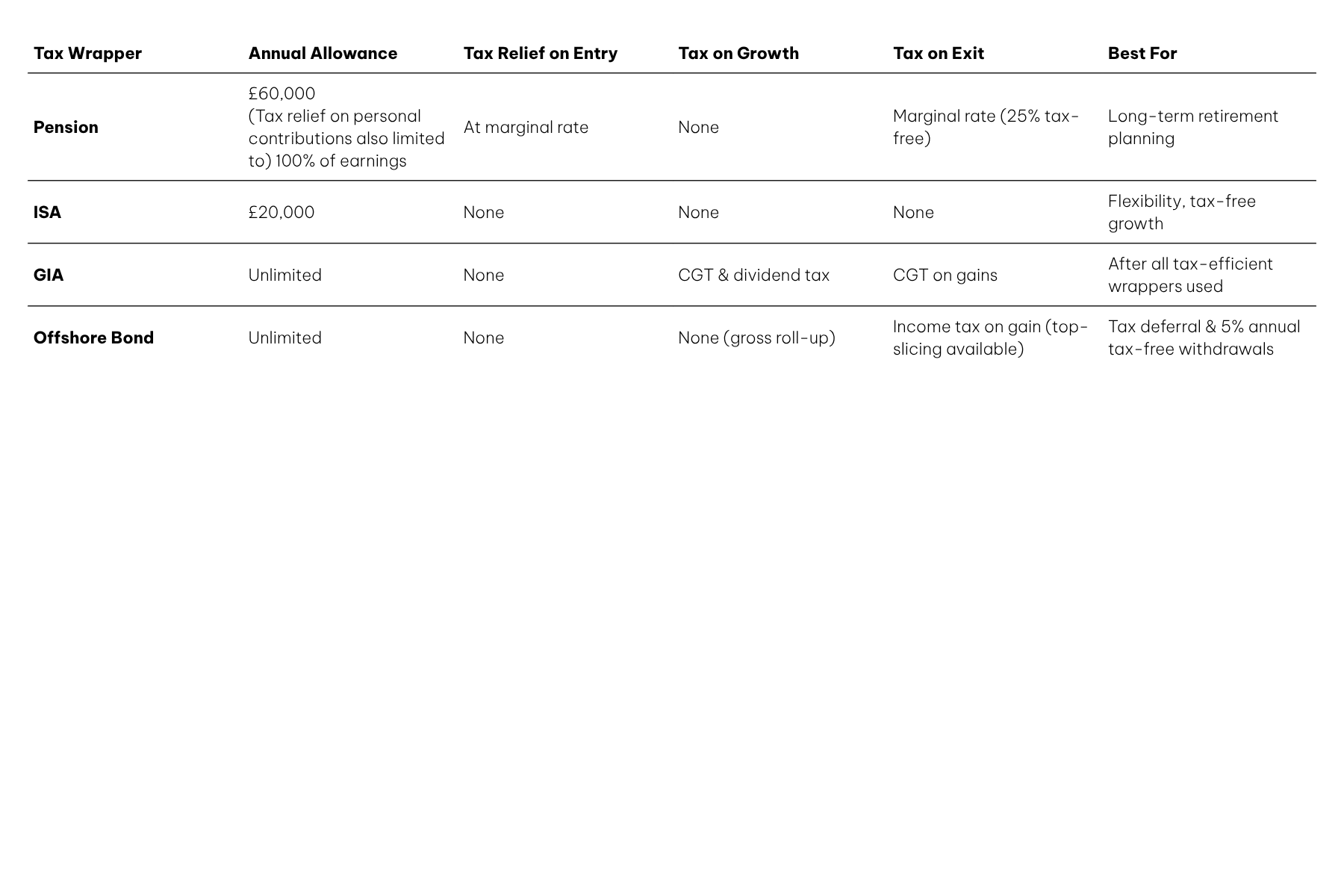
  • Use ISAs, Pensions, GIAs, Onshore/Offshore Bonds and Trusts together – not in isolation;
  • Capitalise on today’s tax allowances and reliefs to invest more tax-efficiently (like the pension annual allowance of up to £60,000, and the removal of the Lifetime Allowance charge);
  • Sequence withdrawals to keep taxable income in low bands during retirement (while using allowances efficiently);
  • Plan for the 2027 pension‑IHT reforms to mitigate double taxation;
  • Deploy advanced moves (phased crystallisation, ‘bed & ISA’, bond segmentation) in a compliant and documented manner.

Practical benefit: for many HNW families, re‑sequencing and multi‑wrapper orchestration reduces annual tax leakage by £10k–£30k+ versus a single‑wrapper drawdown, often without reducing disposable income.

The value of an investment with St. James’s Place will be directly linked to the performance of the funds selected and may fall as well as rise. You may get back less than the amount invested.

The levels and bases of taxation, and reliefs from taxation, can change at any time. The value of any tax relief depends on individual circumstances.

Trusts are not regulated by the Financial Conduct Authority.

The retirement tax landscape at a glance

This section lists the key allowances and rules you will base every decision on, both for saving towards your retirement as well as when eventually drawing down from those investments in retirement.

Key income thresholds and allowances
  • Personal Allowance: £12,570 p.a. per person
    • Protect it! When total income exceeds £100k, the Personal Allowance is tapered by £1 for every £2; until it reaches £0 at £125,140 – an effective 62% marginal band when national insurance is factored in on top. Use pension contributions and other forms of salary sacrifice to avoid this cliff.
    • In retirement, use phased withdrawals to keep income-taxable drawdown below £100k each year.
  • Income tax bands (England & NI for 2025/26):
    • 20% basic rate; 40% higher rate; 45% additional rate.
    • In retirement, these determine the marginal cost of pension/ GIA/ bond events: small changes in taxable income can move you across bands with significant tax consequences.
  • Dividend allowance: £500 per person
  • Savings allowance per person:
    • £1,000 (basic rate taxpayer), £500 (higher rate taxpayer), £0 (additional rate taxpayer).

Practical tip: Always start withdrawal planning by listing all taxable sources (rental income; realised gains; dividend income; taxable pension income). Tax bands and allowances should form the ‘frame’ for sequencing.

The levels and bases of taxation and reliefs from taxation can change at any time. Tax relief is dependent on individual circumstances.

Capital Gains Tax (CGT)
  • Annual Exempt Amount: £3,000 per person
    • Where possible use it every year – it cannot be carried forward.
  • Rates (recently increased):
    • 18% within the basic rate band;
    • 24% for gains above the basic rate band.
    • That tightening increases the potential value that can be gained from annual CGT harvesting and ‘bed & ISA’ tactics.

What is ‘bed & ISA’?

  1. Sell the investment outside your ISA
    • You sell your shares, funds, or ETFs held in a general investment account (GIA) or similar.
    • This sale may realise a capital gain — but you can use your annual CGT allowance (£3,000 in 2025/26) to minimise or eliminate any tax liability.
  2. Repurchase the same investment inside the ISA
    • Using the proceeds from the sale, you immediately repurchase the same investment within your ISA (or choose something else entirely).
    • Once inside the ISA, all future growth and dividends are tax-free.

Practical tip: Small, repeated sales in General Investment Accounts – timed to use Annual Exempt Amounts and avoid income band creep – materially beat large once‑off disposals taxed at the higher CGT rate.

The value of an investment with St. James’s Place will be directly linked to the performance of the funds selected and may fall as well as rise. You may get back less than the amount invested.

The levels and bases of taxation and reliefs from taxation can change at any time. Tax relief is dependent on individual circumstances.

Pension allowances and crystallisation rules

Relevant primarily for Defined Contribution (DC) pensions

  • Annual Allowance: £60,000 (Tax relief is also limited to a maximum of 100% of relevant earnings in the year).
  • Tapered Annual Allowance:
    • Occurs where threshold income exceeds £200,000 and adjusted income exceeds £260,000
    • Allowance reduces by £1 for every £2 of adjusted income above £260,000, down to a minimum of £10,000.
  • Money Purchase Annual Allowance (MPAA): £10,000
    • Triggered if you flexibly access your pension; avoid accidental triggers!
  • Tax‑free pension cash/ Lump Sum Allowance (LSA):
    • 25% of the total value of your pensions, capped at £268,275
  • Lump Sum & Death Benefit Allowance (LSDBA): £1,073,100

Practical tip: After the removal of the Lifetime Allowance charge, one blunt cap was replaced with allowances and lump sum death‑benefit ceilings. Accessing the tax-free portion of your pension requires careful planning, as phased crystallisation can be more efficient than taking lump sums.

The value of an investment with St. James’s Place will be directly linked to the performance of the funds selected and may fall as well as rise. You may get back less than the amount invested.

The levels and bases of taxation and reliefs from taxation can change at any time. Tax relief is dependent on individual circumstances.

Individual Savings Accounts (ISAs)
  • ISA allowance: £20,000 per person
  • Growth and income on assets held within the ISA are free of Capital Gains Tax and Income Tax.
  • Withdrawals are tax free and do not count as taxable income – one of the most powerful levers in retirement sequencing.

Practical tip: Use ISAs to hold growth and yield assets that would otherwise generate taxable income in General Investment Accounts (GIAs) or pensions.

The value of an investment with St. James’s Place will be directly linked to the performance of the funds selected and may fall as well as rise. You may get back less than the amount invested.

The favourable tax treatment of ISAs may not be maintained in the future and is subject to changes in legislation.

Onshore & offshore investment bonds
  • 5% cumulative allowance per policy year: withdrawals up to 5% of capital investment (accumulative) are tax‑deferred (not tax‑free).
  • On a later chargeable event, gains are treated as savings income. ‘Top‑slicing’ relief may reduce the effective tax.
  • Segmentation (issuing multiple small bond segments) enables partial encashments without crystallising the entire bond.

Practical tip: Bonds are sequencing tools – excellent for smoothing when you want to avoid lifting marginal taxable income.

The value of an investment with St. James’s Place will be directly linked to the performance of the funds selected and may fall as well as rise. You may get back less than the amount invested.

The levels and bases of taxation and reliefs from taxation can change at any time. Tax relief is dependent on individual circumstances.

If the withdrawals taken exceed the growth of the Bond, the capital will be eroded.

Trusts and their charges

Discretionary trusts carry entry charges, 10‑year periodic charges (up to 6%), and exit charges – all complex, but invaluable where control and estate planning are jointly required with income management.

Practical tip: Use bonds in trust to provide family controlled distributions while preserving beneficiary tax allowances.

Trusts are not regulated by the Financial Conduct Authority.

The strategic pivot: Pensions & IHT from April 2027

From 6 April 2027, most unspent pensions and many pension death benefits will be included within estates for IHT purposes.

This is a structural change: the once‑automatic IHT shelter provided by pensions will no longer be universally reliable.

Practical tip: Planning that relied on “leaving wealth in pensions forever” should be re‑examined. Sequencing may shift towards partial de‑risking and movement into ISAs/ trusts/ bonds where appropriate.

The value of an investment with St. James’s Place will be directly linked to the performance of the funds selected and may fall as well as rise. You may get back less than the amount invested.

The levels and bases of taxation and reliefs from taxation can change at any time. Tax relief is dependent on individual circumstances.

State Pension

Often overlooked in drawdown, the New State Pension applies to men born on or after 6 April 1951, and women born on or after 6 April 1953.

New State Pension (full rate): £230.25 per week, or about £12,005 per year.

Qualifying years:

  • Minimum 10 years of National Insurance (NI) contributions or credits needed to receive any pension.
  • Full rate requires 35 years of qualifying contributions or credits.

Protected payments: If your earnings record from before April 2016 would give you a higher payout under legacy rules, you may receive that as a “protected payment” on top of the current full rate.

Deferral increases entitlement by ~1% every 9 weeks (~5.8% p.a.).

The “triple lock” policy guarantees the New State Pension will rise by the larger of: inflation (CPI), average earnings growth, or 2.5%. In 2025–26, the increase was 4.1%, based on average earnings growth from May-July 2024.

The government has launched the third review of the State Pension age, to determine whether pension age should be automatically linked to life expectancy, possibly raising it even further. The current plan already includes raising the age to 67 by 2027-2028 and to 68 by 2044-2046.

Arrange your no-obligation retirement planning conversation with an expert wealth adviser

Select date and time

The orchestration mindset: Principles and objectives

How high net worth households could avoid the retirement tax trap.

The objective: Provide for your target net-of-tax lifestyle, sustainably, while minimising total lifetime tax (Income Tax + CGT + IHT) and preserving estate optionality.

The levels and bases of taxation and reliefs from taxation can change at any time. Tax relief is dependent on individual circumstances.

Principle 1. Start with spend, not pots

Build a 10- to 30-year plan, that models the net income required each year, stress tested for market downturns and longevity. This should account for irregular outgoings too, such as travel, contributing to school fees, property works, gifting, and care contingencies.

An expert financial adviser will use sophisticated cashflow modelling software that considers a variety of scenarios.

Principle 2. Segment capital by tax behaviour

Define which savings and investment pots are tax‑free, tax‑deferred, taxable and trust/ legacy oriented.

  • Tax-efficient: ISA
  • Tax-deferred: Pensions & Bonds
  • Taxable but manageable: GIA
  • Plus, those which are Trust-based to offer control & IHT shaping

The value of an investment with St. James’s Place will be directly linked to the performance of the funds selected and may fall as well as rise. You may get back less than the amount invested.

The levels and bases of taxation, and reliefs from taxation, can change at any time. The value of any tax relief depends on individual circumstances.

Principle 3. Sequence withdrawals to preserve low-rate bands
  • Use allowance‑rich pots first and leave taxable pots to years where other income is low;
  • Keep taxable income inside lower bands/allowances;
  • Harvest CGT each year without eroding core capital;
  • Maintain optionality for later-life and estate outcomes.

The levels and bases of taxation and reliefs from taxation can change at any time. Tax relief is dependent on individual circumstances.

Principle 4. Split ownership of assets

Share key allowances between spouses;

  • Personal Allowance
  • CGT Annual Exemptions
  • Dividend allowances

…to avoid higher tax bands as individuals. Although, any transfer must be on an outright and unconditional basis.

The levels and bases of taxation, and reliefs from taxation, can change at any time. The value of any tax relief depends on individual circumstances.

Principle 5. Preserve optionality

Avoid locking all capital into illiquid or high-penalty structures.

For example, pensions generally cannot be accessed until age 55 (rising to age 57 in 2028), and now face potential double taxation inside estates for IHT purposes.

The value of an investment with St. James’s Place will be directly linked to the performance of the funds selected and may fall as well as rise. You may get back less than the amount invested. 

The levels and bases of taxation, and reliefs from taxation, can change at any time. The value of any tax relief depends on individual circumstances.

Principle 6. Annual discipline
  • Harvest allowances;
  • Move assets to ISAs when appropriate;
  • Re-sequence if income profile changes;
  • Crystallise gains;
  • Reset bond segments; and
  • Top up a 2-3 year cash bucket so markets don’t dictate tax timing.

Tax optimisation is allocation and timing: Think allocation (ISA vs GIA vs pension) and timing (year to year sequencing). For HNW households, a modest shift in timing often outperforms a risky, concentrated tax shelter.

Total-return beats income-only: Preferring high yields traps you in dividend tax bands and concentration risk. A total-return approach with controlled sales from the optimal wrapper gives cleaner tax and risk management.

The value of an investment with St. James’s Place will be directly linked to the performance of the funds selected and may fall as well as rise. You may get back less than the amount invested.

The levels and bases of taxation, and reliefs from taxation, can change at any time. The value of any tax relief depends on individual circumstances.

Wrapper-by-wrapper: Deep dive and pro moves

What each wrapper really does, and how to use them. These are the rules, tactical moves, common pitfalls and pro plays for each wrapper.

Pensions – the orchestration core

Core rules:

  • Up to 25% tax-free, but limited by LSA £268,275 (protections aside). Remainder taxed at your marginal rates.
  • Contributions: Annual Allowance £60k, taper from £260k adjusted income (min £10k). MPAA £10k if flexibly accessed.
  • Flexi-access drawdown vs UFPLS: both create taxable income beyond the tax-free element; beware Emergency (Month-1) tax on first payments; reclaim via P55/ P53Z/ P50Z.

What they do well:

  • Tax relief on eligible contributions;
  • Tax‑deferred compounding;
  • Structured death benefits (beneficiary rules).

Key constraints:

  • Taxable on withdrawal beyond PCLS/ LSA;
  • MPAA may restrict future contributions once flexible access is used;
  • PCLS subject to LSA cap;
  • 2027 IHT inclusion looms.

Pro moves:

  • Earning between £100–£125k? Combine pension contributions and other salary sacrifice to reclaim or preserve Personal Allowance (effective 62% marginal relief zone).
  • Phased crystallisation:
    • Crystallise small portions each year to realise up to 25% tax‑free cash (within LSA) and keep taxable income inside target bands.
    • Preferred to large UFPLS where MPAA or rate spikes may occur.
  • PCLS-only first draws (where legally feasible) to avoid MPAA trigger in the short term. Document carefully.
  • Pension contributions as tax-band management: for those near the PA taper band, an extra pension contribution or Gift Aid top‑up can reduce adjusted net income, restoring PA or reducing marginal rates. (Use with caution and model liquidity.)

Common mistakes:

  • Emergency tax shock on first draw; plan cash and reclaim promptly.
  • Taking a large UFPLS early, triggering MPAA or pushing into 45% band. Can trigger HICBC/ benefit cliffs for under-retirement-age households.
  • Failing to segment crystallisations, losing LSA advantage or incurring unnecessary income spikes.

The value of an investment with St. James’s Place will be directly linked to the performance of the funds selected and may fall as well as rise. You may get back less than the amount invested.

The levels and bases of taxation and reliefs from taxation can change at any time. Tax relief is dependent on individual circumstances.

ISAs – the retirement workhorse

Core rules:

  • Withdrawals are tax-free and don’t count as income for tax-band tests – ideal for smoothing income and avoiding higher-rate thresholds.
  • £20,000 p.a. use-it-or-lose-it allowance per person.

What they do well:

  • Tax‑free withdrawals;
  • Tax-efficient growth and income on investments within ISAs;
  • Do not count as taxable income;
  • Ideal for smoothing tax bands.

Pro moves:

  • Prioritise funding ISAs in accumulation years after covering tax‑efficient pension contribution needs.
  • Family pooling: two spouses = £40k p.a.
  • Bed & ISA‘ GIA assets each year to migrate yield/ growth into a tax-free silo.
  • Park high-yield or fast-growing assets inside ISA to silence tax drag.

Common mistakes:

  • Putting low‑growth or defensive assets into ISAs, while leaving high‑growth investments in pensions/GIA – match asset to wrapper strategically.

The value of an investment with St. James’s Place will be directly linked to the performance of the funds selected and may fall as well as rise. You may get back less than the amount invested.

The levels and bases of taxation and reliefs from taxation can change at any time. Tax relief is dependent on individual circumstances.

GIAs – taxable but flexible

Purpose:

Flexible, taxable accounts used for CGT harvesting, dividend management and bridging between tax‑sheltered pots.

Pro moves:

  • Annual CGT harvesting: Crystallise up to £3,000 p.p. every year. Split across spouses for double allowance.
  • Bed & spouse’ transfers: Shift gains to the spouse with lower rates or unused allowances (watch out for 30‑day/ share-matching rules to avoid wash sales).
  • Prefer funds with accumulation units where dividend stuffing would otherwise create tax drag.
  • Target dividends within the £500 allowance; progressively migrate surplus yield into ISAs.

The value of an investment with St. James’s Place will be directly linked to the performance of the funds selected and may fall as well as rise. You may get back less than the amount invested.

The levels and bases of taxation and reliefs from taxation can change at any time. Tax relief is dependent on individual circumstances.

Onshore & offshore investment bonds – mastering deferral

Purpose:

  • Create tax-deferred cashflow via the 5% cumulative allowance – useful when you want spending power without lifting taxable income;
  • Top-slicing relief may mitigate a large one-off encashment if held many years;
  • Assignments (to spouse/trust) normally no gain/ no loss – can shift future gains to different taxpayers/structures;
  • Useful in early retirement or when deterministic withdrawals are required.

Design tips:

  • Segment policies at outset (e.g., 10–100 segments) to allow partial encashment without crystallising the whole bond;
  • Match bond type to tax profile: onshore has a basic-rate credit; offshore maximises gross roll-up but gains are fully income-taxed when they arise.

Pro moves:

  • Segment large bonds into multiple policies/ segments to allow partial surrenders;
  • Use top‑slicing relief modelling when planning a large encashment;
  • Assign to spouse or trust as part of intergenerational planning (assignment usually non‑taxable).

Common errors:

  • Treating 5% as tax-free (it’s deferred); always model the eventual chargeable event with future expected income bands;
  • Large future chargeable events can collide with high-rate bands or Personal Allowance taper.

The value of an investment with St. James’s Place will be directly linked to the performance of the funds selected and may fall as well as rise. You may get back less than the amount invested.

The levels and bases of taxation and reliefs from taxation can change at any time. Tax relief is dependent on individual circumstances.

If the withdrawals taken exceed the growth of the Bond, the capital will be eroded.

Trusts – for control

Purpose:

  • Control, protection, and IHT management for surplus capital;
  • Ring‑fencing and bespoke distributions;
  • Useful when a retiree wishes to provide controlled family income without inflating personal taxable income.

Key charges:

  • Entry: 20% on value above available Nil-Rate Band (NRB) for discretionary trusts;
  • Periodic (10-year) charge: up to 6% above NRB;
  • Exit charges apply on capital appointments.

Where Trusts meet retirement income:

  • House surplus capital in trust (often using bonds) to deliver trustee-controlled distributions while ring-fencing from your personal bands/ means-tests.
  • Time trustee distributions around beneficiaries’ allowances (e.g., adult children in low bands).

Pro move:

  • Use trusts for pension death benefit holding where legislation permits (but seek legal advice).

Trusts are not regulated by the Financial Conduct Authority.

Obtain a no-obligation review of your retirement planning opportunities

Meet with an expert

Withdrawal sequencing playbook

Concrete algorithms and templates you can run each year, according to your household’s objectives.

An expert financial adviser will revisit your sequencing strategies each year using cashflow modelling; taking into account market fluctuations, tax allowances and reliefs, and your changing tax bands.

Template A: Keep taxable income ≤ basic-rate band
  1. ISAs first (withdraw tax‑free cash to meet most of the need).
  2. Bond 5% allowances next (tax deferred).
  3. GIA disposals up to CGT Annual Exemption.
  4. Pension taxable draw only to fill remaining PA/ basic band headroom.

This maximises tax‑free draw, defers taxable draws until necessary, and avoids creeping into 40/ 45% income tax territory.

The value of an investment with St. James’s Place will be directly linked to the performance of the funds selected and may fall as well as rise. You may get back less than the amount invested.

The levels and bases of taxation and reliefs from taxation can change at any time. Tax relief is dependent on individual circumstances.

If the withdrawals taken exceed the growth of the Bond, the capital will be eroded.

Template B: Materially zero-tax year
  1. ISAs first;
  2. Bond 5% allowances next (tax deferred);
  3. Pension up to Personal Allowance only;
  4. Harvest CGT Annual Exemption in GIA, but avoid creating dividend income beyond the £500 allowance.

The value of an investment with St. James’s Place will be directly linked to the performance of the funds selected and may fall as well as rise. You may get back less than the amount invested.

The levels and bases of taxation and reliefs from taxation can change at any time. Tax relief is dependent on individual circumstances.

If the withdrawals taken exceed the growth of the Bond, the capital will be eroded.

Template C: Estate-centric pre-2027 reposition

Goal: Re‑weight pension‑heavy estates to reduce 2027 IHT exposure, without spiking marginal tax rates.

  1. Cash & ISA top ups;
  2. Phased crystallisation of smaller pension tranches to preserve PA and basic rate (not UFPLS lumps) to re-weight gradually from pension to ISA/ bond/ trust;
  3. GIA to fund bed & ISA over multiples years;
  4. Onshore bond assignment to trust where continuity of control is needed;
  5. Life cover in trust to insure IHT if immediate migration impossible.Note: model run‑rate impact carefully; acting too quickly may crystallise gains or incur large income tax;
  6. Maintain a cash buffer (2–3 years) to avoid forced selling in down markets, preserving tax control into 2027+.

Important: Your financial adviser should model the run‑rate impact carefully; acting too quickly may crystallise gains or incur large income tax.

Implementation algorithm (annual):

  1. Forecast the next 24 months of required net spending (base and irregular);
  2. Project all expected non‑portfolio income (state pension, rental, interest);
  3. Run the sequencing template to meet net spend, while keeping taxable income within parameters;
  4. Update ISA/ CGT harvest/ segment bond decisions for each tax year;
  5. Rebalance, migrate high‑return assets into ISAs if room, and reset bond segments.

The value of an investment with St. James’s Place will be directly linked to the performance of the funds selected and may fall as well as rise. You may get back less than the amount invested.

The levels and bases of taxation and reliefs from taxation can change at any time. Tax relief is dependent on individual circumstances.

Example case studies

These examples show the numerical effect of sequencing. All examples are simplified and illustrative, will not be suitable for everyone and do not constitute advice. An expert financial adviser can show more precise outcomes through cashflow modelling. Investment risk, sequencing, spend patterns and wrapper history will alter outcomes.

Example A: £80,000 lifestyle with minimal/ zero tax

Two spouses age 60 and 58 target £80,000 annual expenditure.

Asset breakdown:

  • Pensions: £900k (uncrystallised)
  • ISAs: £450k
  • GIAs: £500k
  • Offshore bond: £300k (10 segments)
  • Cash: £50k

Annual drawdown plan (year 1):

  • Withdraw £40,000 from ISAs (untaxed)
  • Withdraw £15,000 from offshore bond (5% allowance of £300k, tax deferred)
  • Each crystallise pension income equal to Personal Allowance of £12,570, using PCLS to fund the tax‑free portion (zero taxable income)
  • Realise £6,000 in gains from GIA (utilising annual exemption)
  • Earn dividends up to £1,000 (utilising allowances); migrating high-yield positions into ISAs over time.

Net result:

~£80k cash flow with negligible/ zero current-year income tax; no CGT; bond withdrawals deferred; pensions largely untouched and compounding.

Why it works:

Layering tax‑free and tax‑deferred withdrawals plus spouse allowances to avoid higher bands.

The value of an investment with St. James’s Place will be directly linked to the performance of the funds selected and may fall as well as rise. You may get back less than the amount invested.

The levels and bases of taxation and reliefs from taxation can change at any time. Tax relief is dependent on individual circumstances.

If the withdrawals taken exceed the growth of the Bond, the capital will be eroded.

Example B: £1m pension single drawdown (hidden leakage)

Single age 62 targets £80,000 gross from their pension alone.

Income tax:

  • First £12,570 at 0%;
  • Next slice at 20%;
  • Next slice at 40%
  • Typical tax bill £20k-£25k+ p.a. (exact amount depends on other income).

At this rate the pension could run out entirely in less than 20 years, assuming 5% net growth. A quarter of the pension pot is lost unnecessarily to income tax.

This is avoidable if part-funded from ISA/ bond/ GIA to cap marginal rates and preserve allowances.

The value of an investment with St. James’s Place will be directly linked to the performance of the funds selected and may fall as well as rise. You may get back less than the amount invested.

The levels and bases of taxation and reliefs from taxation can change at any time. Tax relief is dependent on individual circumstances.

If the withdrawals taken exceed the growth of the Bond, the capital will be eroded.

Example C: £1m portfolio capping lifetime tax exposure

Asset breakdown:

  • Pensions: £450k
  • ISAs: £250k
  • GIAs: £200k
  • Onshore bond: £100k

Strategy:

  • Years 1-5:
    • Withdraw from ISA (tax free);
    • Withdraw £5,000 from onshore bond each year (5% allowance of £100k, tax deferred)
    • Crystallise pension income equal to Personal Allowance of £12,570 each year
    • Harvest £3k CGT (within annual exemption) via GIA each year
  • Years 6-10:
    • Phase pension crystallisations to keep within basic rate band (20%), avoiding higher income tax rates where possible;
    • Make gifts from surplus income
  • Estate planning considerations:
    • Review pension nominations and possible bypass/ discretionary trust strategies for death benefits;
    • Consider writing a life cover plan in trust to meet an eventual IHT liability;
    • Gradually re-weight across wrappers.

Outcome:

Materially lower lifetime income tax and lower projected IHT exposure vs a pension-only draw.

The value of an investment with St. James’s Place will be directly linked to the performance of the funds selected and may fall as well as rise. You may get back less than the amount invested.

The levels and bases of taxation and reliefs from taxation can change at any time. Tax relief is dependent on individual circumstances.

If the withdrawals taken exceed the growth of the Bond, the capital will be eroded.

Example D: Significant one-off cash is needed (e.g. renovation)

Strategy:

  • Split across two or more tax years if possible;
  • Use ISA first;
  • Use bond encashment with top-slicing analysis (consider partial segment surrenders);
  • Pension: crystallise tranches to maximise PCLS and keep taxable slice within target bands;
  • GIA: realise gains up to CGT annual exemptions across both spouses.

The value of an investment with St. James’s Place will be directly linked to the performance of the funds selected and may fall as well as rise. You may get back less than the amount invested.

The levels and bases of taxation and reliefs from taxation can change at any time. Tax relief is dependent on individual circumstances.

Sound like a lot? Save time with our help

Book your first session, with no obligation

Advanced strategies for HNW households

Phased crystallisation with PCLS routing

Crystallising small pension tranches each year (taking tax‑free element where available, and only taxable as needed) reduces marginal tax spikes and preserves MPAA headroom. Document precisely for HMRC (dates, amounts).

The levels and bases of taxation and reliefs from taxation can change at any time. Tax relief is dependent on individual circumstances.

Bond segmentation and top-slicing

Issue multiple small bond segments (or purchase multiple small policies) to aid partial surrenders and preserve the 5% allowance across different policy anniversaries. When a larger encashment is required, estimate top‑slicing relief to reduce the effective tax rate.

The levels and bases of taxation and reliefs from taxation can change at any time. Tax relief is dependent on individual circumstances.

If the withdrawals taken exceed the growth of the Bond, the capital will be eroded.

Trustee distribution engineering

Trustees can smooth distributions to beneficiaries so the household uses beneficiaries’ PA and lower bands, preserving the settlor’s tax bands and potentially keeping the settlor’s taxable income low (subject to trust tax rules).

The levels and bases of taxation and reliefs from taxation can change at any time. Tax relief is dependent on individual circumstances.

A measured approach to lifetime gifting

Where wealth exceeds long‑term needs and IHT is a concern, measured regular gifting (within the normal expenditure out of income rules) can reduce estate exposure without incurring IHT charges. Keep precise records – to prove regularity to HMRC.

The levels and bases of taxation and reliefs from taxation can change at any time. Tax relief is dependent on individual circumstances.

Your tax trap checklist

Before your first withdrawal

  • Decide on draw type (phased PCLS and income vs UFPLS).
  • Avoid MPAA trigger unless unavoidable.
  • Confirm tax code to avoid Emergency (Month-1) tax shock.
  • Factor in other income (rent/dividends) to avoid band creep.
  • Coordinate spouse allowances (PA/ Dividend/ CGT).

Annual actions

  • Max usage of ISA allowance (£20k p.p.).
  • Harvest Capital Gains up to annual exemption (£3k p.p.).
  • Review dividend flows vs £500 p.p. allowance.
  • Rebalance risk and refill cash reserves.

Estate planning factors

  • Model 2027 pension-IHT exposure; review death-benefit nominations and potential trust structures.
  • Review Wills/ LPAs; keep pension expressions of wishes current.
  • Consider a life plan in trust to meet anticipated IHT liability.
  • Keep robust gift records (rules may change over time).

The value of an investment with St. James’s Place will be directly linked to the performance of the funds selected and may fall as well as rise. You may get back less than the amount invested.

The levels and bases of taxation and reliefs from taxation can change at any time. Tax relief is dependent on individual circumstances.

Will writing  and LPAs involve the referral to a service that is separate and distinct to those offered by St. James’s Place and are not regulated by the Financial Conduct Authority.

Integration with portfolio design

  • Total-return orientation with factor & geographic diversification;
  • Asset location (what sits where):
    • ISA: growth and high-yielding assets;
    • Pension: equities for long runway (tax-sheltered compounding);
    • GIA: tax-efficient funds/ETFs; prefer accumulation units only when they don’t create dividend tax drag beyond allowance;
    • Bond: lower-volatility sleeves to stabilise 5% withdrawals.
  • Rebalancing: set hard ranges; use flows to minimise CGT.
  • Costs: consolidate legacy plans where sensible; monitor ongoing charges and platform fees.

The value of an investment with St. James’s Place will be directly linked to the performance of the funds selected and may fall as well as rise. You may get back less than the amount invested.

The levels and bases of taxation and reliefs from taxation can change at any time. Tax relief is dependent on individual circumstances.

DIY vs Professionally Advised: The Drawdown Pay-Off

When entering retirement, the decisions you make around how, when, and from where you draw your income can add – or subtract – hundreds of thousands of pounds from your future wealth.

Retirees who ‘go it alone’ often underperform – not because of poor investment returns, but because of suboptimal drawdown sequencing and missed opportunities.

Apollo Private Wealth orchestrates every moving part: income sourcing, wrapper sequencing, tax harvesting, inflation protection, and estate planning – producing materially better financial outcomes over the long term.

The value of an investment with St. James’s Place will be directly linked to the performance of the funds selected and may fall as well as rise. You may get back less than the amount invested.

The four biggest DIY mistakes

Front-loading pensions

The problem:

Many DIY investors take the majority of income from pensions first, triggering unnecessary income tax at 40%+ and eroding future compounding potential.

Apollo’s advantage:

Apollo blends ISAs, GIAs, pensions, and bonds intelligently to minimise tax drag and maximise portfolio longevity.

The value of an investment with St. James’s Place will be directly linked to the performance of the funds selected and may fall as well as rise. You may get back less than the amount invested.

The levels and bases of taxation and reliefs from taxation can change at any time. Tax relief is dependent on individual circumstances.

Overlooking allowance stacking

The problem:

DIY retirees often underuse the CGT annual exemption, dividend allowance, and personal savings allowance – meaning they overpay HMRC every year.

Apollo’s advantage:

Apollo engineers an “allowance-maxing” waterfall that uses every relief available.

The levels and bases of taxation and reliefs from taxation can change at any time. Tax relief is dependent on individual circumstances.

Sequence-of-returns risk

The problem:

Withdrawing from growth assets after a market crash can lock in permanent losses – a risk many DIY retirees are blind to.

Apollo’s advantage:

Apollo applies buffer strategies and dynamically switches wrappers to protect growth assets until recovery.

The value of an investment with St. James’s Place will be directly linked to the performance of the funds selected and may fall as well as rise. You may get back less than the amount invested.

Underestimating longevity

The problem:

Many retirees overspend in the early years or fail to inflation-proof later spending, risking depletion. Assets are eroded quickly by unnecessary taxation, rather than continuing to compound.

Apollo’s advantage:

Apollo stress-tests against 100+ scenarios (inflation spikes, recessions, policy changes) to maintain sustainable drawdowns.

How we add value to every £1 withdrawn:

Tax Alpha → Saving £100,000s+ over decades

Behavioural Alpha → Avoid panic-selling, stick to plan

Sequencing Alpha → Reducing portfolio depletion risk

Legacy Alpha → Integrated estate strategy more wealth passed on to your beneficiaries

Would you like us to build your bespoke retirement strategy?

Obtain personalised recommendations with no obligation

The art of retirement drawdown isn’t picking a single ‘best’ pot. It’s orchestrating all of your pots – year by year – to spend well, stay in low bands, and keep options open as rules evolve (not least the 2027 pension-IHT shift). Get the sequencing right, and you keep more of your money – every year for the rest of your life.

SJP Approved 10/09/2025

Should you require more information or have particular questions, we invite you to contact us at your convenience.

Contact Us

Taking the leap: Financial clarity when leaving a high-earning role

Introduction

Whether you’re preparing to leave corporate life behind, scaling back, or stepping into something new – like launching your own business or becoming a partner – it’s crucial to have a clear view of your financial position before you make the move. Here are some of the key areas our team of advisers can help you navigate.

Workplace Pensions

If you’ve built a significant pension through your employer – particularly in a defined contribution or hybrid scheme – it’s worth reviewing your options before you leave:

  • How can you manage multiple pension pots? Many professionals now have multiple pensions scattered across employers, and it’s easy to lose track. Holistic planning will take these into account and seek to preserve any guarantees or employer perks.
  • Will your new business or partnership offer a pension? If not, a personal or SIPP* arrangement might be essential to keep building tax-efficient retirement savings.

*These types of pensions will not be suitable for everybody, as they require investors to be happy in making their own investment decisions and may incur costs not usually associated with other types of pension schemes. The value may fall as well as rise and you may get back less than the amount invested. Pension and tax rules can change at any time and will be dependent on individual circumstances.

Save time – receive a no-obligation financial plan, tailored to your circumstances.

Let’s get started

Equity Compensation: Options, RSUs, and Exit Events

If you’ve received share options, restricted stock units (RSUs), or performance-based shares during your tenure, now is the time to check the fine print:

  • Are you close to a vesting event? Leaving too early might result in forfeiting a significant portion of your equity.
  • What tax liabilities are triggered? Depending on timing, exercising or selling shares may result in income tax or capital gains tax charges.
  • Do you need liquidity planning? If a lump sum or windfall is expected, structuring that into your wider financial strategy could help reduce tax and unlock future opportunities.

We help senior professionals manage these transitions with an eye on both opportunity and downside risk.

Please note that advice with regard to exit strategy planning may involve the referral to a service that is separate and distinct to those offered by St. James’s Place.

The levels and bases of taxation and reliefs from taxation can change at any time. Tax relief is dependent on individual circumstances.

Personal Protection, Specialist Insurance and Private Medical Cover

Group benefits often disappear the moment you leave employment. That might include:

  • Life cover
  • Critical illness protection
  • Income protection
  • Private medical insurance

We help clients identify what’s worth replacing privately, what can be deferred, and how to get covered in the most cost-effective and tax-efficient way. This is especially important for new business owners, where income can be volatile.

Founding a business or becoming a partner?

Starting your own business or joining a partnership structure presents both risks and opportunities:

  • Are you losing employer pension contributions or matched benefits?
  • Do you have startup capital or need to keep cash liquid?
  • How will your income change – and how can your personal finances adjust?

From creating a director’s remuneration strategy to helping you reinvest a bonus or exit package tax-efficiently, we provide forward-thinking advice for professionals building their next chapter.

Please note that advice with regard to exit strategy planning may involve the referral to a service that is separate and distinct to those offered by St. James’s Place.

Planning for retirement, sooner or later

Whether this career change brings retirement forward – or just sharpens your focus – it’s essential to understand:

  • What will you spend? Retirement Living Standards can give you a national benchmark, but our team builds bespoke financial models so you know exactly what’s needed for your lifestyle.
  • How will you draw down income? We’ll help you weigh the pros and cons of drawdown, annuities, or phased lump sums – and time withdrawals to avoid unnecessary tax.
  • Do you still need protection or investment growth? Retirement doesn’t mean standing still. Let’s plan for the future you want.

A strategic wealth plan for professionals

When high-earners leave a role, the stakes are high: pensions, protection, share schemes, benefits, taxes, and future income are all in play.

Whether you’re stepping away to reset, relaunch or retire, our team is here to help you leave on your terms – with confidence and clarity. Let’s take stock of your position and map out what’s next – for your wealth, your goals, and your peace of mind.

Book a Career Change Financial MOT with an expert Private Wealth Adviser.

Start Your Conversation

The value of an investment with St. James’s Place will be directly linked to the performance of the funds you select and the value can therefore go down as well as up.  You may get back less than you invested.

The levels and bases of taxation, and reliefs from taxation, can change at any time. The value of any tax relief depends on individual circumstances.

SJP Approved 08/08/2025

Should you require more information or have particular questions, we invite you to contact us at your convenience.

Contact Us

Should you save more than £1 million in your pension?

Carving out the optimum strategy to save for your retirement, and mitigate tax on your earnings

The removal of the Pension Lifetime Allowance (LTA) charge in 2023 was a significant win for high earners, allowing unrestricted pension growth without an additional tax charge. However, the landscape changed again in October 2024 when it was announced that most unspent pensions will form part of an individual’s estate for Inheritance Tax (IHT) purposes from 6 April 2027.

This raises a crucial question: should you continue maximising pension contributions beyond £1 million, or are there better alternatives? This guide explores the tax benefits and trade-offs of pensions, compared to ISAs and Offshore Bonds.

  • What is the right combination of Pensions, ISAs and Offshore Bonds?
  • How should your strategy be tailored, depending on your level of income?
  • Could you be impacted by these decisions when funding your retirement?

The value of an investment with St. James’s Place will be directly linked to the performance of the funds selected and the value may fall as well as rise. You may get back less than the amount invested.

The levels and bases of taxation, and reliefs from taxation, can change at any time and are generally dependent on individual circumstances.

Save time – receive a no-obligation financial plan, tailored to your circumstances.

Let’s get started

Tax considerations for pensions

Tax relief

One of the biggest advantages of pension contributions is tax relief:

  • Basic rate taxpayers (20%): Receive 20% tax relief at source, on eligible contributions to a personal pension plan.
  • Higher rate taxpayers (40%): Can claim an additional 20% relief via HMRC.
  • Additional rate taxpayers (45%): Can claim an additional 25% relief via HMRC.
  • On earnings between £100,000 and £125,140, the effective rate of tax relief could be as high as 60% if the pension contributions restore your tapered personal allowance.

Example:

A £10,000 pension contribution effectively costs:

  • £8,000 for a basic rate taxpayer.
  • £6,000 for a higher rate taxpayer.
  • £5,500 for an additional rate taxpayer.
  • £4,000 when income between £100,000 and £125,140 is sacrificed to mitigate the tapered personal allowance.

The levels and bases of taxation, and reliefs from taxation, can change at any time. The value of any tax relief depends on individual circumstances.

Tax relief on personal contributions is limited to a maximum of 100% of relevant earnings in the tax year the contributions are paid. Contributions are also limited by the annual allowance. The standard annual allowance is £60,000.

Taxation on Pension Withdrawals

While pensions benefit from tax relief on contributions, withdrawals are subject to income tax:

  • 25% of withdrawals are tax-free, up to the Lump Sum Allowance (LSA) of £268,275.
  • The remaining 75% is taxed at the individual’s marginal rate (20%, 40%, or 45%).

One rule of thumb is that you ought to save into a pension if, when you retire, your marginal rate of income tax is similar to or lower than when you were working. That would typically result in a strong degree of tax efficiency, given the tax-free element up to the LSA.

However, the tax efficiency of pensions is diminished once the total value of one’s pensions exceeds £1,073,100. That’s because less than 25% of the total value is available as a tax-free withdrawal – for instance, the LSA applied to a pension valued at £3 million is equivalent to only 9% rather than 25%.

The levels and bases of taxation, and reliefs from taxation, can change at any time. The value of any tax relief depends on individual circumstances.

When the amount you can save into a pension is ‘tapered’

For high earners, the decision to make increased pension contributions may be taken away from you.

Pension tapering regulates the amount high-earning individuals can contribute to their pensions annually while still receiving the full benefits of tax relief.

For the 2025/26 tax year, the standard annual allowance is set at £60,000. Nonetheless, those earning a higher income may see their allowance reduced to as low as £10,000, based on their total yearly income.

Individuals with a ‘threshold income’ over £200,000 and an ‘adjusted income’ over £260,000 are subject to the tapered annual allowance. The reduction in allowance halts when ‘adjusted income’ exceeds £360,000, setting the annual allowance to a minimal £10,000 for pension savings that receive the full benefit of tax relief.

Broadly, ‘Threshold Income’ includes all taxable income received in the tax year, including rental income, bonuses, dividend, and other taxable benefits.  From this you deduct any personal pension contributions to personal pension scheme.

‘Adjusted income’ includes all taxable income plus any employer pension contributions and most personal contributions to an occupational pension scheme.

Individuals exceeding both a ‘threshold income’ of £200,000 and ‘adjusted income’ of £260,000 will experience a reduction in their annual allowance by £1 for every £2 exceeding £260,000 in adjusted income.

For instance, an ‘adjusted income’ of £280,000 reduces the annual allowance by £10,000, resulting in a £50,000 allowance instead of £60,000.

The value of an investment with St. James’s Place will be directly linked to the performance of the funds you select and the value can therefore go down as well as up.  You may get back less than you invested.

The levels and bases of taxation, and reliefs from taxation, can change at any time. The value of any tax relief depends on individual circumstances.

What are the alternatives?

Making ISA contributions

A Stocks and Shares ISA (or Investment ISA) is a tax-efficient way to invest, offering potential for higher growth than a Cash ISA. Any gains or income within an ISA are free from Capital Gains Tax and Income Tax. You can invest up to £20,000 per tax year (6 April – 5 April), and if you’re married, you might consider using your spouse’s allowance to maximise tax efficiency.

While you can withdraw funds anytime, Stocks and Shares ISAs are best suited for mid- to long-term investing, helping you ride out market fluctuations. While you won’t receive tax relief on your ISA contributions like you might with a pension, the withdrawals you make are entirely tax-free.

The value of an ISA with St. James’s Place will be directly linked to the performance of the funds selected and may fall as well as rise.  You may get back less than you invested. An investment in a Stocks and Shares ISA will not provide the same security of capital associated with a Cash ISA. 

The favourable tax treatment of ISAs may not be maintained in the future and is subject to changes in legislation.

Please note that Cash ISAs are not available through Apollo Private Wealth nor St. James’s Place.

Investing in a General Investment Account (GIA)

A General Investment Account (GIA) can be a useful addition to a retirement strategy, particularly for individuals who have already maximised their pension and ISA allowances. Unlike pensions, GIAs have no contribution limits, and unlike ISAs, they don’t offer tax-efficient growth or withdrawals. However, they provide full flexibility: you can invest as much as you like, access your funds at any time, and choose a wide range of investments.

While investment growth and income within a GIA are subject to capital gains tax (CGT) and dividend tax, you can make use of annual allowances – like the £3,000 CGT exemption and dividend allowance (currently £500) – to manage tax efficiently. In retirement planning, a GIA can complement other wrappers by offering liquidity, investment flexibility, and tax-planning opportunities, especially when used alongside ISAs and pensions to smooth income and reduce overall tax liabilities.

The value of an investment with St. James’s Place will be directly linked to the performance of the funds you select and the value can therefore go down as well as up.  You may get back less than you invested.

The levels and bases of taxation, and reliefs from taxation, can change at any time. The value of any tax relief depends on individual circumstances.

Offshore Bonds

An Offshore Bond is a tax-efficient investment vehicle that can be used as an alternative to or alongside a pension for retirement planning. It offers tax-deferred growth, meaning that any gains within the bond are not subject to UK tax while they remain invested. Instead, tax is only due when withdrawals are made, allowing your investments to grow more efficiently over time.

One of the key benefits of an Offshore Bond is its withdrawal flexibility. You can take up to 5% of your original investment each year, tax-deferred for 20 years, which can be particularly useful for supplementing retirement income without an immediate tax liability.

Offshore Bonds also provide estate planning advantages, as they can be structured under a trust to help mitigate Inheritance Tax. Additionally, they offer investment flexibility, giving access to a wide range of funds, including those not typically available within UK-based wrappers.

While pensions offer tax relief on eligible contributions, they come with restrictions on access, along with the Lump Sum Allowance (LSA) and income tax on withdrawals. An Offshore Bond, by contrast, provides greater control over when and how you draw your money, making it a valuable complement to retirement planning. However, tax treatment will depend on individual circumstances and may change, so professional advice is essential.

The value of an investment with St. James’s Place will be directly linked to the performance of the funds you select and the value can therefore go down as well as up.  You may get back less than you invested.

The levels and bases of taxation, and reliefs from taxation, can change at any time. The value of any tax relief depends on individual circumstances.


Next steps

For many, pensions will still be a core part of retirement planning due to the up-front tax relief. However, it may be time to consider diversifying into ISAs, Offshore Bonds, and other tax-efficient vehicles. The right approach depends on income level, retirement goals, and intergenerational wealth planning objectives.

Speak to an expert Private Wealth Adviser to assess your specific situation and develop a tailored strategy that maximises tax efficiency and protects your wealth for future generations.

The value of an investment with St. James’s Place will be directly linked to the performance of the funds you select and the value can therefore go down as well as up.  You may get back less than you invested.

The levels and bases of taxation, and reliefs from taxation, can change at any time. The value of any tax relief depends on individual circumstances.

SJP Approved 13/06/2025

Start planning now – invest later. Obtain a bespoke financial plan, tailored to your unique objectives.

Book A Conversation

Should you require more information or have particular questions, we invite you to contact us at your convenience.

Contact Us

High earner navigating pension limitations? Plan for increasing retirement costs.

Retirement costs now exceed £60,000

The cost of achieving a comfortable retirement lifestyle has climbed above £60,000 per year for the first time, according to the latest data from the Pensions and Lifetime Savings Association (PLSA) – a figure that should prompt serious reflection among high-earning professionals who face constraints in how they can save for the future.

The 2025 Retirement Living Standards reveal that maintaining a lifestyle in retirement that includes regular dining out, a well-maintained car, generous gifting, and a two-week Mediterranean holiday will now cost couples £60,600 annually, and £43,900 for single individuals – with no housing costs included.1

While these figures may not seem daunting to those earning six or seven figures, the real challenge lies in how such individuals can structure their wealth to generate that income without relying on traditional pensions, especially when the annual allowance is tapered – in some cases down to just £10,000 per year. Business owners and self-employed Partners, too, often overlook the need to save sufficiently for retirement in place of defined contribution pensions.

1 Pension and Lifetime Savings Association Retirement Living Standards Report, June 2025

High income can limit your options

For senior professionals whose total earnings exceed £260,000 (and adjusted income over £360,000), the tapered pension annual allowance significantly reduces the capacity for tax-advantaged pension contributions. As a result, many are either not contributing at all or relying solely on employer contributions, often deferring proactive retirement planning for another day.

However, the figures from the PLSA make clear: deferring action comes at a cost. To replicate a £60,000 per year income in retirement (before tax and assuming full state pension entitlement), individuals still need personal assets in the region of £900,000 per couple – more if retirement is early, spending is considerable, or if higher inflation persists.1

“These aren’t aspirational figures plucked from the air,” says Zoe Alexander of the PLSA. “They reflect the reality of the lifestyle many professionals want – whether they’ve planned for it or not.”

Beyond pensions: Alternative choices

With limited pension allowances, high earners must turn to alternative vehicles to build tax-efficient retirement savings for future income streams.

A couple’s combined £40,000 a year ISA allowances (£20,000 per adult) offer an initial opportunity. Offshore Bonds could also be used to potentially defer tax liabilities (currency movements may affect the value of investments).

For business owners, consider extracting value from the enterprise itself or building diversified portfolios via corporate structures.

An expert financial adviser can help recommend more sophisticated solutions depending upon your individual circumstances.

The silent risk: Lifestyle creep

The greatest risk facing many high-income households isn’t low income – it’s lifestyle inflation. Private school fees, multiple mortgages, and elevated living costs often leave little room for accumulating diversified wealth in investments outside of pensions. Yet the assumption that income will convert automatically to retirement security is, in many cases, misplaced.

According to Scottish Widows, 20% of defined contribution pension savers are still on track for poverty in retirement, and 3.5 million people will carry some housing costs well into their later years – averaging £10,600 annually.2

For those navigating restricted pension allowances, the challenge isn’t saving more, but saving differently. This means a deliberate, tax-aware approach to building non-pension income sources – whether through investment choices, business liquidity events, or structured drawdown strategies.

For many, engaging with an expert financial adviser earlier – before the taper bites or entrepreneurial liquidity arrives – can make the difference between a retirement that reflects years of work and one that feels compromised.

Bottom Line for High Earners: Your income buys you lifestyle today. It’s your wealth structure that will deliver it in retirement. The two are not the same – and time, as always, is your most valuable asset.

2 Scottish Widows’ Annual Retirement Report, May 2025

The value of an investment with St. James’s Place will be directly linked to the performance of the funds you select and the value can therefore go down as well as up. You may get back less than you invested.

The levels and bases of taxation, and reliefs from taxation, can change at any time. The value of any tax relief is dependent on individual circumstances.

SJP Approved 06/06/2025

Should you require more information or have particular questions, we invite you to contact us at your convenience.

Contact Us

Lifetime Allowance Changes: Carry Forward Pension Allowance up to £240,000

Introduction

In spring 2023, the government took pension savers by surprise, by announcing Lifetime Allowance changes, including the removal of the Lifetime Allowance (LTA) Charge. In the 2023/24 tax year, the tax charge for exceeding the Lifetime Allowance threshold of £1,073,100 (or a higher threshold where LTA protection applies) was effectively removed, and the Lifetime Allowance itself was abolished from 6 April 2024.

The Lifetime Allowance changes are particularly welcome news for those whose pensions were already above the value of the LTA, and who were nearing a benefit crystallisation event – including turning 75 years old, drawing down funds, purchasing an annuity, or indeed upon their death.

Many who stopped making contributions to their pension, will now be considering restarting contributions, including Carry Forward Pension Allowance. If you’ve been a member of a qualifying pension scheme, but haven’t used your annual allowances for 2025/26 (£60,000), 2024/25 (£60,000) or 2023/24 (£60,000), then together with this year’s annual allowance of £60,000, you could kickstart your pension by carrying forward these allowances to make a one-off contribution of up to £240,000.

However, it is critical to remember that from the 2027/28 tax year, pensions will be considered part of one’s Estate for Inheritance Tax (IHT) purposes.

How the Lifetime Allowance changes impact retirement planning and saving

Removing the LTA is designed to keep people in work, and attract people back to the workforce

In the UK, employers are required to contribute to their employees’ pensions at a minimum rate of 3% of qualifying earnings, subject to that employee contributing at least 5% of their qualifying earnings. Over time, it’s a considerable benefit of being employed in the workforce. Previously, as workers’ pension savings had approached the LTA, they were becoming disincentivised to continue working. Now, employees may work longer, and those who had already retired may consider re-joining the workforce, which could lead to greater macroeconomic performance in the UK economy, and potentially lessen the burden on the state to subsidise people’s retirements.

It’s also designed to further incentivise savers, to maximise their pensions before turning to other investment vehicles

While it’s important to note that the Lifetime Allowance Charge might be reintroduced in the future, its removal coincided with the government raising the annual allowance from £40,000 to £60,000 with effect from the 2023/24 tax year. The purpose of the LTA had been to cap the tax privileges of pensions. Additional rate taxpayers qualify for income tax relief on pension contributions at up to 45%. If an additional rate taxpayer had opted to use their entire annual allowance at the previous level of £40,000, they would have attracted up to £18,000 in tax relief. With the increased annual allowance of £60,000, they could gain up to £27,000 in tax relief; an additional £9,000 a year. This may incentivise a greater amount of pension saving, subject to the limits on tax relief on pension contributions, before savers turn to other investment vehicles such as ISAs. One option is to Carry Forward Pension Allowance.

The tapered annual allowance may still punish ‘late savers’

Despite the removal of the LTA charge benefitting many savers, the complex tapered annual allowance (TAA) remains for those with threshold income in excess of £200,000 and adjusted income in excess of £260,000 who will see their annual allowance (the maximum they may save into their pension that tax year without incurring a tax charge) taper down (to a minimum of £10,000) by £1, for every £2 their adjusted income exceeds £260,000.

It doesn’t leave out those who took out fixed lifetime allowance protection

In 2012, 2014 and 2016, some pension savers had the opportunity to take out fixed protection against the falling Lifetime Allowance. Each form of fixed protection allows the claimant to retain the level of Lifetime Allowance that was available immediately before the reduction (£1.8 million, £1.5 million and £1.25 million respectively). As a result, those claimants have not made pension contributions for several years in order to preserve their protection.

With these Lifetime Allowance changes, claimants are likely to want to restart pension contributions. This would previously have automatically resulted in the fixed protection being lost and would have resulted in their maximum tax-free cash dropping to the current level of £268,275.

However, HMRC has since confirmed that, as long as fixed protection had been registered before 15 March 2023, the protections cannot be lost. They can therefore restart their contributions without renouncing their bigger tax-free lump sums.

What next?

If over the last few years, you had elected to cease making pension contributions, as the value of your pension crept above £1 million; then the Lifetime Allowance changes may represent a unique and valuable opportunity to significantly boost your retirement savings.

Assuming, as a member of a registered pension scheme, you have not used any of your annual allowances from the tax years 2023/24, 2024/25, 2025/26, and the current tax year 2026/27, you could make contributions amounting to up to £240,000 before 6 April 2027 – provided you are not subject to tapering in any of those years, and you have earnings to support personal contributions in the current tax year. This is via Carry Forward Pension Allowance.

The net cost of each £1,000 contribution could be as little as £550.

That’s because you’ll receive automatic basic rate tax relief of 20%, and an additional rate taxpayer may claim a further 25% tax relief via their tax return.

And, because of the gradual loss of your personal allowance for income between £100,000 and £125,140 resulting in an effective 60% tax trap, you could gain even more if restoring your full personal allowance.

However, it is critical to remember that from the 2027/28 tax year, pensions will be considered part of one’s Estate for Inheritance Tax (IHT) purposes.

There are a number of factors that may cause different results in individual circumstances, which is why it’s important to seek professional advice from an expert adviser, to help you maximise the amount you can contribute to your pension and benefit from tax relief on this year.

The value of an investment with St. James’s Place will be directly linked to the performance of the funds selected and may fall as well as rise. You may get back less than the amount invested.

The levels and bases of taxation, and reliefs from taxation, can change at any time.

The value of any tax relief is dependent on individual circumstances.

Any tax relief over the basic rate is claimed via your annual tax return.

SJP Approved 03/06/2025

Should you require more information or have particular questions, we invite you to contact us at your convenience.

Contact Us

Investment Management

Introduction

By grasping your objectives, investment timeframe, and tolerance for risk, we are equipped to tailor an investment strategy that aligns with your needs.

You can take comfort in the fact that our choices are based on thorough analysis. We aim to build a diversified portfolio for you, integrating an appropriate combination of asset types from various geographical areas through a variety of investment approaches.

This will be carefully adjusted to resonate with your principles, allowing you to concentrate on life’s priorities, knowing that we are diligently applying our investment skills to oversee and safeguard your assets with the greatest diligence.

The value of an investment with St. James’s Place will be directly linked to the performance of the funds you select and the value can therefore go down as well as up. You may get back less than you invested.

Curation

Our approach involves confidently steering through the markets for you, adopting a comprehensive perspective on investment opportunities to capitalise on potential gains.

St. James’s Place extensive knowledge of the market and strategic connections enable them to identify, assess, and offer clients attractive and varied investment opportunities.

Our approach to financial and investment management is based on your unique goals. To understand your goals and provide peace of mind throughout your life, we will work with you in three different ways: 

PLAN: When aiming towards longer-term financial goals, such as a comfortable retirement, you’ll need a detailed plan. We’ll work together to agree a plan that works for you. 

DESIGN: After considering your time horizon and attitude to risk, we can design an investment portfolio to match the plan. 

REVIEW: Market conditions change. So can personal circumstances. We’ll keep a close eye on your investments to help them stay on track. 

We hold the conviction that long-term investment, spanning decades rather than days, is the most effective strategy to fulfill your life’s goals.

Need a bespoke financial plan crafted specifically for your unique requirements?

Book a Demo

Fund selection

From the world’s best fund managers

Top-tier investment expertise isn’t confined to a single company or place. In order to optimise the management of your investments, we tap into the abilities of some of the most skilled fund managers globally.

As a Senior Partner Practice of St. James’s Place, our clients benefit from economies of scale and the best-in-class fund managers and products.

Controlled by the St. James’s Place Investment Committee

St. James’s Place engages external supervision in handling your investments. This worldwide network of fund managers and essential strategic partners minimises bias and guarantees diverse investment perspectives. We also have a wide range of comprehensive expertise within our practice.

You can be confident that we will pinpoint the most fitting investment strategies for you, supported by data and analytics. Trust us to balance opportunity and risk, with our sights set on achieving your long-term objectives.

The Investment Committee features independent participants who contribute experience and specialised insight, affirming the integrity of their process and decisions.

St. James’s Place Investment Management Approach

Our Value Assessment Statement examines the benefits you gain from our services, based on the investment management approach.

It outlines the ways we offer value, describes the measures we’ve implemented in the last year, and identifies areas for further improvement.

This initiative underscores our dedication to presenting transparent and equitable details regarding your investments with us.

SJP recognises that no single investment house has a monopoly on investment expertise, so don’t employ in-house investment managers. Instead, SJP carefully select a number of external managers to manage the range of funds. 

This has a number of benefits: 
  • It gives us the freedom to choose from some of the best managers in the world 
  • It means SJP can change a manager at short notice if the need arises, without inconvenience to you 
  • It gives you a real opportunity to diversify your investments by spreading your money across funds managed by different managers with different styles. 

Key to the distinctive approach is the ability to identify and select fund managers from around the world. Contracting out fund management gives greater freedom and the flexibility to source investment expertise on a global scale, giving you diversification and investment expertise that is beyond the scope of many wealth advisers. 

The value of an investment with  St. James’s  Place will be directly linked to the performance of the funds you select, and the value can therefore go down as well as up. You may get back less than you invested. 

Should you require more information or have particular questions, we invite you to contact us at your convenience.

Contact Us

Access to Specialist Banking and Lending Services

Introduction

As part of our wealth management offering, via SJP’s Private Client team, we can refer you to a range of solutions that have been developed specifically for our clients with more specialist banking and lending requirements. Your adviser will work with SJP’s Private Client team to understand both your current and future needs as well as your servicing preferences, in order to create a solution to your individual circumstances.

Over the years, St. James’s Place has built strong relationships with a panel of carefully selected private banks. The panel comprises boutique banks, offering a range of different specialisms, styles and service levels. We can help you choose the bank that best meets your needs and facilitate the introduction to the bank selected, saving you the hassle and time of searching through a multitude of options.

Need a bespoke financial plan crafted specifically for your unique requirements?

Book a Demo

Services offered

Cash management

By using SJP’s Cash Deposit Service, powered by Flagstone, we can help spread your cash savings to capitalise on market-leading interest rates, and maximise FSCS protection across multiple institutions.

Please note that this is a referral service and the services provided are separate and distinct to those offered by St. James’s Place.

Mortgages

Our advisers can act like a ‘broker’, securing off-market products, and finding lending solutions for your residential or buy-to-let purchases, and provide access to solutions for commercial purchases, as part of your broader financial plan.

Your home or other property may be repossessed if you do not keep up repayments on your mortgage.

Commercial and some buy-to-let mortgages are not regulated by the Financial Conduct Authority.

All enquiries for commercial mortgages will be referred to a service that is separate and distinct to those offered by St. James’s Place.

Investment-backed lending

If you require short-term financing, you may be able to use eligible St. James’s Place and Rowan Dartington investments as security.

St. James’s Place and Rowan Dartington work with Metro Bank to make this short-term lending facility available to you, secured against your investment portfolio.

If the value of the investment falls in relation to the agreed loan facility, the loan may need to be repaid in full. Metro Bank will take a charge over your investments and you will be unable to make any withdrawals from your charged investments without prior approval from the bank. Rates and charges will apply. Please get in touch for full details.

Please note that these services are separate and distinct to those offered by St. James’s Place.

Foreign currency exchange

Whether you’re buying foreign property, sending money to loved ones or moving overseas, we are able to provide access to a currency exchange service provided by TorFX, offering foreign exchange and international payment services.

Please note that this is a referral service and the services provided are separate and distinct to those offered by St. James’s Place.

“Many wealthy clients have complex borrowing needs, which are not well-served by high street banks. We can introduce individually tailored solutions.”

How could a private banking service benefit you?

Through a panel of private banks, we can provide access to a full private banking service offering, via SJP’s Private Client team, including current accounts, deposit accounts, payment services, trustee and executor accounts and foreign currency accounts. More importantly, you will experience a bespoke service, with dedicated bankers and their teams looking after your day-to-day requirements.

The private banks on the panel specialise in truly understanding your individual requirements to ensure you receive a personal and seamless service. Many wealthy clients have complex borrowing needs, which are not well-served by high street banks. Alongside your adviser, our SJP’s Private Client team can review your circumstances and requirements, assess which private bank(s) might best meet these, and seek individually tailored solutions allowing you to choose the option most attractive to you.

These services are available to clients meeting the banks’ criteria, these usually being minimum personal net wealth of £3m to £5m+ and/or annual income in excess of £300,000.

Should you require more information or have particular questions, we invite you to contact us at your convenience.

Contact Us

Estate and Inheritance Tax (IHT) Planning

Introduction

Looking ahead towards estate planning and mitigating inheritance tax (IHT) is key to managing and protecting your wealth, for you and your family. A large proportion of your wealth might be subject to inheritance tax when you die, at up to 40%. This includes assets such as properties, investments, and even old family heirlooms. From April 2027, unspent pensions will also form part of your estate for inheritance tax purposes; requiring a change in approach to estate planning.

Careful IHT planning is all about passing as much of your estate as possible to who you want to receive it, and reducing the inheritance tax liability payable. It’s also about maintaining flexibility and control over any arrangements that are made.

ESTATE PLANNING

The levels and bases of taxation, and reliefs from taxation, can change at any time.  The value of any tax relief is dependent on individual circumstances.

Will writing involves the referral to a service that is separate and distinct to those offered by St. James’s Place. Wills, along with Trusts are not regulated by the Financial Conduct Authority.

Background to inheritance tax (IHT)

The majority of your assets will be subject to IHT if, when you die, the value of those assets exceeds the standard nil-rate band which currently stands at £325,000. If your spouse dies before you without fully using their nil-rate band, any unused percentage can be carried forward to use when you die, subject to a claim being made by your executors within two years of your death.

With the family home often making up a large percentage of an estate, the government has introduced an additional nil-rate band on top of the £325,000, known as the ‘residence nil-rate band’. The current residence nil-rate band is up to £175,000.

This means that if you give away a home that you have lived in as your main home to your children (including adopted, foster or stepchildren) or grandchildren, they won’t have to pay IHT on the first £500,000 (£325,000 nil rate band + £175,000 residence nil-rate band).

If you are a married couple or in a civil partnership then you can combine both your nil-rate bands, meaning that the first £1 million of your assets, including your property, are free from IHT.

The value of all assets in excess of the nil-rate band and the residence nil-rate band will be taxed at up to 40% – paid for by your estate.

However, when the value of an estate exceeds £2 million, the residence nil-rate band is tapered, by £1 for every £2 above this level. You need to consider the value of the estate on each respective death.

The levels and bases of taxation and reliefs from taxation can change at any time. Tax relief is generally dependent on individual circumstances.

Need a bespoke financial plan crafted specifically for your unique requirements?

Book a Demo

Key tax-efficient solutions

Gifting assets

Should you be worried about how Inheritance Tax (IHT) could impact your estate and the wealth you wish to transfer, incorporating a Gift Plan into your wealth management approach might serve as an excellent solution. Our Gift Plan combines an investment bond (either onshore or offshore), with either an absolute or discretionary trust which is controlled by you and benefits those who you want it to.

Assets held within a discretionary trust do not become part of the beneficiary’s estate as long as they remain in the Trust. This plan is versatile, serving various purposes including maximizing exemptions from Inheritance Tax (IHT) or covering educational expenses.

The value of an investment with St. James’s Place will be directly linked to the performance of the funds you select and the value can therefore go down as well as up. You may get back less than you invested.

The levels and bases of taxation and reliefs from taxation can change at any time. The value of any tax relief depends on individual circumstances.

Trusts are not regulated by the Financial Conduct Authority.

Trusts

A Trust ensures that the correct funds are delivered to the right people at the appropriate moment, offering flexibility, innovation, and control that may not be possible with a Will alone.

It’s understandable to assume that estate planning primarily concerns the distribution of your assets posthumously. However, its scope extends beyond that, encompassing the current organisation of your wealth to enhance its utility, whether for protecting your loved ones or reducing tax implications.

Trusts are not regulated by the Financial Conduct Authority.

Life Cover Plan written into Trust

Over and above gifting sufficient assets to reduce your gross estate value to within £2 million, if you have excess income during your retirement, it might make sense to consider a life cover plan written in trust, to meet the eventual IHT liability, which could be as high as £400,000 on an estate valued at £2 million.

It is important that the life cover plan is written into trust, and that the premiums are paid using excess income, rather than from assets – otherwise, the premiums paid could be treated as a chargeable lifetime transfer (CLT).

Note that probate is required to release estate assets, whereas IHT needs to be paid before probate is granted. By placing a life policy in trust the sum assured will be paid into trust and can be used to meet some/all of the IHT liability. This means the executors will not necessarily need to realise the sale of other assets, such as property and investments, in order to meet the said liability – particularly advantageous if markets are underperforming at the point in time that the sale of assets otherwise needs to be realised.

The levels and bases of taxation and reliefs from taxation can change at any time. The value of any tax relief depends on individual circumstances.

Trusts are not regulated by the Financial Conduct Authority.

Business Relief

Typically, a trading business is eligible for 100% Business Relief from Inheritance Tax (IHT), allowing it to be transferred to heirs without incurring IHT upon the owner’s demise.

The levels and bases of taxation and reliefs from taxation can change at any time. The value of any tax relief depends on individual circumstances.

An example inheritance tax calculation

A husband died five years ago, having left all of his assets to his wife. He had not made any gifts in his lifetime. His estate was worth below £2 million.

When his wife dies, her estate includes a property worth £1.2 million, and various other assets such as savings amounting to £1.1 million.

If the couple were able to reduce the gross value of their estate to under £2 million (for example by gifting sufficient assets more than seven years before their deaths), thus restoring their full residence nil-rate bands.

BeforeAfter
Gross estate value£2,300,000£2,000,000
Less 2x nil-rate band-£650,000-£650,000
Less 2x residence NRB-£350,000 – £150,000
(Tapering: £300,000/2 = £150,000)
= -£200,000 tapered RNRB
-£350,000
Net estate£1,450,000£1,000,000
IHT due at 40%£580,000£400,000

Gifts that are not covered by any of the available exemptions may be taxable where death occurs within seven years if they exceed the available nil-rate band. Inheritance Tax (IHT) payable on those failed gifts may be reduced in the form of taper relief. Taper relief operates by reducing the amount of tax payable not the amount of the gift.

The amount of the taper relief depends on the length of time by which the deceased survived the transfer. If death occurs within 3 years of the gift, then no tapering applies. From year 3 onwards, the tax charge is reduced by 20% for each complete year after the gift is made.

The levels and bases of taxation and reliefs from taxation can change at any time. The value of any tax relief depends on individual circumstances.

Need a bespoke financial plan crafted specifically for your unique requirements?

Book a Demo
Privacy Overview

This website uses cookies so that we can provide you with the best user experience possible. Cookie information is stored in your browser and performs functions such as recognising you when you return to our website and helping our team to understand which sections of the website you find most interesting and useful.

Close Search

Email To Myself

Close

By submitting your details you give consent for Apollo Private Wealth to reach out for marketing purposes. You may unsubscribe at any time.

Apollo Private Wealth together with St. James's Place Wealth Management plc are the data controllers of any personal data you provide to us. For further information on our uses of your personal data, please see our Privacy Policy or the St. James's Place Privacy Policy.