Landlords: Mitigating Inheritance Tax When Passing On Property And Personal Assets

Introduction

Inheritance Tax (IHT) can be tricky to understand, but its impact can mean less money ends up in the pockets of your loved ones.

Landlords face additional considerations and potential barriers when it comes to Inheritance Tax (IHT) planning. Whether you opt to retain, sell, or gift a property, tax liabilities can arise for buy-to-let landlords. Amidst various choices, it’s easy to overlook other methods to diminish the size of your overall estate as well.

The levels and bases of taxation and reliefs from taxation can change at any time. The value of any tax relief depends on individual circumstances.

At a glance

  • You can reduce Inheritance Tax (IHT) or Capital Gains Tax (CGT) liabilities on your properties with careful planning and expert advice.
  • Starting your estate planning in your 60s and 70s can make a real difference to your IHT or CGT tax bills, and mean you leave more to your loved ones.
  • Bespoke trust solutions may help you reduce your estate for IHT purposes while retaining some form of access to your investments.

Trusts are not regulated by the Financial Conduct Authority.

Simplifying a daunting process

What will be counted as part of my estate?

Upon your death, all your possessions, including savings, assets like property, ISAs, and shares, constitute your estate. Inheritance Tax is typically charged at 40% on assets outside of the Nil-Rate band of £325,000 per individual. When passing on your primary residence to your direct descendants, you may also benefit from the Residence Nil-Rate Band amounting to a further £175,000.

It’s evident how a property investor accumulating holdings over several years could surpass £2 million or more. Once your estate exceeds £2 million, some tax allowances are reduced or become unavailable for Inheritance Tax (IHT) purposes.

The levels and bases of taxation and reliefs from taxation can change at any time. The value of any tax relief depends on individual circumstances.

How much does my estate need to be worth to be liable for IHT?

The first step in reducing your Inheritance Tax (IHT) liability is understanding how it operates. Everyone is entitled to a Nil Rate Band (NRB) threshold of £325,000. This threshold allows you to leave assets to ‘non-exempt’ beneficiaries, such as children, grandchildren, or other family members, without triggering IHT. However, if you leave more than this amount to non-exempt beneficiaries, IHT becomes payable on the excess.

If you pass away leaving your entire estate to a UK domiciled spouse or civil partner, it allows them to use any unused percentage of your NRB threshold upon their death. Consequently, they can leave assets up to 100% of the value of two unused NRB thresholds (currently £650,000) to non-exempt beneficiaries without incurring IHT.

Furthermore, if you leave your home to children or grandchildren, you may be eligible for an additional tax-free threshold called the Residence Nil Rate Band (RNRB), currently set at £175,000 for individuals. This threshold doubles to £350,000 upon the second death for married couples or civil partners who haven’t used any percentage of the RNRB on the first death.

Moreover, if you donate 10% or more of the net value of your estate to charity upon death, the rate of IHT applied to gifts exceeding the NRB to non-exempt beneficiaries is reduced from 40% to 36%.

The levels and bases of taxation and reliefs from taxation can change at any time. The value of any tax relief depends on individual circumstances.

What will happen if I decide to keep a buy-to-let property, and pass it on?

If you pass away owning property, your beneficiaries will inherit the property without any historical capital gain, but it will still be considered part of your estate for Inheritance Tax (IHT) purposes. IHT is levied at a rate of 40%, so if you die with a property valued at £400,000, and the nil rate band has already been utilised, your beneficiaries may need to pay £160,000 to HMRC.

However, IHT becomes a more significant concern if the estate exceeds the nil rate band. In such cases, if you only own one or two buy-to-let properties along with few other assets, retaining the property may be advantageous.

The levels and bases of taxation and reliefs from taxation can change at any time and are dependent on individual circumstances.

What will happen if I decide to sell any of my buy-to-let properties?

If you sell a property that you’ve never lived in, it becomes subject to Capital Gains Tax (CGT) if its current value exceeds the purchase price. CGT is imposed on the gain or profit you’ve realised. For residential property, CGT rates are 18% for basic rate taxpayers and 24% for higher rate taxpayers. The rate of CGT payable will depend on your other income.

However, there are avenues to potentially reduce your CGT liability. If the property was your main residence at one point, you may qualify for Main Residence Relief, which can lessen the amount of tax owed. Additionally, any expenditure on renovations can be deducted from the sale price to calculate your net gain. Selling a property offers the opportunity to reinvest the proceeds, potentially leading to further growth in a more tax-efficient environment, including one with reduced Inheritance Tax (IHT) implications.

It’s crucial to note that if you sell or gift a property just before your death, both CGT and IHT may apply, affecting you and your family financially.

While investing sale profits into an ISA can offer tax benefits concerning income and capital gains tax, they are still considered part of your estate for IHT purposes upon your death. Pension funds, however, are generally excluded from your estate.

Ultimately, the outcome will hinge on your individual circumstances, such as age, health, and other factors. These decisions are among the most significant financial choices you’ll make in your lifetime, underscoring the importance of consulting a financial adviser to explore your options thoroughly.

The value of an investment with SJP will be directly linked to the performance of the funds you select and the value can therefore go down as well as up. You may get back less than you invested.

The levels and bases of taxation and reliefs from taxation can change at any time and are dependent on individual circumstances.

Can I make gifts to mitigate IHT?

You have several options to gift money without it being included in the final calculation of your estate for Inheritance Tax (IHT) purposes.

Firstly, you can give away up to £3,000 each tax year, known as your ‘annual exemption’, in addition to the ‘small gifts exemption’ for making any number of small gifts up to £250 per person, to any number of individuals as long as you have not used another allowance on the same person. These gifts are exempt from IHT.

Furthermore, the £3,000 annual exemption can be carried forward for one tax year, allowing you to give away £6,000 in a single tax year if you made no gifts in the previous year.

Gifts exceeding the £3,000 allowance are still exempt from IHT as long as you survive for seven years after making the gift. However, gifts made within the seven years preceding your death will be added back into your estate, potentially using up some or all of your nil rate band. If the gift surpasses the nil rate band, some tax may be due. Nonetheless, if you survive the gift by at least three years, the amount of tax payable decreases on a sliding scale, meaning the longer you live, the less tax is owed. This approach not only supports your family during your lifetime but also reduces your IHT liability afterward.

Additionally, if one of your children or grandchildren is getting married, each parent or grandparent can gift up to £5,000 to the child or £2,500 to the grandchild. This gesture can provide a new marriage or civil partnership with a financial boost, aligning with your intentions.

Finally, gifts made regularly from surplus income are also exempt from tax, provided you can demonstrate that they do not impact your usual standard of living.

The levels and bases of taxation and reliefs from taxation can change at any time. The value of any tax relief depends on individual circumstances.

Can I gift my properties during my lifetime?

Many landlords consider gifting property during their lifetime as a strategy to reduce the size of their estate for Inheritance Tax (IHT) purposes.

If you don’t rely on the rental income from the property, an outright gift might be an option. This is known as a Potentially Exempt Transfer (PET). If you survive for seven years after making the gift, there will be no IHT to pay. However, once the property is gifted, you lose control and flexibility with no possibility of reversing the decision.

Gifting a property constitutes disposing of an asset, potentially triggering Capital Gains Tax (CGT) if the property has appreciated in value.

Alternatively, you could gift the property into a Discretionary Trust, offering more control. By transferring the property to such a trust, the transfer is a chargeable transfer for IHT, but you might qualify for a relief allowing you to defer CGT payment until the trustees sell the property. If you survive for seven years after making the gift, the property will not be considered part of your estate, resulting in no 40% IHT liability, similar to a Potentially Exempt Transfer.

Considering this option requires guidance from a financial adviser.

It’s important to note that when gifting any asset, you must survive for seven years. Failure to do so means the gift reverts to your estate, potentially leading to double taxation – CGT when making the gift and IHT upon death.

My properties are part of my retirement income – what happens if I give them away?

If you’re deriving income from your rental properties, or intend to do so in retirement, the situation becomes more intricate. If you gift the entire property – whether to your children or into a trust – while continuing to receive an income, it’s considered a Gift with Reservation. In this case, the property remains part of your estate despite the transfer.

However, there may be an option to gift only a portion of the property into a specialised trust, retaining the right to receive income without violating the gift with reservation rules. Seeking advice from a solicitor to determine whether a trust is suitable for your circumstances will ensure your financial plans align with your long-term goals.

There’s a limit of £325,000 that can be gifted into a lifetime trust within any consecutive seven-year period. Exceeding this threshold incurs a 20% IHT on the surplus. Additionally, if the property being gifted to the trust has appreciated in value since acquisition, you may also be subject to CGT.

Gifting and trusts can be highly advantageous and tax-efficient strategies for legacy planning. Trusts, in particular, offer versatility, but it’s essential to seek expert guidance and discuss your options with a financial adviser or solicitor before establishing a trust.

The levels and bases of taxation and reliefs from taxation can change at any time and are dependent on individual circumstances.

Trusts are not regulated by the Financial Conduct Authority.

The value of financial advice and IHT planning

Inheritance Tax (IHT) is a highly intricate area, and very few individuals are familiar with every rule, exemption, and allowance, or how to leverage them effectively.

Given that your assets may fluctuate in value over time, regular reviews of your financial situation are crucial as they will impact your IHT liability. Additionally, it’s advisable to consult with a financial adviser whenever you engage in property transactions or contemplate doing so. They can offer guidance to ensure that your choices are tax-efficient for both you and your beneficiaries.

Taking proactive steps in Inheritance Tax planning while you’re in good health enables you to create a more secure financial future for those you care about.

SJP Approved 21/05/2025

Should you require more information or have particular questions, we invite you to contact us at your convenience.

Contact Us

Using a Life Cover Insurance Plan Written in Trust to Meet an Inheritance Tax (IHT) Liability

Introduction

Inheritance Tax (IHT) can be tricky to understand, but its impact can mean less money ends up in the pockets of your loved ones. This is even more so the case as pensions will form part of your estate from 2027. A solution could be to write a Life Cover Insurance Plan into Trust.

Tax allowances such as the residence nil-rate band (RNRB) begin to fall away for estates valued in excess of £2 million. In the case of the RNRB, this is tapered by £1 for every £2 an estate exceeds £2 million.

What is a Life Cover Insurance Plan?

Life insurance offers a tax-exempt payout to a chosen beneficiary upon your death.

This insurance comes in two forms; term assurance and whole of life assurance.

Term assurance covers you for a set duration. It is often chosen to safeguard against debts that will diminish or conclude over time, like a mortgage repayment, or to ensure there is a fund available for specific future expenses, such as your children’s education costs.

Whole of life assurance, on the other hand, guarantees a payout at the time of death, as long as the premiums have been consistently paid throughout the policy’s term.

Whole of life policies are generally aimed at addressing financial responsibilities that will arise at your death, regardless of its timing, like covering an inheritance tax bill or enhancing the inheritance you leave behind. These plans are suitable when the need for coverage is indefinite or unclear.

How can a Life Cover Insurance Plan help pay towards an Inheritance Tax (IHT) bill?

Over and above gifting sufficient assets to reduce your gross estate value to within £2 million, if you have excess income during your retirement, it might make sense to consider a Life Cover Insurance Plan written in trust, to meet the eventual IHT liability, which could be as high as £400,000 on an estate valued at £2 million.

It is important that the Life Cover Insurance Plan is written into Trust, and that the premiums are paid using excess income, rather than from assets – otherwise, the premiums paid could be treated as a chargeable lifetime transfer (CLT).

Note that probate is required to release estate assets, and IHT needs to be paid before probate is granted. Therefore, an estate’s assets cannot be directly used to meet IHT liability, and an alternative solution such as life cover in trust provides the funds required.

How much might a Life Cover Insurance Plan cost?

As of May 2025, a guaranteed whole of life joint plan with a sum assured of £400,000 would cost £6,366 per annum, assuming a 65-year-old male non-smoker and 65-year-old female non-smoker insured through Vitality, and not including ‘waiver of premium’ as an additional option. These figures are based on guaranteed premiums, meaning the provider cannot change the premium as you get older.

Guaranteed whole of life cover provides certainty; if the premiums are paid until death, then the sum assured will pay out. To put the figures in perspective, a 65 year old woman has a life expectancy of 24 years. By the time she is 89, she would have paid around £153,000 in premiums, but the payout from the plan would be £400,000 on second death. If the woman lives to 100, she will have paid £223,000 in premiums, and the payout from the plan would still be £400,000 on second death.

The value of financial advice and Inheritance Tax (IHT) planning

IHT is a highly complex area and very few people know every rule, exemption and allowance, or how to use them.

As your assets increase or decrease in value, your IHT liability will change and regular reviews of your financial position will therefore be important. It’s always a good idea to get in touch with a financial adviser whenever you buy or sell property too, or if you’re thinking of doing so. They can help make sure the choices you make will be tax-efficient for you – and those you leave behind.

Making confident decisions about Inheritance Tax planning while you’re still fit and healthy helps to create a better world for everyone you care about.

Appointing an expert wealth manager may enable you to capitalise on tax efficiencies such as these, mitigating paying unnecessary tax in your retirement and in the event of your death.

The levels and bases of taxation and reliefs from taxation can change at any time.

Tax relief is generally dependent on individual circumstances.

SJP Approved 21/05/2025

Should you require more information or have particular questions, we invite you to contact us at your convenience.

Contact Us

Taking Retirement Income: Tax in Retirement and Drawing Down

Introduction

There’s much greater flexibility when it comes to retirement income these days, but there are also a few traps waiting for the unwary.

It used to be that when you reached retirement, your journey as a pension investor effectively ended. That’s no longer the case, thanks to the 2015 reforms to Defined Contribution (DC) pensions, which have resulted in many people remaining invested during retirement. The process is now much more seamless, and in some cases very little really changes.

But some things do change, and it’s important to be aware of them. Perhaps the most obvious is the way in which you’re taxed once you begin to take an income in retirement. While there are more opportunities for tax-efficiency these days, there are also a few more pitfalls that need to be avoided.

What you need to know

A new tax regime

During your working life you generally didn’t have to think too much about which income would be taxed, because it would usually be your earnings. And you may well be aware that while you can still be charged Income Tax in retirement, you don’t pay National Insurance on investment income or on any earnings after hitting State Pension age.

But the tax situation is suddenly quite different in other ways too. From a tax perspective, you can now control much more about how you take your income and how much tax you pay. You could well have pensions, Cash ISAs, Stocks & Shares ISAs, property, earnings and so on. But how you extract money from that, and use it as income, is treated and taxed differently.

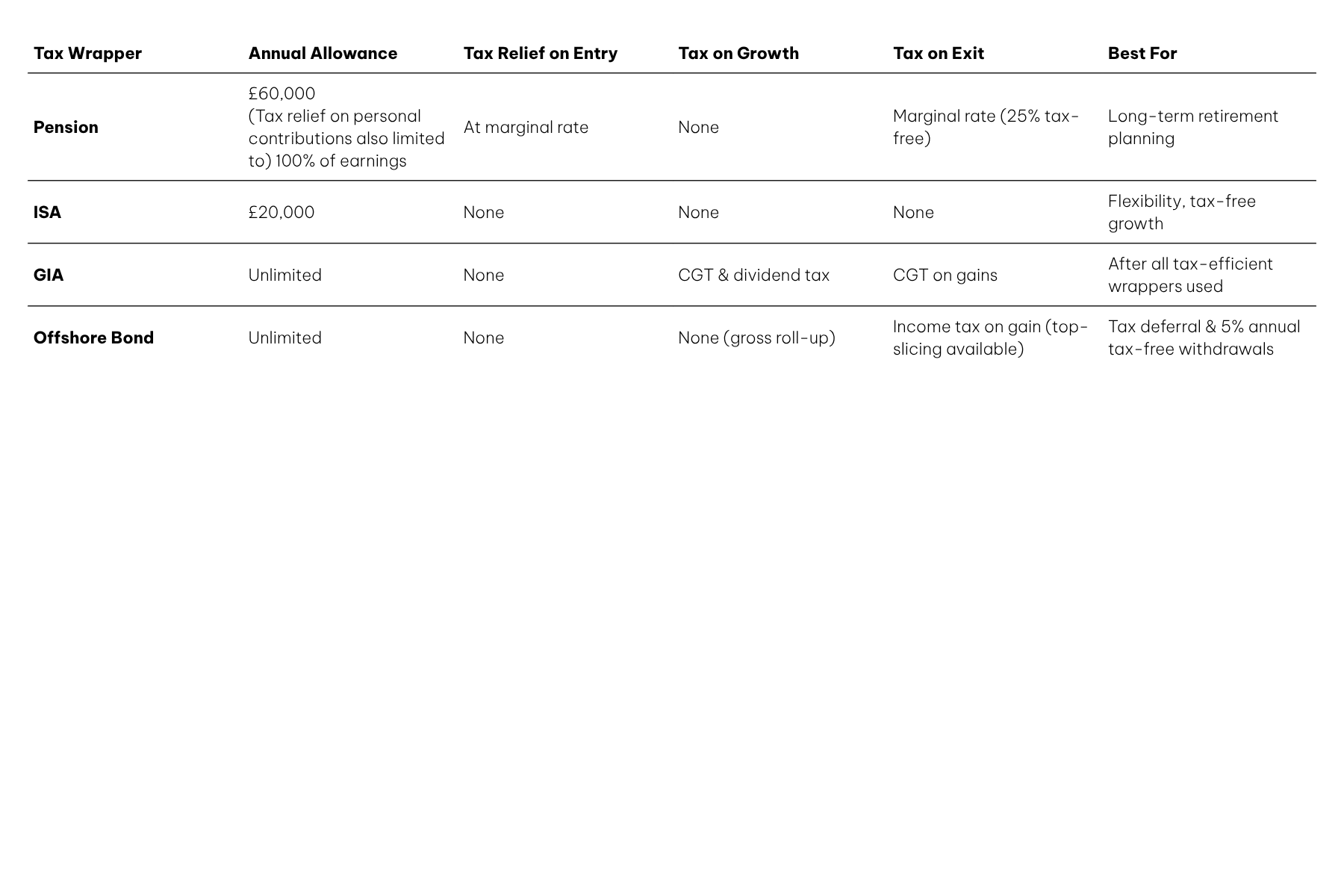
The best course of action won’t always be obvious. For many of those who are deciding where to take an income from once they’ve retired, the starting point will be their pension – but while the first quarter of your DC pension pot can be taken tax-free, people often forget that anything above that 25% will be taxed at your marginal rate. In other words, the way the pension is taxed makes it worth exploring other options.

For example, income from your ISA won’t be taxed, giving you flexibility to take your income from one place and not another, or to have a mix. A lot of people don’t necessarily realise this and they would rely heavily on a pension income that’s taxed, perhaps because they’re not aware of other ways of doing it. This is where an adviser can step in and help you, simply by knowing which levers to pull.

The levels and bases of taxation and reliefs from taxation can change at any time. The value of any tax relief depends on individual circumstances.

Steering clear of the traps

There’s one failsafe way to ensure you don’t end up paying more tax in retirement than you need to – get pension advice from someone who knows the costly mistakes to avoid.

When you’re approaching retirement, you should speak to an adviser to ensure you’re taking income in the most tax-efficient way, because it is quite different from how you’re taxed when you’re working. This applies to anyone leading up to and entering retirement. And it can be especially pertinent for those reaching retirement with both DC and Defined Benefit (DB, or final salary) pension pots.

That’s because the income from a DB pension will be paid to you whether you want it or not, and it will be taxed. So, it’s important to know which incomes you’re going to get anyway and which incomes you have more flexibility with.

An adviser can help you see the bigger picture and understand which of your assets are subject to which tax regime when you take money out. It’s a time of life when a lot of people want to take lump sums, and there are important decisions to make, so you don’t want to take your eye off the ball at the last minute.

Planning for your retirement can be overwhelming, but Apollo can help you begin the journey of budgeting for your later years. If you’re thinking of starting a pension or would like to review your existing pension plans, it’s a good idea to get advice.

The value of an investment with St. James’s Place will be directly linked to the performance of the funds selected and may fall as well as rise. You may get back less than the amount invested.

The levels and bases of taxation and reliefs from taxation can change at any time. Tax relief is generally dependent on individual circumstances.

You can also access free impartial pensions guidance from the Pension Wise website, or you can book an appointment over the telephone: 0800 011 397.

SJP Approved 21/05/2025

Should you require more information or have particular questions, we invite you to contact us at your convenience.

Contact Us

Giving Your Children and Grandchildren a Head Start

Introduction

While money isn’t the be all and end all, it undeniably offers children a significant advantage. A nest egg can contribute towards their education, grant access to diverse opportunities, and give them a head start in their adult lives.

Saving now provides them with greater flexibility to pursue their desired paths when the time comes. It’s another avenue through which you can afford them the best possible start in life.

The cost of growing up

Raising children can be financially challenging. While families may cover many of the costs of raising young children through their income, having a financial reserve as adulthood nears can be invaluable.

As young adults approach major milestones such as purchasing their first car, attending university, or buying their initial home, significant expenses arise.

By providing support, you can assist them in pursuing their aspirations. Starting to save early ensures they’ll have greater opportunities as they grow older.

01

£48,470

The average debt of a student leaving an English university in 2024
Source: Statista, December 2024
02

£151,731

The average deposit for a first-time buyer in Greater London
Source: UK Finance Key Mortgage Market Data, February 2025
01

£48,470

The average debt of a student leaving an English university in 2024
Source: Statista, December 2024

02

£151,731

The average deposit for a first-time buyer in Greater London
Source: UK Finance Key Mortgage Market Data, February 2025

Start early

You don’t have to allocate a substantial sum each month to establish a solid nest egg for a child. The crucial step is to commence saving as early as possible.

Beginning to save when children are young offers the advantage of time. It’s remarkable how even modest amounts saved consistently can accumulate over time. The power of compounding, combined with prudent investment decisions, has the potential to substantially enhance the value of your fund as children mature.

The value of an investment with St. James’s Place will be directly linked to the performance of the funds selected and may fall as well as rise. You may get back less than the amount invested.

Savings that work for everyone

You might choose to save a modest sum monthly, or invest lump sums as it fits your circumstances.

Your choice may be grant the funds to your child/ grandchild at age 18, or you might prefer to maintain control for a longer period of time.

Regardless of your preferences, selecting an investment solution that provides a suitable balance of flexibility, tax efficiency, and accessibility is crucial.

Invest in a Junior ISA

Junior ISAs represent an opportunity for saving towards a child’s future. The funds are inaccessible until the child reaches their 18th birthday.

These accounts can be set up by a parent or legal guardian, however further contributions can be accepted from anyone once the account has been set up. Regular deposits or one-time payments up to the annual limit (currently £9,000) are permitted, with all income and gains being exempt from Income Tax and Capital Gains Tax.

Upon reaching the age of 18, the Junior ISA automatically turns into an adult ISA which offers further flexibility to invest or withdraw funds as desired.

Junior ISAs offer the choice between cash or stocks and shares options. While cash is perceived as lower risk, considering the potentially lengthy investment term of up to 18 years, stocks and shares Junior ISAs typically offer superior returns over time. Although it is possible to spread the risk by subscribing to both a cash Junior ISA and a stocks and shares Junior ISA – provided the annual limit is not exceeded.

The value of an investment with St. James’s Place will be directly linked to the performance of the funds selected and the value may fall as well as rise. You may get back less than the amount invested.

An investment in a Stocks and Shares ISA does not provide the security of capital associated with a Cash ISA.

The favourable tax treatment of ISAs may not be maintained in the future and is subject to changes in legislation.

Please note that St. James’s Place does not offer Cash ISAs.

Set up a trust

Another frequently overlooked option is establishing a bare trust or designated investment account for a grandchild. Typically, the funds are invested in a portfolio of unit trusts, offering the benefits of professional management, risk reduction through diversification, and tax efficiency.

This straightforward legal arrangement of setting up a bare trust is an excellent solution for grandparents seeking to invest money for a grandchild. Until the beneficiary turns 18 and assumes ownership of the investment, the grandparents retain control over the funds. Subsequently, the grandchild can independently make decisions about the plan.

Unlike a Junior ISA, there are no limits to how much you can invest in a bare trust. The assets are held by a trustee, usually the parent or grandparent, for the child’s benefit until they reach 18 (or 16 in Scotland).

As long as the investment is made by someone other than the parents, the assets are taxed as if they belong to the child, which usually means there is little or no tax to pay on any income or gains.

This information applies for bare trusts in England. Bare trusts work differently in other regions.

Payments into bare trusts are considered to be gifts for inheritance tax purposes.

The value of an investment with St. James’s Place will be directly linked to the performance of the funds selected and the value may fall as well as rise. You may get back less than the amount invested.

The levels and bases of taxation, and reliefs from taxation, can change at any time and are generally dependent on individual circumstances.

Trusts are not regulated by the Financial Conduct Authority.

Start a pension

While initiating a pension for a child might initially appear unusual, for certain families, it can be a highly astute decision.

These pensions can be established by a parent or legal guardian, with contributions welcomed from anyone once they’re set up.

The blend of tax efficiency and an investment horizon potentially spanning over 60 years presents an exceptional opportunity for wealth growth. Even a single lump sum payment into a child’s pension could significantly enhance their retirement savings and alleviate some financial burdens in adulthood.

Moreover, if concerns arise regarding how a child might utilise the saved funds, there’s the added advantage that the money will remain beyond temptation’s reach until they reach retirement age.

You can put a maximum of £2,880 into a pension for a child each year. Tax relief will boost it to £3,600.

Investing the maximum £3,600 each year into a pension fund from birth until a child turns 18 could create a pot worth £1,030,000 by age 65.*

*Assumes an annual growth rate of 5% net of charges.

These figures are examples only and are not guaranteed. What you get back will depend on your investment performance and the tax treatment of your savings. You could get back more or less than this.

The value of an investment with St. James’s Place will be directly linked to the performance of the funds you select and the value can therefore go down as well as up. You may get back less than you invested.

The levels and bases of taxation and reliefs from taxation can change at any time. The value of any tax relief depends on individual circumstances.

SJP Approved 21/05/2025

Should you require more information or have particular questions, we invite you to contact us at your convenience.

Contact Us

Pensions: Explaining The Tapered Annual Allowance

Introduction

For those earning a high income, it’s essential to understand the implications of the Tapered Annual Allowance on making pension contributions. This guide offers an overview of the tapered annual allowance and its operational mechanism.

Understanding when the Annual Allowance is Tapered

Pension tapering regulates the amount high-earning individuals can contribute to their pensions annually while still receiving the full benefits of tax relief.

For the 2025/26 tax year, the standard annual allowance is set at £60,000. Nonetheless, those earning a higher income may see their allowance reduced to as low as £10,000, based on their total yearly income.

Individuals with a ‘threshold income’ over £200,000 and an ‘adjusted income’ over £260,000 are subject to the tapered annual allowance. The reduction in allowance halts when ‘adjusted income’ exceeds £360,000, setting the annual allowance to a minimal £10,000 for pension savings that receive the full benefit of tax relief.

Broadly, ‘Threshold Income’ includes all taxable income received in the tax year, including rental income, bonuses, dividend, and other taxable benefits.  From this you deduct any personal pension contributions to personal pension scheme.

‘Adjusted income’ includes all taxable income plus any employer pension contributions and most personal contributions to an occupational pension scheme.

Mechanics of the Tapered Annual Allowance

Individuals exceeding both a ‘threshold income’ of £200,000 and ‘adjusted income’ of £260,000 will experience a reduction in their annual allowance by £1 for every £2 exceeding £260,000 in adjusted income.

For instance, an ‘adjusted income’ of £280,000 reduces the annual allowance by £10,000, resulting in a £50,000 allowance instead of £60,000.

Tapered Annual Allowance and Carry Forward

The tapered annual allowance does not prohibit the use of carry forward rules, which permit the transfer of unused annual allowance from the previous three tax years. The tapered allowance for each year determines the amount that can be carried forward.

Employer Contributions and Exceeding the Tapered Annual Allowance

The tapered annual allowance applies to all pension contributions, including those made by employers. Exceeding your annual pension allowance incurs an annual allowance charge at your highest marginal income tax rate.

Calculating Your Tapered Annual Allowance

Determining your adjusted and threshold income can be complex. Additional information on calculating your tapered annual allowance is available on the Government’s website, and consulting an expert Adviser or tax specialist is advisable for tailored planning.

The value of an investment with St. James’s Place will be directly linked to the performance of the funds you select and the value can therefore go down as well as up. You may get back less than you invested.

The levels and bases of taxation and reliefs from taxation can change at any time. The value of any tax relief depends on individual circumstances.

SJP Approved 21/05/2025

Should you require more information or have particular questions, we invite you to contact us at your convenience.

Contact Us
Privacy Overview

This website uses cookies so that we can provide you with the best user experience possible. Cookie information is stored in your browser and performs functions such as recognising you when you return to our website and helping our team to understand which sections of the website you find most interesting and useful.

Close Search

Email To Myself

Close

By submitting your details you give consent for Apollo Private Wealth to reach out for marketing purposes. You may unsubscribe at any time.

Apollo Private Wealth together with St. James's Place Wealth Management plc are the data controllers of any personal data you provide to us. For further information on our uses of your personal data, please see our Privacy Policy or the St. James's Place Privacy Policy.